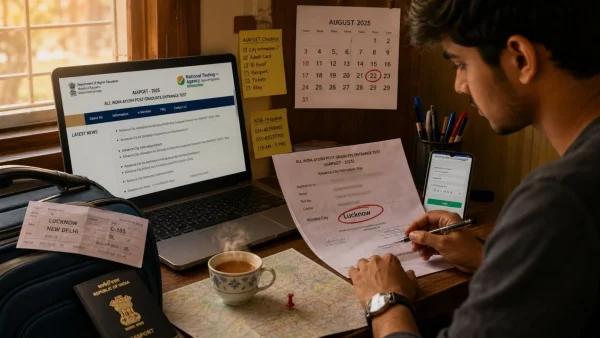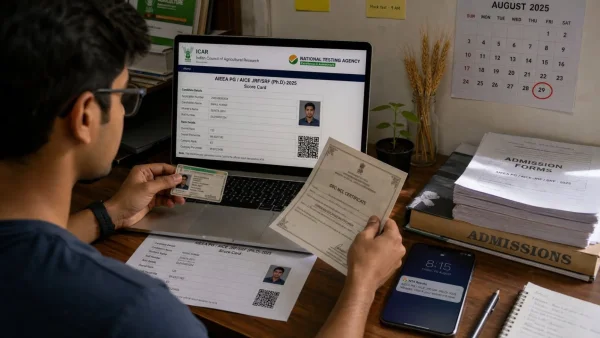
Those with postgraduate seats in agriculture in mind can rest easy; the NTA has made an announcement of the ICAR AIEEA (PG) and AICE JRF/SRF (PhD) 2026 results at exams.nta.nic.in/icar. Given that the clock is ticking on admissions, it is best for students to get their scorecards and verify them straight away before counselling commences.
The testing body has confirmed the release and says one can access the results with an Application Number and Password. This follows the ICAR AIEEA PG 2026 exam of July 4, which was the gateway to postgraduate work in agriculture and allied fields.
Immediate impact on admissions
Universities and colleges will use the results to drive shortlisting and category-wise seat actions, as well as set their counselling timetables. For the student, the scorecard is what counts: it has the rank, percentile and marks that establish one’s merit. Should there be any discrepancy in the personal or category information, flag it at once to sidestep trouble with document verification later on.
It is more than a matter of a cut-off. Ranks will dictate not only whether one gets in but also the choice of programme within an institute, given the breadth of specialisations in the sciences. An accurate scorecard on hand is the most sensible first move.
How to download your ICAR AIEEA PG, AICE JRF/SRF scorecard
Provided you have your credentials, the process on the live portal should not take long. To save your result, do the following:
– Head to exams.nta.nic.in/icar for Candidate Activity.
– Open the link for either the ICAR AIEEA (PG) or AICE JRF/SRF.
– Enter your Password and Application Number to log in.
– Download the scorecard and store it in a safe place.
After you have done so, look over the name, roll number, marks and category data. It is prudent to have both a hard copy and a cloud version for when you report to college or if a tie-break is called for.
Participation numbers and timing
The agency puts total registrations for the two exams at 42,110 – 30,619 for the AIEEA (PG) and 11,491 for the AICE-JRF/SRF (PhD). In the end, 38,720 candidates sat for the paper, a level of involvement that points to stiff competition in the popular specialisations.
Results were made available on August 29, 2026 via the website. As the agency has been at pains to point out in earlier notices, the official portal remains the best source for anything regarding seat allocation and counselling.
Merit list rules for AICE JRF/SRF 2026
When it comes to doctoral fellowships, the merit list is governed by certain tie-resolution criteria. The agency gives priority to the candidate with the lower negative marks. Failing that, age becomes the differentiator and the older candidate is put ahead. If necessary, the higher UG or Bachelor examination score will be the deciding factor.
Anyone after a JRF or SRF would do well to examine the response pattern and any penalties, not just the overall score. Knowing the rules makes it easier to gauge where one stands in the initial round of offers.
What candidates should do next
Go through the scorecard and make any needed corrections through proper channels. Have several copies to hand for the various forms and physical checks that institutes may demand during counselling.
Institutions are aligning their timelines to the new results, so it pays to be quick when preferences are close. Monitor exams.nta.nic.in/icar for the latest instructions and schedules.
If you are dealing with both the AIEEA (PG) and AICE JRF/SRF (PhD), run your applications in parallel. Put together a folder with transcripts, identity papers and category certificates. When seats become available, having your documentation in order will keep your options open and avoid any last-minute friction.
In the final analysis, your rank and percentile are what will open doors to programmes. Be strategic in how you approach institutes and get ready for a fast-paced counselling process as soon as the official calendar is in effect. University helpdesks can offer some useful direction in the meantime.