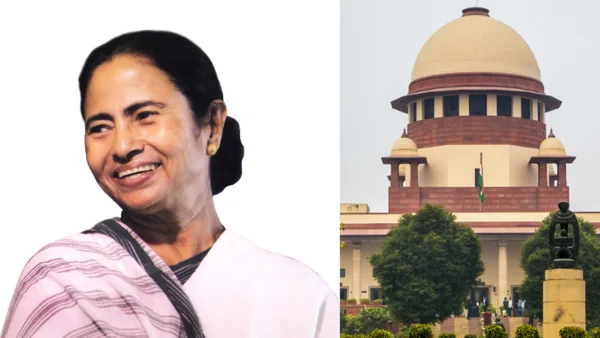
Mamata Banarjee, Chief Minister of West Bengal, challenged the Special Intensive Revision (SIR) in the State’s voters’ roll in which she said that justice is crying behind the door. She then urged the judges to step in on grounds of the mass deletions and procedural improprieties and the particular impact of the ‘SIRing’ process on ladies and migrants.
What Mamata Banerjee stated before the court
Mamata Banerjee, in response to the bench headed by CJI, stated that she had written several letters to the Election Commission regarding the SIR process and urged them to take appropriate actions. It criticized SIR as being primarily used for deletions instead of any bonafide purpose of verification and also expressing that this was a ‘bigger cause’ she was voicing without the consideration to the limitation of the political party.
She underlined the difficulties caused by the time limitations and intruding notice to merges of the seasons more practical than the harvest and festivals celebrating women in politics. She requested the court to secure ‘people’s rights’ charging them with ensuring that no registered voter is left out before the elections took place.
Controversies Concerning the Accountability of the Election Commission and Political Manipulations during the Polls – The so-called Irritating Issue of Micro Observors
While criticizing the actions of the Election Commission within the SVEM in the process of the pre and post elections, The Head of The Government accused the body on several occasions of deploying several micro-observers. This was in contravention and in violation of the legislation and of also some regulations in place whose guidance had been sought for by the Election Commission. The Leader claimed that the micro-observers are rejecting documents including Aadhaar, domicile and Caste Certificates on false issues and causing deletion of names.
She What is more, Ms Banerjee decrying the situation charged that the other states were having little exercise at all before going for the elections while differentiated this with West Bengal which was required to go through a lot of process. And repeated her caution that routine life events like women changing names after marriage were nothing more than routine and were not reasons that should be used to remove people from the voter’s roll.
Court Cases on Data and Procedural Presentations
Following the proceedings of the entrants’ senior counsel’s views were marred by overwhelming evidence of what he labeled as corruption on a large scale. The said submissions to the court cited the existence of a wide range of entries estimated at between 1.25 – 1.36 crore indicated with red marks, or in simple terms – as logic discrepancies, not excluded as deficient registrations and hundreds of thousands of voters who have been accounted for, but have not been mapped or have pending hearings; a figure that is a bit substantial as far as the state electorate is concerned.
The counsel also pointed out that there were unresolved subscriptions together with the SIR program pausing out. It was argued by the petitioners that the vacancies have worsened the logistics of the revision exercise in addition to the posting of micro observers that has addressed the fairness and transparency of the exercise.
Response and directions of the Hon’ble Supreme Court
The Court has taken this very seriously and served notices to the Commission of India and also to the Chief Electoral Officer of the concerned state directing them to file a reply by a particular date. The President has assured His orientation on appreciation of issues and resolutions thereof when matter comes up for next hearing.
The Honourable Judge emphasized the need to take a more dynamic approach to the issue in question and offered solutions. Pointing out, in particular, that the responsibility of the issuance of notices should be given with the most tiny officials. The court required the state to complete the list of Group B officers who would be able to facilitate the reading very soon and emphasized that machinery has to intervene to put in place some safeguards, lest even innocent citizens are left out of the system.
What are the legal implications of the two orders and what are the steps that will be adopted in the future?
If such criticisms exist, and the deletions made by the EROs are either too much or have been made in an illegitimate way, the possible orders by the Court could redefine the way in which the process of voter verification would be done in the days preceeding the election. Some of the possible solutions could also include higher standards of document consistency, changes in the time periods or a complete renouncing of the proposal of micro-observer duties.
The matter in question also exemplifies the larger contestation between election management and electoral voter rights, that is, VIE. It raises issues of the availablity of documents, problems regarding languages or transliteration and the way in which women who might need help, as well as migrants and persons in ‘seasonal’ employment are disadvantaged in administrative maters.
Possible Options and Subsequently Expected Outcomes
This case is now down for the next hearing where follow-up dates are set to allow the parties, that is the ECI and the state to bring in their affidavits and data in more detail. The bench severally noted the necessity for haste but at the same time was looking for solutions that promote the interest of eligible voters.
The list of possible solutions to this matter could be where there are adjustments to the rules, or more lenient, inclusion of other official documents compliant with the law, or functional changes of the activities to be flagged off by local authorities. This case could go in favour of what is adjudged good for democracy more than what should be, in balancing electoral integrity with the right to suffrage.