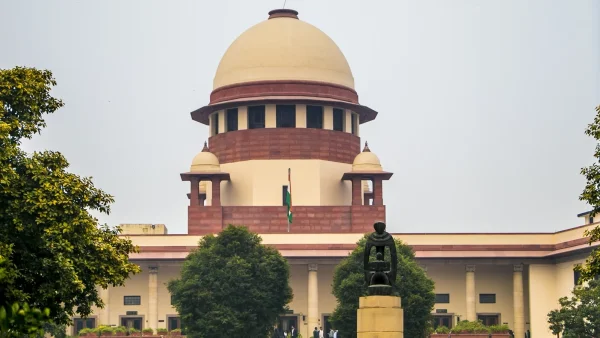
On Tuesday, the Supreme Court delivered a strong message to WhatsApp and Meta regarding the new privacy policy 2021, saying it is totally unacceptable if the Indian users’ Privacy is sold in the guise of data. A three-member panel said it would give an interim order on February 9 and told the Ministry of Electronics & Information Technology to assist the petitions.
Sitting remarks and the assured interim order
The bench headed by the Chief Justice made it clear to the companies that they cannot violate the right to privacy of citizens as they please and said privacy is one of the most cherished aspects of the Constitution and hence, there is a possibility of immediate judicial intervention on 9th February.
The court noted that the details of WhatsApp and Meta’s structure were insufficient as far as data sharing is concerned and a relief order comprising of a cease and desist order was sought. The case is now handled with representation of the government.
How the case reached the apex court
One of the primary reasons for this disagreement was an antitrust authority’s conclusion that the 2021 privacy policy contained uneven terms and an abuse of market power, and levying a fine of Rs 213.14 crore. Subsequently, a company law tribunal for appeals concurred with most of these conclusions, but slightly relaxed some restrictions on using advertising data information.
Both providers then contested the decision of that tribunal, and the regulator too approached the apex court seeking that the order granting limited relief be revisited. Those diverging appeals and the regulator’s appeal will be examined by the same apex court.
Key Privacy concerns in the year 2021 policy:
In 2021, the amendment allowed that information about the user be transmitted to the parent company for use in business including the performance of targeted advertising. Detractors of the policy criticize it for not making provision of a meaningful opt-out and effectively requiring a user to accept terms of service or else stop utilizing the service.
The court has asserted that legal or technical language used in privacy policies cannot always be understood by the public. That’s exactly what justices said due to the -literal- many lessiciary rights inscribed in these terms then even if literally users can provide the ‘informed consent’ the directive contains, it is expected difficult with millions of users, some not even accurately undergoing schooling or access.
Data monetisation, behavioural profiling and market power
The ability to share or use a dataset by undertaking astute market research is another issue that the court has raised. In fact, its recent ruling on this matter seemed to present challenges that extend beyond the sharing of consumer data, namely the existence of a platform which has a large market share and does not share necessary details of data collection and data use.
Furthermore, the judges expressed their disapproval to the lack of any middle ground in the choices offered by the service to the consumers, which was only either to share the information or not. The bench went on to suggest that such differentiations in the design can be used to sell a person’s personal information, which is not in their hands, as a goods, focusing on intermediaries’ interests but not consumers as it should.
Before the court arrives at a final decision in OS, the First defendant could be ordered to stop all transfers of data and or even ordered… I propose a measure containing an obligation to do or not to do certain… Both of these options will mean a notice of more active intervention by the court in what data platforms are doing.
Following this particular case, the decision may have an impact on the way the authorities control consent mechanisms, open standards and measures of transparency, as well as, perhaps antitrust. Companies that are funded by advertising that relies on the consumption of data from the sources on different platforms may be forced to buy even more and accept a more complicated set of rules and organizational procedures than before.
The way forward and impacts on users in general
The audience is waiting with bated breath for the 9th of February the date the court will issue an interim order. The addition of the government to the… increases the chances of a national enforcement solution in respect of the regulation and a proper wearing of regulatory statute.
For the users, this speaks to how the legal framework is changing to protect personal data. The reasoning behind laws is often clear enough to help protect all people from such dangers as fraud and harassment, and would emphasize the importance of the immediate opt-out process to any data subject.
Even though the dignity of the Supreme Court never broke, the tone is clear, the right to information has its enemies. Intensifying in-depth of consent will become a key factor for computerization evolution so in a few years there will be no such a concept as “free” service.