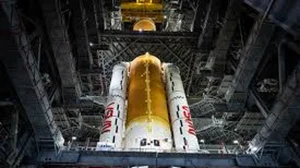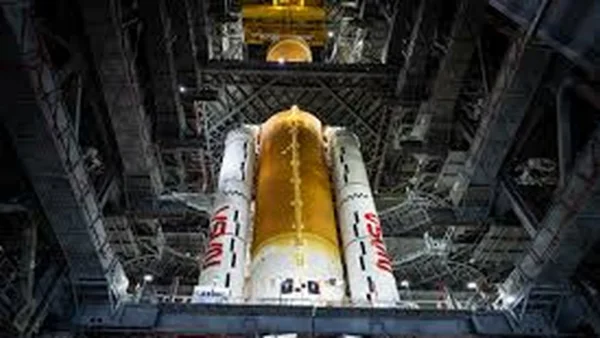
The Artemis 2 moon mission launch was postponed to a date in March by NASA management after engineers noticed the leak of liquid hydrogen during the rehearsal at the Kennedy Space Center. A work schedule associated with the repair of this problem followed an activity labeled as a ‘wet dress rehearsal,’ which was designed to enable the crew launch vehicle and Orion spacecraft to be fueled in the manner the launch would.
Information on the conduction of the ‘wet day attire’ test and the defect
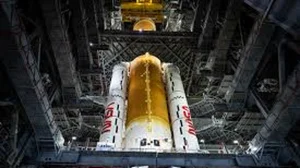
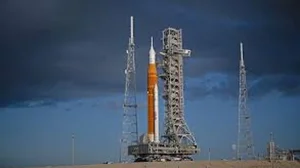
During the period that lasted two days, the members of the team loaded upwards of 2.6 million liters of liquefied hydrogen as well as liquefied oxygen in the launch vehicle and capsule structures so as to allow the crew launch vehicle system to be operationally counted down. There was a problem when it was observed that there was a leak in an interface which is used to direct the cryogenic propellant to the SLS core stage.
In addition, there were instances of problems also alongside Intermittent ground problem which was one of the issues as well as a problem with a male valve in the closeout hardware associated with the Orion crew vehicle. The experts had to stop and eliminate all the obstacles through decisive intervention as they continued to collect telemetry and sensor readings that enabled them to come up with the devices initial defects or motivational steps.
Why The Later Deadline is Important for the Timeline of Artemis
Artemis 2 is the second one and the followed Artemis last ending in a multi-billion dollar Artemis project. The others are about the first Artemis four-man lunar orbit mission for about ten days. The aggressive mission, Artemis 2, will lead to the Artemis 3 involving planning for a crewed landing near the lunar south pole.
Exercising all the classes of risk scenarios on a dress rehearsal makes the team all go red about the systems upon which they’d depend flying the vehicle and reduces risk of launch day mishaps. NASA has stated that it doesn’t plan to launch in March without conducting another WDR in the process of. Putting safety and mission before the shortened timeframe.
Crew conditions and operational adjustments
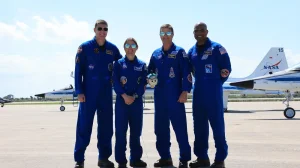
Following the astronauts’ possession for impeding them against communicable diseases since the 21st of January, the crew did not emerge before the launch. NASA announced that the astronauts would remain in isolation for about a fortnight, approximately two weeks in the month of March.
Of the four crew members of Artemis 2, three are US astronauts and one is Canadian. Considering everything goes to the plan, the mission will move the ultimate frontier mankind has reached far from the Earth in the last fifty years. It will also be the first time in our history when a non-US astronaut can be dispatched to the orbits located high above Earth’s surface.
Whatever technological, project, and decision-making, matters have been established
It was confirmed that the spacecraft was subjected to failures expected to be met during the prime months of SLS core stage development, especially recalls of hydrogen leaks in those races. The issues that are repeated again and again, show the extent of problems that come with dealing with cryogenic fuel in huge rockets and the importance of extensive ground tests.
Certainly, the current situation from a program standpoint may have an impact on Artemis III budget projections as well as future deadlines in reflection of lunar works with the broader expectations for further luar develepment. The policy-makers and program managers would be compelled to decide whether to conduct additional tests as long as adhering to the protection of human crew and maintenance of the credibility of the program.
What Comes Next and What To Wait For
Exercises to be done, and criteria for these processes, is what we are to talk about next.
The NASA team will evaluate the wet dress rehearsal data entirely in order to come up with the help out and recertify activity. The proportion of the effort shall be put on the propellant interface and the Orion valve as the corrective actions will be incorporated in the skillful support of the system
There are several origins that indicate specific dates as potential launch windows until the end of April, and more recently, an aim has been pointed out for a launch in March after the successful elimination of defects and another dry rehearsal. Those observing the mission should be alert and expect revised schedules, evaluations on technology and also calling out if the rockets and the Crew systems have achieved their required level of preparedness.
More general ideas related to the Artemis Project’s fulfillment
Artemis II premised on an Artemis I unmanned flight and serves to build on a programme for establishing operational activities in and around the moon. Lessons arising from these setbacks will be incorporated into the system design, operational practices and supply chain where applicable as the program advances.
The issue demonstrates the importance of constant adequate human spaceflight trials and underlines the intricate system of technology deployment, safety considerations, and foreign collaboration that influences the return to the counter-revolutionary orbit. The continued focus of the agency on maintaining the confidence of the public and on meeting safety standards has never been as strong, even whilst there is already some notion of rapid descent to the earth.