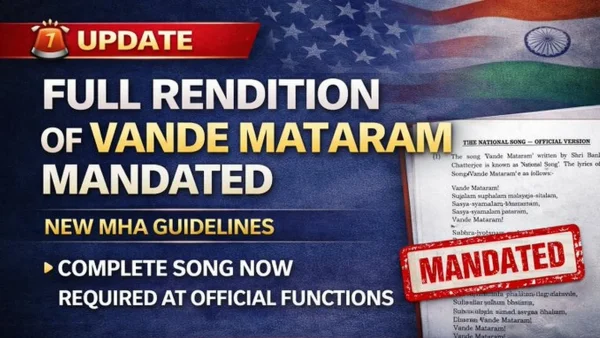
The Union Home Ministry has established new rules which create an official procedure for Vande Mataram, which represents India’s national song. The rules require standing during the song at specific events and they mandate playing all six stanzas and they establish a 190-second duration for the hymn. The new regulations establish official procedures that were previously followed without standardized guidelines.
What the MHA guidelines say
The Ministry of Home Affairs (MHA) establishes that the audience must stand to attention when the official version of Vande Mataram is performed. The document explains that standing is not necessary during newsreels and documentaries because these mediums require uninterrupted viewing while cinemas do not need to follow this requirement. The guidelines establish that Vande Mataram must be played before both the national song and national anthem performances. The official version will present all six stanzas composed by Bankim Chandra Chatterjee who created four stanzas which were deleted in 1937 and the complete performance will last 190 seconds.
When and where Vande Mataram will be played
The MHA designates multiple formal events which include flag unfurling and presidential arrival and departure at events and presidential addresses and governor formal arrival and departure ceremonies. The national flag will be displayed during the parade and at public investitures which will also feature this event. Vande Mataram will be performed at civilian award ceremonies which include national awards that the President will attend. Schools must establish methods to promote national song singing and instill flag respect in their students. The guidelines function to embed the song into scheduled government events across all governmental operations.
Legal and constitutional background
The Constitution of India contains Article 51(A) which mandates that citizens must show respect toward national symbols and this article has been the basis for national anthem protocols. The Prevention of Insults to National Honour Act, 1971 exists as the only existing law which protects national symbols but it only applies to national anthem protection. Vande Mataram started as a song from Bankim Chandra Chatterjee’s 1882 novel which later became an anthem for the freedom movement. The national song received official status when two stanzas became recognized in 1950. The MHA order establishes the first complete government regulations which define how to perform the entire musical composition at designated times.
Political reactions and potential implications
The guidelines will lead to greater political discussions. Some leaders have praised the move as restoring historical completeness, while critics argue it could be used as a political instrument. Recent public statements by senior officials who named past leaders responsible for decreasing the song’s importance have strengthened public dialogue on this matter. The public conversation encompasses political aspects and social unity together with the feelings of minority groups. People will debate about cultural inclusiveness and historical memory and national symbols because people will want to know how the new method will represent various cultural groups in the nation.
Practical considerations for institutions
The execution process needs detailed planning work. The 190-second song performance requires adjustments to event timing and audio systems and practice periods for group singing. Schools and administrative bodies will need clear guidance on the official audio version, acceptable accompaniment, and respectful conduct during performances. Authorities must find the right balance between program promotion and public understanding of the program. The organization will benefit from staff training who will manage ceremonies while conducting voluntary educational sessions about the song history and maintaining performance dignity. The explanation of exemptions which includes cinemas will help eliminate potential misunderstandings. The MHA guidelines establish Vande Mataram as an official component of governmental operations while creating operational procedures which all institutions must implement. The new protocol will determine how civic rituals develop throughout time until it becomes established in public usage.