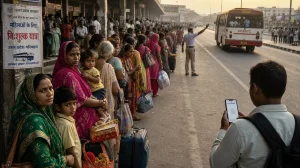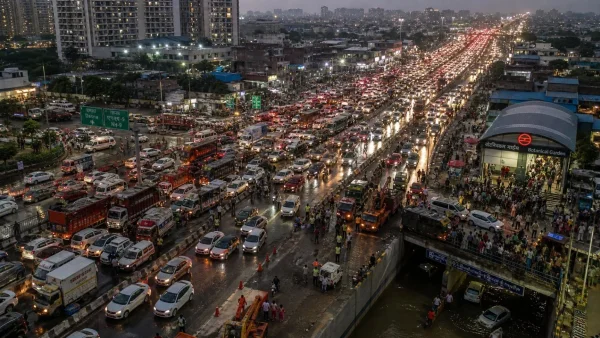
There was a collision of sorts between the evening rush from the office and families making their way home for the festival, leaving the region with tailbacks that stretched for miles. In Ghaziabad one could find a 15-minute journey taking an hour, with the gridlock spilling into Noida and other main city corridors.
Where the gridlock hit hardest
On the Delhi-Meerut Expressway there is a well known choke point where eight lanes are reduced to two at a turn; here the expressway had its troubles. The merge caused queues that were plain to see from the high-rises along the corridor.
NH-9 was no exception, especially in the stretch from Dasna to the Mehrauli cut. By late evening the pressure had built up in Ghaziabad and radiated out to Lalkuan, GT Road, Ambedkar Road and Meerut Tiraha.
Movement came to a standstill near ABES College. Over in Noida the road off the Botanical Garden Metro Station was particularly slow, which the traffic unit put down to a lot of pedestrians around peak time.
Why Thursday spiralled
It was a case of two surges meeting: early starters for Raksha Bandhan and those clocking out of the office. The double wave was too much for what are already busy arteries.
One can see the extent of it in a clip that has been doing the rounds from the outer Ghaziabad area near the Dasna Cut, with vehicles in dense lines putting in an inch or two at a time.
Not everyone heeded the ban on two-wheelers on the expressway. Some riders were observed on the Delhi-Meerut route and at times in the opposite lane, an added hazard when things are moving this slowly.
Bottlenecks beyond the expressway
You only have to look at the infrastructure to understand the friction. Police had to close the Bamheta underpass because of waterlogging, sending more cars to alternatives that were already overburdened. And with roadwork to widen the service lane on NH-9 coming from the industrial area, drivers were funneled onto the Lalkuan stretch where congestion was at its worst.
Debris after the Bhatia Turn did not help matters between GT Road and Lalkuan. At the entry to the expressway in Dasna you would find vehicles lined up in the Hapur-bound lane as incoming traffic mounted.
What authorities changed on the ground
Anticipating the festival crowds, the Ghaziabad Traffic Police were ahead of the curve with advisories and teams on the ground. You would find senior officers like the Deputy Commissioner of Police (Traffic) and his Additional counterpart there to direct the flow and clear any blockages.
For the festive period they introduced some hard measures. Heavy vehicles were told to take the Eastern Peripheral or the Delhi-Meerut Expressway and were not allowed on NH-9. It was a necessary move but it did put more strain on the other corridors.
As for Noida, the Traffic Police pointed to the pedestrian numbers. ‘Traffic is moving slowly due to the heavy influx of pedestrians. Traffic personnel are ensuring the smooth movement of traffic,’ they said.
The official line for the holiday was as follows:
– Advisory issued and enforcement teams deployed
– Heavy vehicles diverted 26 to 28 August
– NH-9 barred for heavy vehicles during diversions
– Senior officers managed ground operations
What commuters experienced
Patience was tested from Lalkuan to Dasna where queues were at a standstill. The squeeze from eight to two lanes on the Delhi-Meerut Expressway was the obvious culprit, and at the worst of it a 15-minute drive became an hour.
Even with the management of lanes and diversions, the expressway and NH-9 were anything but fast going late in the day, with the problem spreading to GT Road, Ambedkar Road and Meerut Tiraha.
What comes next
According to police the job of managing the rush will go on through the night. With the 26 to 28 August window for heavy vehicle diversions still in effect and festival travel in full swing, one can expect them to hold the course and try to ease the kind of choke points the Raksha Bandhan surge has laid bare.