The Uttar Pradesh government’s announcement of free bus travel for women during Raksha Bandhan has been welcomed as a welfare measure—but on the ground, some women commuters say the bigger problem is not the fare, but finding a bus in the first place.
Chief Minister Yogi Adityanath announced that women would be allowed to travel free on Uttar Pradesh State Road Transport Corporation (UPSRTC) buses, accompanied by one person, from 6 a.m. on August 27 until midnight on August 29. The government also directed that more than 900 urban buses be included in the arrangement.
The announcement has now triggered a different question among commuters:
“If the journey is free, where are the buses?”
Women question the gap between announcement and reality
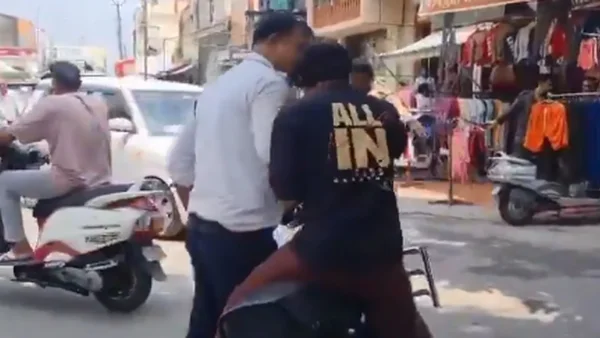
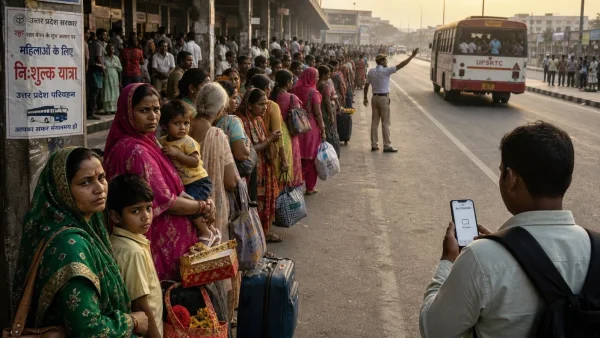
Videos and statements circulating from commuters have highlighted alleged difficulties in getting buses, with women claiming that services are difficult to find or heavily crowded.
Some passengers have questioned whether a promise of free transportation has meaning if adequate public transport is not available when people actually need it.
For women travelling home for Raksha Bandhan, particularly those travelling with children, elderly family members or luggage, waiting for an overcrowded or unavailable bus can turn a promised convenience into a frustrating experience.
One criticism being voiced by passengers is that free travel cannot compensate for inadequate frequency or availability.
What the government actually announced
The criticism needs to be viewed alongside the government’s official measures.
For Raksha Bandhan, female passengers were permitted free travel on UPSRTC buses along with one companion during the specified August 27–29 period. The state also instructed the Urban Development Department to extend the facility to more than 900 buses. Officials were directed to coordinate transport, police and local administration to ensure smooth travel and passenger safety.
Separately, the state has launched the Lokmata Ahilyabai Matrushakti Yatra, under which women aged 60 years and above are eligible for free travel on UPSRTC buses. The scheme was formally launched by Yogi Adityanath on August 26.
So the permanent scheme is specifically for senior women—not for every woman in Uttar Pradesh.
“Promise is not enough”
The central criticism from commuters is therefore less about the idea of free travel and more about implementation.
A woman passenger does not experience a government scheme through a press conference or an official announcement. She experiences it at the bus stop.
Is there a bus?
How long does she have to wait?
Can she actually board?
Is the bus overcrowded?
Are sufficient buses operating on routes with exceptionally high demand?
These are the questions that determine whether a transport policy succeeds.
Free fare, but what about availability?
Public transport systems routinely face exceptional pressure during major festivals.
Raksha Bandhan is one such occasion, with large numbers of people travelling simultaneously between cities, towns and villages.
The government’s decision to make travel free is likely to increase demand further. That makes adequate fleet deployment and route management particularly important.
If additional buses have been deployed but commuters continue reporting shortages on particular routes, authorities need to identify where the bottleneck lies.
The answer cannot simply be that the facility is available on paper.
A scheme will be judged on the road
The controversy highlights a familiar problem in public policy: the difference between announcing a benefit and delivering it effectively.
The Uttar Pradesh government has made transportation a major part of its welfare and infrastructure narrative. The free-travel initiative is intended to make mobility easier for women, particularly around the festival period.
But the success of the programme will ultimately be judged by passengers.
If women can reach bus stations, find buses, travel safely and reach their destinations without unreasonable delays, the scheme will have achieved its purpose.
If passengers instead encounter long queues, overcrowding and inadequate services, criticism is inevitable.
The real test begins at the bus stop
For the women who have to travel today, the political debate is secondary.
They simply want a bus.
Free travel is meaningful only when there is reliable transportation to travel on.
The government has made the announcement. Now the public will judge its implementation—not from speeches, but from what happens at bus stops across Uttar Pradesh.
The question being asked by commuters is therefore simple:
“The fare may be zero—but can we actually find a bus?”