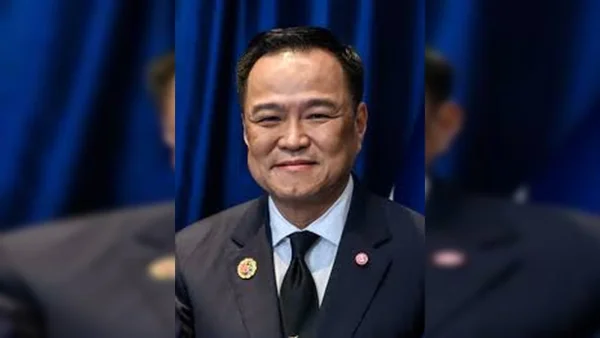
In order to realise an unassailable victory, polling did not anticipate Anutin Charnvirakul’s ‘pilot PM’ status that ended the election. Anutin absolutely dominated opinion polls, and according to unofficial tallies, his Bhumjaithai Party was storming the battleground with a formidable lead, fine-tuning his control of the reins of government, and most importantly, setting the course for policy in Thailand, at home and abroad.
VICTORY IN NATIONALISM AND CONTROL
His “nos” vote sprang forth from the heart of an ever-encroaching security partiality that played well against the backdrop of heightened Khmer-Thai tensions. He was strong in strengthening a masochistic military bearing, as per a swift response to internal provocations at the border without any approval from a cabinet clause last year. Indeed that sense of bravery complimented much more the man-of-action stature that more and more is taking root in the nationalist milieu.
He articulated an unabashedly patriotic identity for his party. ‘For us real nationalists, we all really have the spirit of nationalism,’ he said on election day, whilst referring to the party’s blue color and the national flag. This promise of stability mattered to many conservative and swing voters who were tired of months of partisan mudslinging.
Up until the reality of the situation in the north began to emerge: horrific clashes at the borders between Laos and Thailand left scores dead and precipitated a great exodus of over a million blood-soaked souls. This totally affected campaign dynamics, for this allowed Mr. Anutin to present himself as a wartime leader fighting for his nation’s sovereignty, reassuring his supporters with words such as “nobody wants fighting” and stressing his administration’s commitment to ensuring an indefinite peace by keeping the peace talks alive.
The populist charisma of the “pilot PM”
While everyone knows him as the scion of a business family, he built the impression of being down-to-earth. He was always popping out for street food, wearing T-shirt half-trousers, and performing obscure renditions of 80s Thai pop music either on the saxophone or the piano. His casual relatability transformed the dynamics among elite heirs and compelled people to take notice of him in a much more personable way.
His jet pilot side hustle oozed a kind of eccentricity. Grounded from politics by an onerous party ban in the late 2000s, he took to flying and ultimately used much private planes to deliver kidneys. The ordeal underlined the can-do, technocratic profile that complemented his political evolution.
Brain policy was another attribute that distinguished him. Managing a portfolio in the health sector when the economy was hit mostly by tourism during the time of the pandemic in 2020, he pulled through the cannabis act last year. He made a vigorous appeal to the younger crowd and for small business, while leaving the conservatives in a tizzy.
Hand in hand, the unconventional and the conservative approaches reinsuring the appeal to the king were maintained. With such distinguishing abilities-economically the modernizer and culturally the arch-preserved-Mr. Everything carried countrywide importance among the charged energies of the Bahujan Swabhiman.
Figures and Coalition Calculations
Ninety percent of the votes counted so far, Bhumjaithai are unofficially on two hundred seats in the House of Representatives for any compromise. The prime minister needs to get 251 seats. Maybe the final allocation will adjust depending on candidate lists at the base level of counting and cast further enlightenment.
The second-ranked People’s Party cried for 114 seats whereas Pheu Thai, a relevant populist mainstay, chose to hide out for the time being with a mostly comfortable 78 seats. In Thailand, in a mixed system 400 seats of constituencies are chosen directly by voters and a hundred seats from party-lists are distributed according to national votes. From earlier opinion, an outright majority was not expected, thus, the most fierce and heated-coalition-building would be the next step.
The victorious party leadership had immediately ruled out any maneuvering for an opposition candidate. A promise to not support Anutin would reduce Anutin’s options science further. Hence Pheu Thai has not closed the door on cooperation, and many acknowledge as a plausible possibility from the inside that.
Bhumjaithai has flexed its muscles in the vote-rich northeastern region – an area still vibrant with old-style patronage politics and rooted grassroots organizing. With this form of conservative rhetoric, there is no way that the country’s king-and-church apologist military complex would let go of a potential political force that promises stability amidst the uncertainties of electoral politics and the country’s king-and-church apologist military establishment.
Reformists reconsider their strategy after a shock disappointment
A by-product of the dissolved Move Forward Party that topped the 2023 vote, the People’s Party had a lot of energy but was checked by some strong winds. Their reform agenda-being constantly upbeat about civil rights and custodial power-received cynicism as security appeared to concern most of the villagers and even rival political party leaders.
Its leader voiced as respectful for the parliamentary norms by suggesting the winning party form a government first. Such a stance may place that party as the most vocal opposition, should Bhumjaithai rise to power, and send out a signal reformers will pour their energies into the legislative and oversight battles.
Policy direction: economy, security, and the cannabis question
The HE Mr Anutin Charnvirakul will see whether he will be able to interweave political stabilization with economic growth against a global economy that is generally weak. Would he open up infrastructure spending, export promotion, and relief to households selectively? Knowing what are the family businesses in which he is involved, procurement and project transparency will surely be under scrutiny if awarded big projects. Linguistic discourse on cannabis is still unclear because whilst entrepreneurs and farmers are staggered by the next phase of legalization, conservative elements get themselves worked up about over-regulation and public health.
Certainly, the security policy remains in its effect. The peaceful and cordial agreement with Cambodia, as well as modern defense modernization and better cross border trade logistics, remain closely connected and have intertwining paths. Sustainable de-escalation would encourage more and safer tourism, protect communities at border settings, and stabilize investor hopes in Mekong subregion.
Referendum on Constitution as Change with Disclaimers
At the same time as the election, citizens voted on whether to hold a constitutional amendment convention to replace the military charter enacted in the wake of the coup in 2017. Preliminary ballot reports suggested 60 per cent status quo, indicating the desire for change within existing institutions-but not just any change.
Pro-democracy factions consider a new constitution necessary to rein in out-of-control unelected bodies and fleshing out the dynamics between the executive and legislative arms, while conservatives argue that too sudden a change could destabilize. The drafting process will be multi-staged, acrimonious, and informed by the government that wins.
The Challenges, Opportunities Part, And What to Tackle Next
Apart from the 200-seater barrier paired up for Bhumjaithai, a long-lasting coalition needs considerable stitching for meeting the magic number of 251, hence giving incentives to discipline a go – detracted by the bargaining of portfolios, regional niggles and anticorruption measures. Fiscal policy, infrastructure, and cannabis regulation, which carry economic implications, will draw close scrutiny for possible policy insights resultant from the composition of the new cabinet.
On the other hand, the ultimate in metaphorical swing factor lies in border management. A single misstep could escalate into conflictant clashes, throwing the whole interrelated nexus of tourism and commerce process into limbo. On the other hand, if a credible framework is instated to de-escalate tensions with Cambodia, this could facilitate some degree of mutual investment zones with logistics infrastructure, significantly upraising the competitiveness of the area as a major possibility for Thailand.
The link to public endorsement solidifies within the four walls of flood resilience, relieving the debt of householders and firms at the grassroots, discussion chiefly determined by the capacity vested in public health. Anutin’s words were simple: “We owe our voters a fortune.” Executing results while ensuring the unstoppable aura does not set the edge into the realm of too much will define his reign as Thailand’s first ‘pilot PM.’