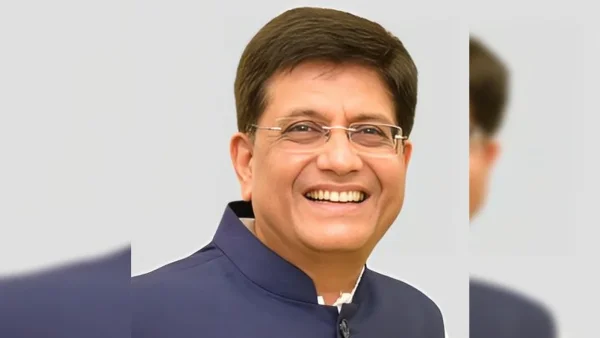
Piyush Goyal, the Union Minister of Commerce, has elaborated most aptly on the sensational USD 500 billion in the of The US-India Interim Trade Agreement by dilating upon this point that this amount is in keeping with India’s intention of doing business. He pointed out that the contract is only to commercial specifications and does not go into the matter of defense or decisions relating to sovereign energy.
Piyush Goyal’s Disclosure on the USD 500 Billion Mentioned
The minister interpreted the terms of the offer to be buy from US firms concerning his own “intention” to make a purchase, taking an exhibit of the money earmarked in the next five years. The offer is essentially recorded but in a sense Polemic, for it, voiced India’s import orders for various goods that it has been perceived as shaping.
It was further emphasized that these estimates are hardly a consensus where US suppliers reap competitive advantages. The Minister clarified for the umpteenth time that, in good faith, the intent should be taken restrictively and that no clause says that any annual export values have to be kept by India.
Commercial Trade Deals’ Focus is Not Defense
Goyal had a clear distinction between the parameters of commercial trade paths, vis-a-vis defence procurement. According to him, “Trade does not deal in defence.” “Trade deals with commercial needs,” he insisted, asserting that particular defence agreements and independent judgments for armed purchases are secluded from the frame of trade agreements.
The idea behind this demarcation is to allay the fears of stakeholders, lest any defence-related responsibilities be inserted into the trade deal. The minister reaffirmed that defense cooperation was outside the bounds of bilateral or multilateral trade.
Sectors of Demand: Import Estimates
The figure of USD 500 billion is composed of several high-demand categories- such as energy, civil aviation, coking coal for steel, and ICT goods. Goyal said that the big purchases of flight aircraft and rising energy requirements were the driving examples.
As far as coking coal import is concerned, the planned 300 MTPA steel capacity expansion in India, up from 140 MTPA, will exert sizable upward pressure. As of now, coking coal import level is around USD 17 billion, which, Goyal anticipates, can escalate depending on higher capacity: USD 30-35 billion more per year.
The Indian-US trade relationship in view of demands in civil aviation and ICT.
Over the projected purchases, a significant treatment is proposed for civil aviation. Goyal enumerated-third generation-USD 50 billion, in addition to the unsourced emerging infotainment or digital data related trades and services that may possibly scale up to USD 80-100 billion, which include nearly all instruments like engines and spare parts.
Likewise, the import-driven requirements could see a reasonably massive uptick in data centers, artificial intelligence, and quantum-computing items. While he reckons that India is about to import around USD 300 billion annually in ICT products right now, he is putative on getting it to around USD 2 trillion over the next five years, with US suppliers expected to play critical roles in the development.
Energy Sourcing, Russian Oil Context, and Sovereign Choices
In a response given about the possibility of importing Russian oil, Goyal didn’t make a direct statement one way or the other and stated that the Ministry of External Affairs handles sovereign foreign policy and energy sourcing. He maintained the argument that since India wants to diversify its energy sources, these purchases from the US could be an alternative.
The minister has also dismissed the idea of using bilateral energy or defense deals to determine trade access. Rather, he shared that a Free Trade Agreement strives to confer preferential tariff lines and reciprocal advantages in favor. The latter was meant to allow big hairy and ugly manufacturers to profit from the attractive benefits offered by bilateral trade.
Goyal, however, took into account the political accountability and characterized the US $500 billion as an estimate rather than a contractual commitment, hitched to India’s growth path and factual procurement interests. This clarification outlines how trade policy, industrial expansion, and sovereign energy choices will altogether sculpt future commercial relations between India and the United States.