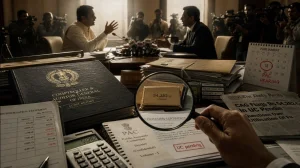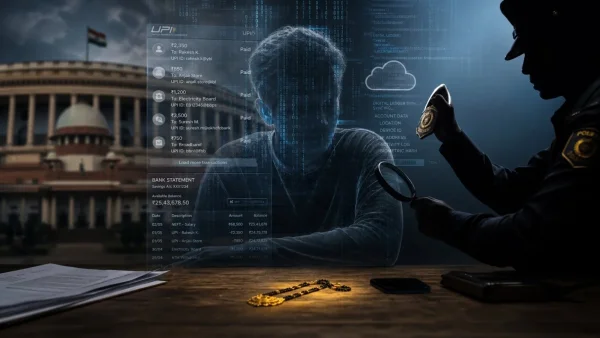
A dramatic claim is spreading across social media: that the Modi government is bringing a new Bankers’ Books Evidence Bill, 2026, under which senior police officers could obtain citizens’ complete banking records without a court order.
The claim has triggered a predictable social-media explosion.
“Your savings are no longer private.”
“They are coming after your mangalsutra.”
“One police letter and your entire financial history is exposed.”
And, naturally, someone has already compared India with North Korea.
There is just one problem: the viral claims need to be separated from the actual law.
The official Lok Sabha legislation database currently does not show a 2026 Bankers’ Books Evidence Bill among the listed bills. Therefore, claims that the Lok Sabha has already passed such a bill in the precise form being circulated online should be treated cautiously until the official bill text and parliamentary record are available.
What Is the Bankers’ Books Evidence Law Actually About?
The existing Bankers’ Books Evidence Act, 1891 is an old piece of legislation dealing with the use of bank records as evidence in legal proceedings.
That law was written when banking meant paper ledgers, physical account books and handwritten entries.
Today, your “bank book” may actually be:
A digital database
An electronic transaction record
A cloud-based banking record
A UPI transaction history
An electronically generated statement
So modernising the legal framework is not inherently controversial.
In fact, India’s banking system has moved so far into the digital age that a law written in the nineteenth century obviously needs updating.
The real question is how far the State’s access to those records should extend.
Your Bank Account Knows More About You Than You Think
Consider your last month’s transactions.
Your bank may know where you travelled, where you shopped, which subscriptions you paid for, whom you transferred money to, which hospital you visited and how much you spent.
Your financial records can therefore reveal something far more intimate than your bank balance.
They can reveal your lifestyle.
And that makes financial privacy a serious democratic issue.
But Where Did the “Mangalsutra” Claim Come From?
The viral message specifically warns Hindu women that the government is coming after their mangalsutras and savings.
That claim is not established by the legislation currently verifiable from official parliamentary records.
There is no basis to say that a proposed or existing banking-evidence law specifically targets Hindu women or authorises the State to seize mangalsutras.
That is political messaging—not a demonstrated provision of law.
But dismissing the entire issue as fake would also be too easy.
The legitimate question underneath the viral rhetoric remains:
What safeguards should exist when the State wants access to a citizen’s financial records? That question applies equally to Hindus, Muslims, Christians, Sikhs, women, men, business owners and ordinary taxpayers.
The Real Privacy Debate
Imagine an investigator being able to obtain someone’s complete financial history.
That information could potentially expose:
Income → spending → investments → loans → donations → relationships → travel → purchases.
The greater the information available to authorities, the greater the responsibility to prevent misuse.
Therefore, any law expanding access to financial information should clearly specify:
Who can request the information?
What level of suspicion is required?
What written reasons must be recorded?
Who reviews the request?
How long can the information be retained?
Who can access it?
What happens if officials misuse the information?
Can an affected citizen challenge the disclosure?
These aren’t anti-government questions.
They’re pro-accountability questions.
And Here Comes the Sarcasm
Apparently, the twenty-first century has finally arrived in Indian banking.
Your money moved online years ago.
Your shopping moved online.
Your electricity bill moved online.
Your groceries moved online.
Your UPI history is already sitting somewhere in a database.
And now the law is also trying to catch up.
The only thing that hasn’t received an upgrade is perhaps the citizen’s ability to ask:
“Excuse me, who exactly is looking at my data?”
Does Access to Bank Records Mean the Government Can Take Your Money?
No.
This is another important distinction.
Access to banking information is not the same thing as confiscation of money.
Investigative agencies may, under existing laws and procedures, obtain financial information in connection with investigations. Freezing or attaching assets generally involves separate legal powers and procedures.
So the viral suggestion that a new banking-evidence law automatically allows police to walk into your account and take your savings—or your jewellery—is misleading.
But Parliamentary Scrutiny Still Matters
Here is where the criticism deserves attention.
Any proposal that affects citizens' financial privacy should receive proper parliamentary scrutiny.
A law dealing with banking records is not a minor technical amendment.
India has hundreds of millions of bank accounts and an enormous digital payments ecosystem.
If Parliament is considering changes that affect access to those records, citizens deserve to know:
What exactly is changing?
Why is it changing?
What safeguards are being added?
Who will be accountable if the power is abused?
A voice vote or limited discussion—if and when such a bill is actually considered—should not become a substitute for public understanding.
Government vs Citizen: The Trust Question
The government needs investigative tools.
That is undeniable.
Financial records can be crucial in investigating:
Fraud
Money laundering
Terror financing
Tax evasion
Corruption
Organised crime
But investigative efficiency and privacy are not mutually exclusive.
A democratic government can have strong investigative powers and strong safeguards.
The challenge is getting the balance right.
The Bigger Question: Who Watches the Watchmen?
The debate should not be reduced to:
“Modi government is coming for your mangalsutra.”
Nor should it be dismissed with:
“If you have nothing to hide, why worry?”
That second argument is particularly dangerous.
Privacy isn’t only for people who have something to hide.
It is for people who have something to protect.
Your salary.
Your medical expenses.
Your family transfers.
Your investments.
Your personal relationships.
Your financial choices.
These are pieces of your private life.
Bottom Line
The viral narrative surrounding the alleged Bankers’ Books Evidence Bill, 2026 contains claims that cannot presently be treated as established fact. The official parliamentary database should be the starting point for verifying whether a bill has actually been introduced and passed in the form being circulated.
But the broader debate is absolutely legitimate.
As India becomes increasingly digital, financial data is becoming one of the most powerful sources of personal information.
So the question isn’t whether police should be able to investigate financial crimes.
They should.
The question is whether those powers come with enough transparency, oversight and accountability to protect ordinary citizens.
Because in a democracy, the government’s ability to see your bank account should never become a matter of “trust us, we won’t misuse it.”
There should be rules.
There should be records.
There should be oversight.
And most importantly—
There should always be someone watching the people who are watching your money.