India’s globally acclaimed digital payments ecosystem has become the centre of a fresh political controversy after opposition leaders alleged that the Union government is paving the way for transaction fees on digital payments under pressure linked to trade negotiations with the United States.
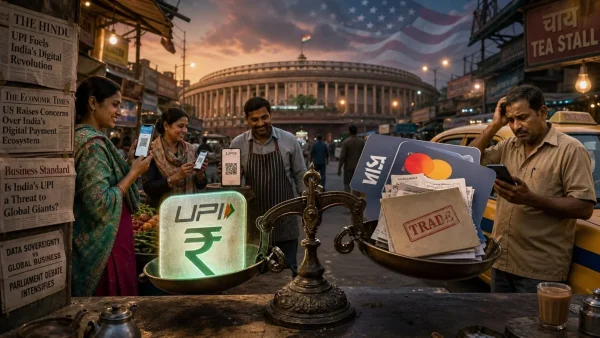
The allegations come amid concerns that global payment companies such as Visa and Mastercard have sought a more “level playing field” in India’s rapidly growing digital payments market, where the government-backed Unified Payments Interface (UPI) has emerged as the dominant mode of digital transactions.
The government has not stated that it is introducing a general fee on all UPI transactions, and any changes to payment regulations would be subject to the legislative and regulatory process.
What Is the Controversy?
Opposition leaders have alleged that:
International payment companies have expressed concerns over India’s digital payments ecosystem.
Pressure linked to trade discussions with the United States is influencing domestic policy.
Legislative changes could eventually open the door to charging fees on certain digital transactions.
Once such a framework is introduced, the scope of charges could gradually expand.
These are political allegations. The government has not publicly accepted the claim that its policy decisions are being dictated by external pressure.
Why Is UPI Different?
Launched by the National Payments Corporation of India (NPCI), UPI has transformed the way Indians make payments.
Today, it enables:
Instant bank-to-bank transfers.
QR-code payments.
Merchant transactions.
Peer-to-peer transfers.
Small-value daily purchases.
One of the biggest reasons for its widespread adoption has been that, for most users, UPI transactions are free.
This has encouraged millions of consumers and small businesses to move away from cash.
The ‘Level Playing Field’ Debate
Global card networks such as Visa and Mastercard operate on a business model where merchants generally pay a Merchant Discount Rate (MDR) for processing transactions.
UPI, on the other hand, has largely operated without MDR on many categories of transactions due to government policy, making it significantly cheaper for merchants.
International companies have argued in various forums that different regulatory treatment creates competitive challenges.
Supporters of UPI argue that the system was intentionally designed as public digital infrastructure to promote financial inclusion and reduce transaction costs.
Would Transaction Fees Change Consumer Behaviour?
Economists suggest that even small transaction charges can influence consumer habits.
If digital payments become more expensive, some users and small businesses may prefer:
Cash payments.
Alternative payment methods.
Fewer small-value digital transactions.
Whether this would happen depends on the nature and scale of any future policy changes.
Government’s Position So Far
The government has consistently highlighted UPI as one of India’s biggest digital success stories.
Officials have repeatedly pointed to:
Record-breaking transaction volumes.
Increased financial inclusion.
Reduced dependence on cash.
Growth of digital commerce.
As of now, there has been no official announcement that ordinary UPI payments will universally attract user charges.
Political Criticism
Opposition leaders have criticised the alleged move, arguing that:
India’s digital payments ecosystem should remain affordable.
Public digital infrastructure should not be weakened.
Parliament should have greater debate on any significant changes affecting millions of users.
They also contend that any perception of policy changes being driven by external trade pressure would raise broader questions about economic sovereignty.
The government rejects suggestions that it compromises India’s interests in trade negotiations.
Why Does This Matter?
India’s digital payment revolution has become a global case study.
Millions of people—including street vendors, small shopkeepers, taxi drivers, and neighbourhood businesses—depend on low-cost digital transactions every day.
Any policy affecting transaction costs could therefore have implications for:
Consumers.
Small merchants.
Banks.
Fintech companies.
The broader digital economy.
The Bigger Question
The debate is no longer just about payment fees.
It is about the future direction of India’s digital economy.
Should India’s digital payment infrastructure continue to prioritise low-cost public access, even if private global companies argue that the market is uneven? Or should policymakers revisit the regulatory framework to create what some describe as a more “competitive” environment?
These are policy questions on which reasonable people may disagree.
As discussions continue, one expectation remains common across the political spectrum: any significant change affecting millions of digital payment users should be transparent, clearly explained, and subject to informed public debate before implementation.