A reported dispute over an Indian rice shipment at Bangladesh’s Chattogram Port has sparked a fresh conversation about food quality, export checks and India-Bangladesh trade.
According to the claim circulating online, Bangladesh authorities have objected to an 11,500-tonne consignment of Indian non-basmati parboiled rice, with around 3,500 tonnes reportedly already unloaded before concerns were raised about its quality.
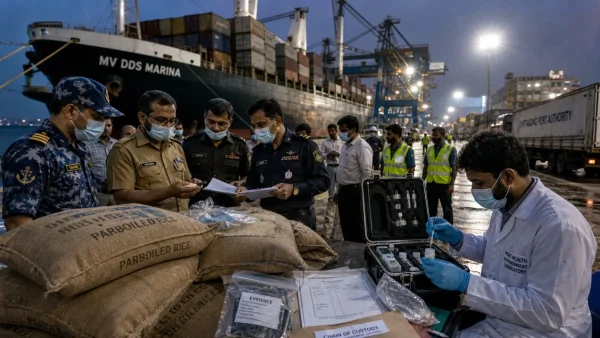
But there is an important catch: the publicly available reporting I could verify does not substantiate the claim that this particular 11,500-tonne shipment was rejected as unfit for human consumption. What is documented is that an 11,500-tonne Indian parboiled-rice consignment arrived at Chattogram Port in March 2025, and Bangladesh’s Food Ministry said physical sample testing had already been completed before unloading. (Views Bangladesh)
That distinction matters.
The ₹-Crore Question Isn’t the Only Question
Whenever thousands of tonnes of food are involved, the first question should be simple:
Was the rice actually fit for consumption? If laboratory tests subsequently found a serious quality problem, then Bangladesh would have legitimate grounds to stop distribution and investigate.
But if the shipment had already passed the required inspection, another question immediately follows:
How did a consignment allegedly cleared during initial testing later become a quality concern?
That is where transparency becomes crucial.
What We Know About the Shipment
Bangladesh had entered into a broader agreement to import 4.5 lakh tonnes of parboiled rice from India across nine packages.
The 11,500-tonne consignment was carried by the vessel MV DDS Marina and arrived at Chattogram Port in March 2025. Bangladesh’s Food Ministry said samples had been physically tested and preparations for unloading had begun.
The procurement was intended to support Bangladesh’s domestic demand and emergency food requirements.
So this was not an informal shipment—it was part of a government-backed procurement arrangement.
If There Was a Rejection, What Should Be Checked?
Any genuine rejection should trigger a proper chain-of-evidence investigation.
Authorities would need to establish:
What exactly failed the quality test?
Which laboratory conducted the testing?
What were the original test results?
Were samples representative of the entire cargo?
Was the rice damaged during transportation or storage?
Were moisture and contamination levels within contractual limits?
Who approved the shipment before loading?
Who cleared it after arrival?
These questions are more important than social-media claims about one country “rejecting” another country’s food.
India’s Export Reputation Is at Stake Too
India is one of the world’s major rice exporters.
That makes quality control particularly important.
An export shipment does not simply represent one trader. It contributes to the reputation of Indian agricultural products in international markets.
If a shipment genuinely fails contractual specifications, corrective action is necessary.
But if a shipment meets the agreed standards and is rejected without adequate evidence, the exporter also deserves due process.
Food quality should be decided by laboratories—not geopolitics.
And Bangladesh Has Every Right to Check
There is another side to the story.
Bangladesh, as the importing country, has a responsibility to ensure that food entering its market meets safety and contractual standards.
If officials discover that a consignment is genuinely unsafe or substantially below specification, they cannot simply ignore it because it came from a neighbouring country.
Food security comes before diplomatic convenience.
The Political Angle Cannot Be Ignored—But It Shouldn’t Replace Facts
India-Bangladesh relations have experienced considerable political changes in recent years, and trade has inevitably become part of the broader conversation.
That makes any major trade dispute susceptible to political interpretation.
But jumping immediately from “quality dispute” to “political rejection” would be premature without evidence.
The same caution applies in the opposite direction.
A rejected shipment, if verified, should not automatically be presented as proof that Indian rice exports are generally poor quality.
One shipment cannot define an entire country’s agricultural exports.
The Real Story May Be the Quality-Control Chain
Here’s where this gets interesting.
Imagine a ship carrying thousands of tonnes of rice.
First, the exporter checks it.
Then samples are collected.
Then laboratories test it.
Then the shipment reaches the port.
Then officials inspect it again.
Then it is unloaded.
If concerns emerge after all these stages, the obvious question is:
Which checkpoint failed? And if every checkpoint worked, then why is there a dispute?
That’s the part that deserves answers.
No Need for Nationalism—Just Transparency
It is tempting to turn every India-Bangladesh trade dispute into a patriotic shouting match.
But rice doesn’t care about borders.
A consumer simply wants to know whether the food is safe.
An exporter wants to know whether contractual standards were followed.
And taxpayers on both sides deserve to know whether public procurement was properly managed. The Bottom Line The reported claim about Bangladesh rejecting 11,500 tonnes of Indian rice as unfit for human consumption needs to be treated cautiously until official documentation or credible reporting confirms the specific rejection.
What is firmly documented is that an 11,500-tonne Indian parboiled rice shipment arrived at Chattogram Port and underwent physical sample testing before unloading as part of a much larger Bangladesh procurement programme. (The Daily Star)
So before declaring “Bangladesh rejected Indian rice”, the more important question is:
What did the laboratory reports actually say?
Because when 11,500 tonnes of food are involved, the real headline shouldn’t be about India versus Bangladesh.