There is a certain beauty in the language of taxation.
The customer pays GST, but technically the merchant deposits it.
The employee loses TDS from their salary, but technically the employer deducts and deposits it.
So, depending on how you describe it, apparently nobody is paying the tax.
Problem solved.
Except, of course, the money is still leaving someone’s pocket.
FACT CHECK: How GST Actually Works
Under India’s GST system, the supplier is generally liable to pay the tax to the government, although there are exceptions such as reverse-charge mechanisms. (CBIC GST)
But the CBIC itself explains the crucial point: GST is a destination-based consumption tax, and its economic burden is intended to be borne by the final consumer. (CBIC GST)
So when you buy a product for ₹1,000 plus 18% GST, the shopkeeper may be the person collecting and depositing the tax—but the ₹180 ultimately comes from the transaction with the consumer.
In simple language: Merchant = tax collector/remitter
Consumer = generally the person bearing the economic burden
Calling GST simply a “tax paid by merchants” therefore tells only half the story.
And Then Comes TDS
The same confusion appears with Tax Deducted at Source.
An employee receives a salary.
The employer calculates the applicable TDS, deducts it before paying the salary and deposits it with the Income Tax Department.
The Income Tax Department itself confirms that employers are responsible for deducting salary TDS and issuing Form 16 to employees. (Income Tax Department)
So yes, technically:
Employer deducts.
But whose tax is it?
The employee’s.
The employer is essentially acting as the government’s collection agent.
The Sarcasm Writes Itself
Following this logic, perhaps tomorrow we can announce:
“Income tax isn’t paid by taxpayers. Their employers pay it.”
And GST?
“Consumers don’t pay GST. Shopkeepers do.”
And perhaps the next election slogan could be:
“Nobody pays taxes. Taxes simply happen.”
Unfortunately, the bank balance has a different opinion.
The Real Issue: Legal Liability vs Economic Burden
This distinction matters enormously.
There are two different questions:
Who is legally responsible for depositing the tax? And:
Who ultimately bears the economic cost? Those are not always the same person.
GST demonstrates this perfectly.
The registered supplier generally has the legal obligation to pay GST, while the tax is designed as a consumption tax whose burden is ultimately borne by the consumer. (CBIC GST)
With salary TDS, the employer is responsible for withholding and depositing the tax, but the deduction reduces the employee’s salary income received.
Where the Controversy Begins
This distinction becomes politically important when governments discuss the country’s tax burden.
A government can point to a system in which businesses collect and deposit GST, while millions of employees never physically transfer their income tax to the government themselves.
But the citizen sees something else:
The amount deducted from salary.
The GST added to the bill.
The tax appearing on the invoice.
The money disappearing from the household budget.
That is why technical terminology can sometimes create a very different impression from the economic reality.
Does GST Always Fall Entirely on Consumers?
Not necessarily.
This is another important fact.
The statutory incidence and the economic incidence of a tax can differ.
Businesses may adjust prices, margins, wages, investment or purchasing decisions in response to taxation.
So saying that consumers always bear 100% of GST in every circumstance would also be an oversimplification.
But GST is fundamentally designed as a consumption tax, with the CBIC explicitly describing its burden as falling on the final consumer. (CBIC GST)
The Bigger Question: How Much Tax Does an Ordinary Indian Actually Pay?
This is where the debate becomes interesting.
A person can encounter taxation at multiple points:
Earn → Income tax
Spend → GST
Buy a vehicle → Taxes and fees
Buy fuel → Excise/VAT
Invest → Applicable taxes
Earn interest → Applicable income-tax treatment
The argument isn’t that taxation itself is illegitimate. Governments need revenue to fund infrastructure, defence, healthcare, education and public services.
The legitimate debate is about how much is collected, who bears it, how efficiently it is spent and whether citizens receive adequate value in return.
The Result: Tax Terminology Shouldn't Hide Tax Reality
GST being deposited by merchants does not mean consumers are untouched by it.
TDS being deposited by employers does not mean employees aren’t paying income tax.
The government may have perfectly accurate technical language for describing the collection mechanism—but taxpayers experience taxation through something much simpler:
How much money is left in their pocket? And that is why the sarcastic claim about “GST paid by merchants” and “TDS paid by employers” touches a genuine issue.
The person who hands the money to the government and the person who ultimately bears the cost are not always the same.
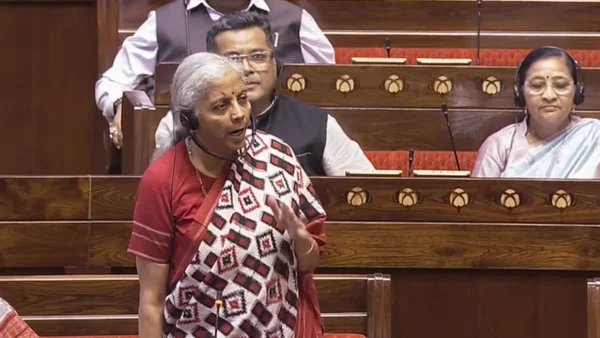
So yes, the Finance Minister can technically explain who deposits the tax.
But ordinary taxpayers are more interested in knowing:
“Fine. But whose money was it?” And that question is considerably harder to answer with a technical definition.