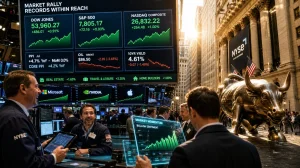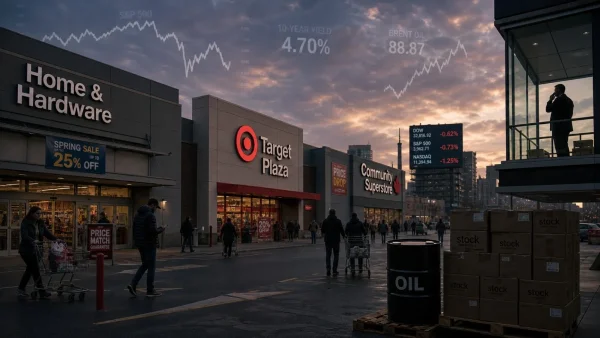
On Monday Wall Street was careful about its approach to record territory. The emphasis has moved away from index milestones to what is of consequence at the moment: whether the big names in retail can make headway against stubborn inflation, a less certain job market and the cost of borrowing. By 10:30 a.m. Eastern time the S&P 500 had given back 0.1%, the Dow Jones was down 163 points and the Nasdaq was little changed.
Retail earnings become a stress test for consumer strength
One could view the marquee numbers coming this week from Home Depot, Walmart and Target as a referendum on how durable US demand really is. With July’s retail figures showing an unanticipated drop from June and households under fresh labour market strain, remarks from these firms may well recalibrate expectations.
For some time the market has been propped up by the profit engine of Corporate America; now the baton is in retail’s hands. FactSet puts S&P 500 companies on course for about 50% year-over-year growth in per share earnings for the spring quarter, but the major retailers have yet to file their reports.
In an environment where prices remain high, the chains are vying for wallet share with shoppers who have grown more circumspect. It lends urgency to their projections on pricing and inventories when one considers that employers put more people out of work last month than they took on.
What executives are likely to address
Investors will be attuned to the following from the retailers this week:
– How consumer spending has altered since June
– Inflation’s toll on budgets
– Any indication of a softening in the labour market
Oil and bonds are redefining the risk backdrop
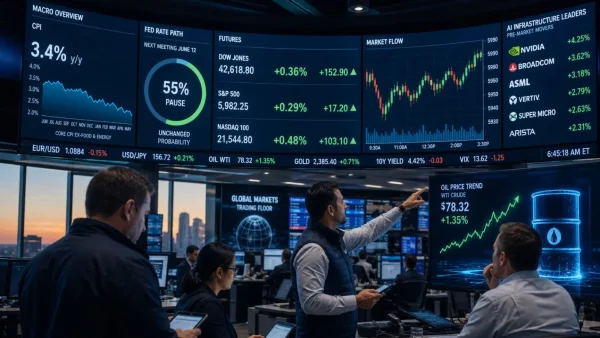
The market is facing a two-pronged headwind from energy and rates. Brent crude was up a modest 0.4% to $88.87 on Monday after some recent turbulence. A month ago there was more drama, with prices ranging from $72 to $102 on hopes of a US-Iran deal to open up the Persian Gulf to oil tankers.
Such oil gyrations are felt in the bond market. Following better than expected manufacturing numbers out of New York, the 10-year Treasury yield inched from 4.68% late Friday to 4.70%. It is a climb from the 3.97% seen prior to the war with Iran, a reflection of renewed anxiety over inflation.
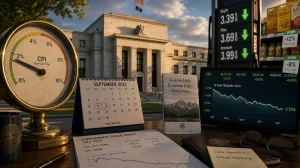
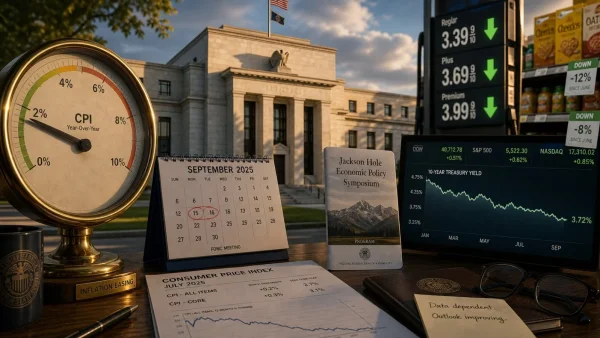
When yields are higher, financial conditions are constricted and risk is repriced in every sector, making each new piece of data on growth or prices a possible catalyst. There has been some cause for optimism that the Federal Reserve might hold off on another rate hike until later in the year, given last week’s reports that July inflation was not as bad as earlier in the summer.
Borrowing costs are already biting
You can see the effect of the 10-year yield’s advance in the average long-term US mortgage rate, which has been driven to near its peak for the year. Late summer is shaping up to be a material drag on big-ticket consumer spending and those industries most attuned to interest rates.
Retailers are no exception; with financing costs impinging on everything from the credit they extend to customers to the cost of holding inventory, one will be looking at the guidance from the likes of Walmart, Target and Home Depot for signs of margin discipline, demand elasticity and how well they have their costs in check.
Stock-specific moves reveal shifting leadership
There has been a rotation in leadership under the surface as corporate news broke. L3Harris Technologies was down 3.2% once word came out that Christopher Kubasik was to step aside as CEO and chairman over conduct the company deemed at odds with its values. The firm made it clear the issue had nothing to do with operations, customer relations or financial reporting.
Then there were the moves by Berkshire Hathaway. After the conglomerate put in some homebuilder investments and upped its position in the Google parent, Alphabet still gave back 0.7%. On the other hand, when Berkshire offloaded all of its holdings in the maker of Modelo and Robert Mondavi, Constellation Brands fell 4.8%.
Such activity shows that even defensive and mega-cap stocks are not insulated from portfolio shuffling when earnings, oil and rates are all in flux. In the relative quiet of trading, single-stock news can make a difference.
Global cues keep the crosscurrents alive
It is not just domestic factors at play. European indexes retreated after firmer showings in Asia. In Tokyo the Nikkei 225 put in a 0.7% gain on data pointing to more of a slowdown in Japan’s second-quarter growth than had been forecast, while Shanghai and Hong Kong saw advances of 1.4% and 1.3% respectively.
The global picture is mixed, indicative of a market attempting to reconcile better profit trends with macro headwinds. US investors would do well to be tactical in how they view the way international currency and commodity swings are factored into the guidance of multinationals this season.
Why this week matters and what to watch next
All eyes will be on retail earnings to see if the market’s record run can find footing outside of energy and tech. Should we see that spending holds up in the face of inflation and higher rates, the bull case for above-expected profits may well carry on through autumn.
Oil is still the wild card. Brent has been anywhere from $72 to $102 of late, which is headline risk enough. A fresh flare-up in the Persian Gulf could send prices up and make the Fed’s job on inflation harder, not to mention putting more upward pressure on Treasury yields.
As for bond traders, they will be monitoring regional labour and manufacturing figures for any hint of re-acceleration or deceleration. Last month’s softer inflation numbers provided some breathing room but did little to settle the policy debate. The market seems to be pricing in a wait-and-see approach for the time being.
Those following the immediate setup will note three things:
– What comes out of the books at Home Depot, Target and Walmart
– Where Brent crude goes from its recent jaggedness
– The 10-year yield in the vicinity of 4.70%
The stakes are straightforward. Get a good report from retailers, steady yields and no trouble from oil and the indexes may test records once more. But let down on any of those fronts and volatility could set in, calling into question how solid this profit-led rally truly is.