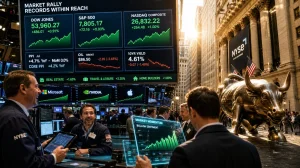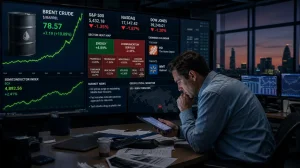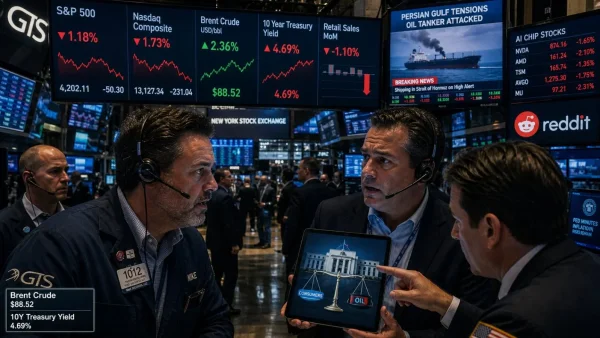
One could say the record run on Wall Street had a reality check. Weakness in US retail sales ran headlong into an oil resurgence to trim the major indexes and make a Fed rate hike next month seem less likely. Traders were left weighing any relief from inflation against the risk that growth is cooling even as prices hold firm.
The markets made a firm start before fading on the back of rising Brent crude, turning what were early gains into modest losses by the end of the session. The S&P 500 still closed the week in positive territory, but Friday’s numbers spoke of a more guarded mood as investors considered how long policy can remain tight when consumers are retreating.
The Fed’s path narrows as consumers pull back
Shoppers were not as forthcoming last month as in the one before, an unexpectedly soft retail sales figure that went against the grain of economists who had pencilled in another increase. In the wake of it, shorter-dated Treasury yields were pushed lower and the idea of tighter policy in September was put in perspective.
Not for long though. With oil on the upturn, US government bonds reversed course and longer yields put in some ground, a sign of where expectations for growth and inflation are heading. The 10-year Treasury yield was at 4.69 per cent from 4.63 per cent late Thursday, and Treasuries gave up their initial rally to fall.
Some strategists would have you wait before reading too much into one report. Jennifer Timmerman of the Wells Fargo Investment Institute pointed out that earlier months may have been propped up by the World Cup, an Amazon Prime Day and large tax refunds. But the figures have brought stagflation warnings back to the fore, a worst-case scenario the Fed has little easy remedy for.
Oil’s surge resets risk and sector leadership
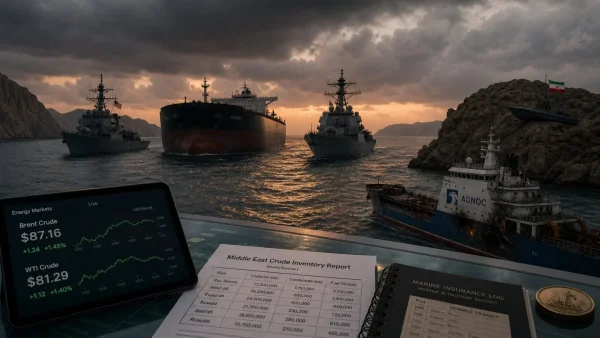
It was the oil market that reasserted its sway over risk assets. As the session wore on, the move in prices was enough to rattle stocks from their highs. Brent finished at USD 88.52 a barrel, a 1.7 per cent advance, with US futures at USD 82.40, up 1.42 per cent.
Geopolitics were front and centre on the energy tape. With the US threatening to extend a naval blockade and otherwise turn up the economic screws on Iran, markets kept a close watch on the tense talks and the question of when tankers can leave the Persian Gulf unimpeded. The volatility was plain to see; earlier in the week Brent had slipped 0.2 per cent to USD 86.92.
The macro cross-currents were evident in currency and commodity hedges. The dollar index was down to 99.65 on the retail sales news, while the euro put in a rise to USD 1.1567. There was talk of the Bank of Japan moving on rates in September, and the yen responded by strengthening to 159.33. Spot gold inched up 0.53 per cent to USD 4,374.27 an ounce; US gold futures settled 0.4 per cent in the green at USD 4,437.30.
From records to reversals: where indexes ended
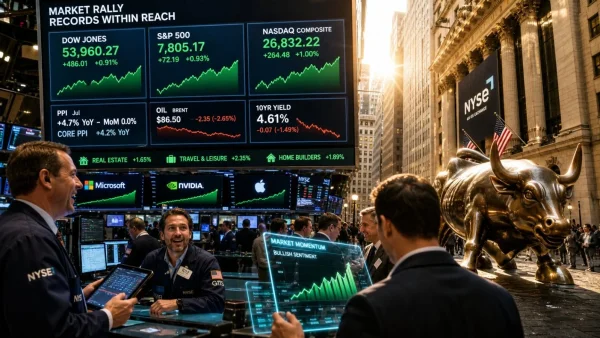
After making a record the previous day, the S&P 500 gave back 13.23 points to end at 7,785.76. Tech was no exception as energy strength and jitters over growth dragged on the Nasdaq and Dow Jones Industrial Average, which fell 0.28 and 0.20 per cent to 26,729.16 and 53,732.41 respectively.
The S&P 500 still managed a third consecutive winning week, the longest it has been since the nine-week run that came to an end in May. Elsewhere in the world MSCI’s stock gauge was down a marginal 0.07 per cent to 1,160.01, with European shares putting an end to four weeks of gains.
Then there was Asia. MSCI’s broad index of Asia-Pacific shares (excluding Japan) told a different story, closing 0.29 per cent in the plus at 1,640.08. A 2.4 per cent rise in the Kospi on Friday was South Korea’s third consecutive day of such a move, putting in evidence that Seoul is ground zero for the kind of market turbulence AI can engender. The FTSE 100 in London was not so buoyant, edging down 0.2 per cent.
AI trade meets reality as expectations bite
For certain AI-linked stocks, tailwinds from earnings were no match for lofty expectations. Take Applied Materials: even with CEO Gary Dickerson touting another record quarter and citing a global appetite for artificial-intelligence technology to explain profit and revenue that beat analyst estimates, the shares gave up 5.1 per cent on top of an earlier 4 per cent slide. It is hard to top what the market has already put into the price.
The wider AI complex was in flux as investors wondered if valuations are outstripping revenue growth; names like Intel and Broadcom were in the red. “A lot of the drivers in the market right now are around various parts of AI,” said Thomas Martin of GLOBALT Investments.
Then there is the question of volatility. John Sidawi of Federated Hermes would have it that while markets have put up with a good deal of uncertainty without calling for higher risk premiums, this is an equilibrium unlikely to hold. Economic and geopolitical risk may be lagging at present, but some caution it will not stay that way.
Passive flows loom as index reshuffle kicks in
Market mechanics were on display with Reddit. The stock was up 14.7 per cent before leaping another 12.6 per cent on word it will be inducted into the S&P 500 on Tuesday. When an index makes an addition, funds tracking the benchmark are compelled to buy, creating a short-term demand that has little to do with fundamentals.
Such is the power of passive capital to direct price action while macro forces make the headlines. It also speaks to a tension in today’s market between event-driven flows and the sustainability of earnings in an environment where the growth outlook is growing more fragile.
Consumer and sentiment signals turn cautious
There are indications households are feeling the pinch in the softer retail environment. A preliminary University of Michigan survey found consumer sentiment to have eroded more than economists put in their models, with older and lower-income demographics showing particular strain from inflation.
While some will say one weak month is no trend when transitory factors have propped up prior spending, others see a complication for policymakers should demand cool off and energy prices remain firm.
The bond market made its point with an intraday pivot as well. Treasury yields crept up on the back of oil, a sign that inflation expectations are still at the mercy of energy. Stocks that had put in some modest gains at the open could not hold their ground once that story broke.
Key market signals to watch now
Traders are keeping a close eye on the following:
– Odds of a Fed hike in September have receded
– Brent hovering near USD 88.52 keeps the focus on inflation hedging
– 10-year Treasury yield at 4.69 per cent
– Early August weakness in the University of Michigan numbers
– Tuesday’s S&P 500 entry for Reddit
Why it matters and what comes next
The market’s reaction function is changing even as policy sensitivity is up. “Geopolitical uncertainty remains the only major macro roadblock,” according to Kyle Rodda, who pointed to the US-Iran standoff as a source of rhetoric that has a habit of building over the weekend.
With energy making a comeback, the rate-sensitive growth stocks that have been setting records are being put to the test. Portfolio positioning will come down to whether AI earnings can justify their premium and if supply risks in oil abate.
For the moment, the poor retail data has scuppered hopes of a Fed hike next month, though inflation figures this week argue for a pause rather than cuts. Whether equities find their next leg will be determined by if this is a passing consumer blip or the harbinger of something more widespread.