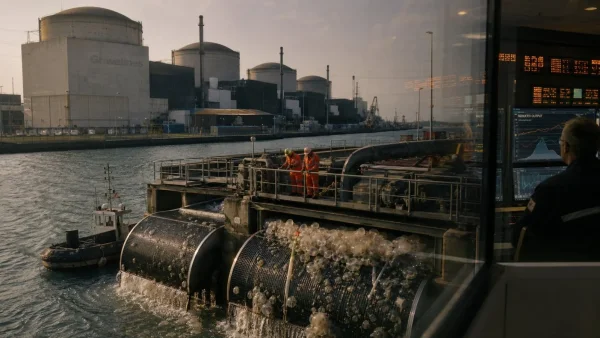
It was an uncommon reverse for Europe’s nuclear heavy weight. A mass of jellyfish clogged the seawater intakes at the Gravelines site near Dunkirk, leaving France with no option but to close three of its units. The precautionary step has dented output at the nation’s biggest nuclear installation and put a spotlight on the security of coastal energy.
Why the shutdown matters for France’s power supply
With six 900-megawatt reactors, Gravelines is what one might call the linchpin of the region’s electricity. In the wake of the incident, three were put offline; a fourth is running at half capacity while another is at full tilt. One unit was already down for maintenance as planned.
It is poor timing for French nuclear generation, which has had a hard summer of it. Heatwaves and drought have done their part to disrupt things this year. AFP figures from EDF show that before these latest closures, Sunday’s nuclear production was 15.6% under normal levels.
EDF is insistent there has been no compromise of safety for the environment or staff. Yet the hit to production is telling. It shows how a biological surge in the sea can send ripples through the grid even when there is no technical problem within the plant itself.
The operational status as reported by EDF:
– Three reactors shut down at Gravelines
– Fourth reactor reduced to half capacity
– One reactor at full capacity
– One reactor offline for scheduled maintenance
What triggered the emergency stop at Gravelines
According to EDF, the jellyfish got into the seawater pumps meant for cooling. Once the flow is impeded, automatic protections kick in and operators are left to halt generation to avoid straining the equipment; the reactors will not run otherwise.
The company does not see it as an accident so much as a safety measure. The systems are built to react to any anomaly in pressure or flow, and that is exactly what occurred when the jellyfish made a blockage of the intake components.
How seawater cooling became a chokepoint
To get rid of heat from the power cycle, Gravelines pulls seawater from a canal off the North Sea. It is supposed to be filtered before it gets to the cooling circuits. The jellyfish put an end to those defences in this instance.
A large swarm was drawn in and put up a barrier to the rotating drum screens. That kind of obstruction changes the pressure and flow to the point where protective thresholds are met. As a result, three reactors were taken off line and the output of another was turned down to take some of the load off the intake system.
Has this happened before?
Gravelines was in the same position a year ago when its pumping stations were clogged by jellyfish. Operations were put right once the obstruction was cleared, but to have it happen again suggests a pattern, not an aberration.
One sees similar things at nuclear plants in Japan and Sweden. Designs may differ but they all have to rely on a steady stream of seawater to do the job of dissipating heat.
Why jellyfish swarms are growing harder to ignore
There are reasons for it, experts will tell you. Warming seas, plastic pollution and overfishing have made for good conditions for the animals to put on numbers and reproduce. A bloom can come on fast and ride the current, making a routine intake a sudden problem.
Do not mistake it for a vulnerability of the reactor. A jellyfish is not going to harm the core. The danger is in the sheer volume. When enough biomass piles up at the intake, the filtering is disabled and the cooling water stops or slows.
Then you have the added complication of France’s recent weather. Between the droughts and heatwaves, nuclear output has been curtailed this year; the jellyfish are just another stressor in an already trying summer.
What comes next for grid planners
The message is clear: if one is to plan for extreme weather, one must also make allowances for the odd surge of marine life. EDF says Gravelines is safe, but when output is squeezed from several directions the constraints can work their way through the market.
For the moment the priority is to get the intake systems clear and flows back to normal. But there is a longer term question for the energy system as a whole: how to adjust coastal infrastructure to a marine world that is warmer and less predictable, where a swarm of jellyfish is no longer something to be written off.