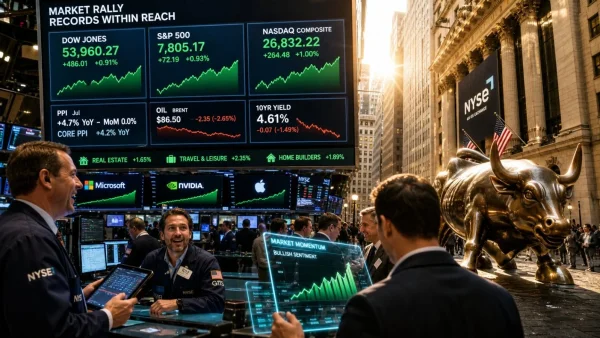
In early trade, Wall Street was driven toward record territory as softer wholesale inflation and cooling oil rekindled the notion that the Federal Reserve will keep rates steady next month. US stock benchmarks were set for another go at all-time highs as rate-sensitive names and the big tech leaders put in strong performances.
What changed the market mood
The latest Producer Price Index put to rest any idea of broad inflation pressure building again. Wholesale prices were up 4.7% in July on the year, a step down from 5.5% in June and under what was forecast. Month on month the PPI was flat in July, which was welcome news for those looking for a lasting cool-down.
Falling costs in energy and food have only served to strengthen the disinflation message and take some of the edge off consumer prices further down the road. All of that has helped bring bond yields in and removed the equity market’s chief headwind of the last twelve months: the threat of more monetary tightening.
The 10-year US Treasury yield gave up ground to 4.61%, compared with 4.68% when Wednesday closed. It is also off the 4.72% it was at on Monday, yet still nowhere near the 3.97% mark prior to the Iran conflict sending gasoline and oil into a run.
Fed expectations and market positioning
On the heels of soft consumer numbers yesterday, the milder wholesale inflation figures have lent credence to a wait-and-see approach from the Fed. CME Group figures show traders are now pricing in just a 35% likelihood of a September hike, a drop from the 50% or so they saw two days ago.
Should policymakers decide to pull the trigger, it would be the first move in over three years and one not without its political complications; President Donald Trump has been vocal in his demands for lower rates to foster growth.
Sector leadership has been redefined in short order by the lower yields. Real estate has done well of late, with cheaper financing and a desire for income putting those names ahead of the tape. Equity traders have also been adding to long-duration assets, lifting the major technology and growth stocks.
Indices sprint toward highs
By 10:09 a.m. ET the Dow Jones Industrial Average had put in 190.02 points, a 0.36% advance to 53,960.29. The S&P 500 was up 56.52 points, or 0.73%, to 7,805.02, while the Nasdaq Composite added 244.05 points for a 0.92% gain to 26,832.54.
There was a constructive tone right out of the gate. When the bell rang, the Dow had climbed 58.3 points to 53,828.55. The S&P 500 tacked on 14.7 points to 7,763.18 and the Nasdaq was 42.9 points higher at 26,631.341, showing wide participation.
Oil’s retreat removes a key overhang
Energy has been something of a tailwind. Brent crude futures dropped 2.7% to the $86.50 area, erasing some of a six-day advance as traders factored in the prospect of weaker demand globally this year and rising US inventories.
It has been an intense time for volatility. Brent has been anything but steady in the last month, whipsawing from $72 to as high as $102 a barrel on changing supply outlooks tied to expectations for shipping in the Middle East. The Strait of Hormuz is still heavily restricted and, as a senior Iranian source would have it, there is no sign of Iran and the U.S. coming to any permanent terms to put an end to the conflict.
The lower price of oil has its way with inflation expectations and trims operating costs for those industries that are heavy on fuel. Combined with yields in retreat, the result has been one of the more accommodating environments for equities we have seen in some time.
Winners and laggards as rotation takes hold
There was a broad advance in tech. Microsoft put in 1.4%, Nvidia 0.6% and Apple 0.5%. On the hardware side, Dell Technologies and HP were up 2.5% and 4% respectively, riding the coattails of Lenovo’s strong showing.
But the rally did not extend to every large cap. Cisco Systems was left behind, tumbling 7.4%. Even with a fiscal 2027 revenue projection that beat Wall Street, investors had other concerns about the margin trajectory and the rest of the outlook, and they punished the stock accordingly.
Rate sensitivity was on display among consumer and property stocks. Tapestry fell 15% on the strength of some guidance nuances that overshadowed a positive annual forecast. AvalonBay Communities and Builders FirstSource were on the upswing at 2.6% and 3.4%, their gains in line with better housing sentiment courtesy of lower yields.
Travel and leisure also found support in falling fuel prices. United and Carnival were up 1.7% and 2.9% on the promise of cheaper operations. And when Jack in the Box reported numbers that exceeded what was called for, the shares leapt 7.3%, a reminder that solid earnings are the bedrock of this rally.
Today’s notable themes:
– Big Tech on the rise with yields down
– Real estate outperforming on income
– Travel stocks fed by cheaper fuel
– A miss at Cisco
The competitive angle in tech
With discount rates in check, the argument over premium valuations for AI and cloud leaders is back in play. One sees incremental moves in Microsoft or Apple, then again you have Cisco’s slide, which tells you investors are not forgiving when margin visibility is in question. Then there is the share-shifting in global PC demand, evident in how Dell and HP followed Lenovo’s lead.
What comes next for US stock market today
As the indices inch back to record territory, policy clarity is the catalyst to watch. Between the 4.7% PPI rise in July and stable pricing, along with the ebb in oil, the Fed has reason to be patient. Markets will be looking at the data to see if disinflation holds without taking a toll on growth.
In terms of portfolio strategy, the tape of the day offers three things to consider. Quality tech and reasonable growth are once again in the driver’s seat thanks to yields. There is room for real estate and housing plays to make use of the rate relief. And should energy costs keep drifting, travel and consumer services will be the beneficiaries.
Of course, there are risks. Oil has run a wide range and the Middle East lanes are constrained. Equities can be touchy on the odds of a Fed move; the chance of a September hike is now put at 35%, off the 50% figure earlier in the week.
That said, the bulls had the advantage on Thursday. With Treasury yields down and crude and inflation both softer, the runway for risk assets was open. Barring a reversal in those conditions, Wall Street seems poised to press on toward new highs.