The man from Mumbai who made the comparison has India’s convenience culture in the spotlight. His post has a way of making an old question feel new again: when you hand over the cash, are you getting a better result or have you just purchased some ease of mind?
It was only supposed to be a normal booking, but it ended up being a textbook example of the kind of trade-off city folk make every day. Since he put his story out there on 14 June 2026, it has opened up a wider talk on how these platforms put a number on value when you can still find plenty of good options off the grid.
What set off the discussion
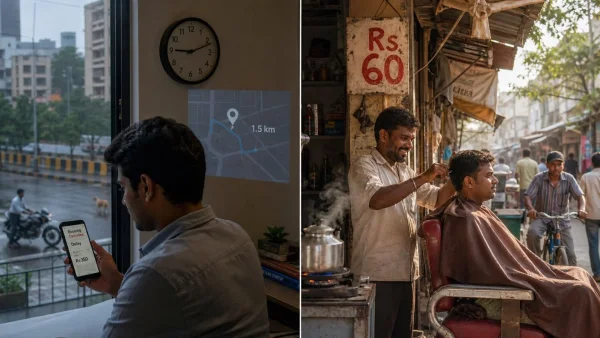
You wouldn’t think it was the cost, but it was the wait. The pro on the other end of the line let him know his bike had given out and he’d be hours behind. Not in a position to put it off, the customer called it off and went out to see what was around the corner.
He didn’t have to go far. A few minutes from his place he came across a little salon he’d never noticed before. In 20 minutes he was back home with a neat cut and a bill for Rs 60. That’s when it hit him: the Rs 300 gap was, as he put it, what you pay for not having to do anything.
You’re buying the convenience, not the service
Kejriwal’s take is that apps are in the business of the last mile more than they are of top-shelf service. The extra you put in covers the fact that they’ve handled the logistics and you don’t have to, he says. It has nothing to do with the workmanship or the tools used.
Then again, in this country, a steeper price tag isn’t a guarantee of a better product. You can find the same level of skill in the unorganised sector as you can in the formal one, so in the end the finish can be much the same even if the invoice tells a different story.
This is what he put forward and what people have been saying in reply:
– Convenience is what you’re after
– People will part with a bit more to not have to put in the legwork
– For the most part, the results are on a par
Where users stand
The comments on the post are a study in contrasts. Some are happy to fork over the premium so they don’t have to be in a car for two or three hours or put up with a packed salon. Having a set time at home is worth it to them.
There are those, too, who will tell you the cost is in the name of dependability and the professional’s time. Then there was the matter of factoring in travel, being on time and the like. Some put it down to the overheads of a platform. Others made the case that you’re paying for a certain kind of professional with some extra training, and that’s what the price difference is for.
You could make out three kinds of trade-offs from the replies:
– Time for money
– The sure thing versus the walk-in
– Proper training and standards against the bare minimum
What this means for the big players and the local salon
It’s a case in point for the likes of Urban Company, Swiggy or Zomato: your whole position in the market is built on convenience. Let your reliability waver for a second and people will go back to the hyperlocal spot they’ve always known.
So the standard for dependability has to be high. If you can be up-front with pricing, run a tight ship and have a plan B, then the upcharge for convenience makes sense. For the local salons, it’s about being seen and moving fast. When an app user hits a wall, you can win them over if you’re right there and efficient.
There’s also the question of how value is viewed in a market as price-conscious as ours. A lot of our consumers see time as something you can haggling over. If there’s a lot of hassle, a higher price is fine. But if you can get the same outcome for Rs 60 in no time, that premium is hard to swallow.
The figures in the middle of it
Take what Kejriwal had to say. He had just moved and the closest barbershop on his phone was 1.5 km away, so he put in for an Urban Company cut at roughly Rs 350. Turns out the barber’s bike gave out and he was left waiting for hours. In the end, he went to a place down the street for Rs 60 and was done in 20.
He put it at an extra Rs 300 for the luxury of having it come to you, almost six times what it should be. His point wasn’t that these services are a rip-off, but that they are selling you the absence of having to look for, go to, and wait on a service.
In a way he put it best: the product is the convenience. It’s a fair take because it ties the cost to being on time and not having to run errands, rather than the service itself.
It gives you a good read on the competition, too. These platforms aren’t just up against the quality of a local salon; they’re up against the clock. And when a customer’s day is thrown off, the local guy wins on proximity and no-nonsense speed.
To put his original decision in a nutshell, Kejriwal said he didn’t want to have a pop-up in his living room, but he wasn’t in the mood to put in 1.5 km either.
As this gets talked about, one thing seems clear. In a city like this, the one who comes out on top is the one who puts a fair price on a person’s time. The rest is in the details: show up, do a good job, don’t be a pain. The premium will take care of itself.