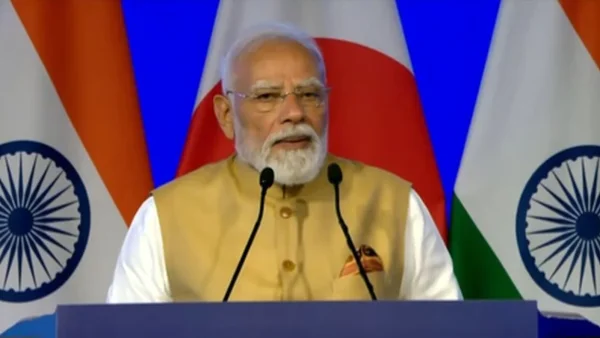
You could call it a twin-state blitz. The prime minister is set to put in motion a series of moves that will see a Modified UDAN come to life, Rs 1.06 lakh crore worth of work in Rajasthan, and a fresh OSAT for semiconductors in Gujarat. There are real economic and competitive chips on the table here, not to mention the push for chip packaging and connectivity.
Why this twin-state push matters
Put simply, the announcements tie up three loose ends: getting people and freight where they need to be, building more in India, and running on cleaner power. If you look at the numbers, you’ll see projects in everything from aviation and petrochemicals to rail, roads, solar and microchips – a clear sign of an infrastructure and supply-chain plan in full swing.
Then there is the matter of states vying for investment. Rajasthan is putting down some industrial and logistics roots, and Gujarat is making its case in the semiconductor space. In the end, it’s meant to make India less of an importer and more of a player in the industries of tomorrow.
Aviation rethink under Modified UDAN
The government has put some heft behind its regional aviation plans. The Modified UDAN, for one, comes with a 10-year outlay of Rs 28,840 crore, offering the kind of operating support that can make a new route work.
Jodhpur is where it starts. They’ve put in a new terminal for Rs 480 crore; it’s over 23,000 square metres and good for 2 million a year. You’ll find arches and jharokhas alongside the kind of water and energy-saving tech that should put them in line for a 5-Star GRIHA.
What the scheme is after when it comes to the network:
– An outlay of Rs 28,840 crore to be spread over a decade
– 100 aerodromes made from unserved strips, at a cost of over Rs 12,000 crore
– Some Rs 2,500 crore plus for O and M at the airports
– 200 helipads of a modern make in various parts of the country
– VGF for the airlines, in excess of Rs 10,000 crore
– Made-in-India aircraft like the HAL Dhruv and Dornier
There is a method to it. By backing indigenous options and Viability Gap Funding, they want to open up to the hinterlands and keep the books in order for the carriers. It’s a way to deal with both access and use, which is something of a departure from the stop-start approach of the past.
Rajasthan’s industrial and logistics build-out
It all hinges on Balotra for the state’s next phase of growth.
In Pachpadra, the Prime Minister is set to put the finishing touches on India’s inaugural greenfield integrated refinery and petrochemical complex. A 9 MMTPA plant and a joint venture between HPCL and the Rajasthan government, it has seen an outlay of some Rs 79,450 crore. On top of that, there is 2.4 MMTPA in petrochemical capacity and plans for a new park for petrochemicals and plastics.
But the day is about more than just infrastructure; there will be some job creation as well. Some 54,000 fresh recruits from various state departments in Rajasthan will be handed their appointment letters, in a way of tying capital expenditure to putting food on the table.
Metro, rail and roads: network effects
We are also seeing a dual focus on moving people and goods. The second phase of the Jaipur Metro, at a price tag of over Rs 13,000 crore, is a 41-km north-south run with 36 stops. It will link up key points like the airport, SMS Hospital and the Vishwakarma Industrial Area.
Then there is the matter of supply chain redundancy. We have the Churu-Sadulpur and Churu-Ratangarh rail line doubling, which has come in at roughly Rs 900 crore, and the four-laning of the Jodhpur Ring Road (NH-125A) for a little under Rs 740 crore, all to make urban logistics a bit swifter.
Renewable power and grid capacity
Rajasthan is upping its game in the renewables space. You can expect the inauguration of two major projects: the 1,000 MW Bikaner Solar Energy Project by SJVN, with an investment of around Rs 5,500 crore, and a 300 MW plant in Karnisar from NHPC.
To get that energy where it needs to go, a new transmission line will be opened. At the same time, we will be laying the foundation for a 530-km system to handle what comes out of the state’s Renewable Energy Zone down the line.
Semiconductor packaging milestone in Sanand
Over in Gujarat, the state’s foray into semiconductors is now a going concern. The CG Semi OSAT in Sanand, backed by more than Rs 7,500 crore, is opening for business as one of the first of its kind in the country under the India Semiconductor Mission.
When it is up and running, you can count on 5 billion chips a year. It will be handling everything from wafer sorting to testing and logistics for the likes of 5G, telecom and the auto industry.
This is a way for India to get in on the value of chip packaging. Put this with some home-grown aviation and the manufacturing in Rajasthan, and you have a plan built on scale and resilience.
The hard part is the follow-through. Whether it is the UDAN routes, the metro or the Sanand plant, the work has to be done. For the states and industries vying for growth and employment, the clock is ticking.