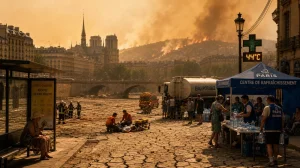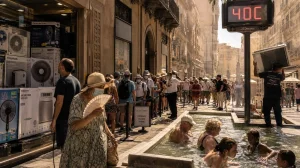
What was a heat wave has become an emergency of continental proportions. Italy has every major city on red alert and in Austria they are logging 41.2 degrees Celsius. The strain is being felt in tourism and transport as well as energy; one need only look at the power cuts or stalled barges. Health warnings are now in effect for millions of residents and visitors alike.
There is no time to lose. In Budapest the overnight temperature did not fall below 28 degrees Celsius, leaving the vulnerable with no respite. With record figures pushing systems to the breaking point, grid operators, shippers and firefighters are having to make quick adjustments.
As the world’s fastest-warming continent, Europe has been through weeks of it already, from the wildfires in France and Spain to the record heat. Now the focus has turned east and the pressure is mounting on public health, industry and rivers from the Balkans to Italy.
Italy issues nationwide red alert
On Thursday the Italian Health Ministry raised the alarm to the highest level for all 27 cities in its network, from Trieste to Palermo. It is the first occasion this year the system has been so uniformly red. According to officials, the danger is to the whole population, not just the elderly or those with pre-existing conditions.
With some areas seeing 40 degrees Celsius, the advice from authorities is to keep out of the sun at the worst of the day, drink up and remain indoors if one can. This applies to the tourists who are here in force for the summer as much as to locals.
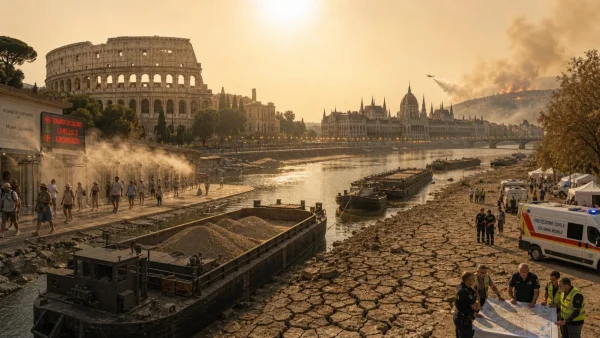
Popular tourist spots have made changes for the safety of the crowds. The Colosseum and Pantheon will be open later into the evening and mist fans have been put in at the Colosseum to provide some relief. Extra medical stations are on hand for any heat emergencies.
Other local steps have been taken to offer a measure of protection. Genoa is allowing anyone over 65 into museums and libraries free of charge during the peak heat. Rome has put off the end of its free air-conditioned cinema screenings by 10 days, until 14th August. And in Piedmont a state of emergency has been called due to the threat of drought and fire.
Energy and transport face mounting strain
The Danube has run so low that Hungary’s sole nuclear plant, which needs the water to cool, has had to scale back output to 10 per cent of what is normal. The government has had to call in emergency conservation to relieve the power system.
Between 5 pm and 10 pm in particular, big industrial users and households are being asked to cut back on electricity. Freight trains are not running then. Companies like Mol, Gedeon Richter, Suzuki, Mercedes-Benz, Audi and BMW have all reined in their use of power. Even the parliamentary sessions have been called off to conserve energy, and the decorative lights on Budapest’s landmarks have been put out.
In Romania they are readying four rock-filled barges to be sunk in the Danube in order to direct water to the country’s one operational reactor and buy a few more days. Down in Bucharest they have dimmed the street lights by a third and turned off the night-time illumination on landmarks to reduce the load.
Germany is dealing with the same problem on the Rhine and elsewhere; with water levels in decline, vessels are making do with partial loads and the cost of freight is going up. In a meeting with the groups most at risk, Transport Minister Steffen Bilger sounded a note of caution over the formidable obstacles facing inland shipping and the logistics and industrial sectors. The BUND environmental organisation has been calling for action to stem water withdrawals in times of drought and to hold more of it in the landscape.
The problems on the Rhine do not stop at the border. As a key thoroughfare for oil, coal, minerals and grain, the river is under pressure. Every centimetre of water lost means cargo is put on the shelf, prices go up and logistics chains throughout Central Europe are made all the more difficult to manage.
Record heat and deepening drought in Austria
GeoSphere Austria reports that the country has seen its highest temperature ever: 41.2 degrees Celsius was registered on Wednesday at Bad Deutsch-Altenburg, not far from Slovakia. That is the most intense reading in the region. Such heat is made worse by a lack of rain. Between 1 January and 30 June, precipitation was 27 per cent under the national long-term average, with some in the east getting no more than half of what is usual. Alexander Orlik, a climatologist, notes that in parts of the country one would have to go back to 1885 to find conditions this dry.
Wildfire danger from France to the Balkans
Firefighters have kept a watchful eye in the Var region of southeastern France where, after a major fire put down in recent days, there is still the possibility of a flare-up. It has already consumed over 60 square kilometres since 20 July, making it the largest in decades. With the ground so dry and the winds strong, the danger remains acute.
Across the Balkans, where temperatures have been close to 40, crews in Serbia have had to contend with rough terrain in putting out blazes near Kraljevo and to the west of Belgrade. In Dubrovnik, tourists on the Adriatic have been making for the shade and staying off the beaches when the heat is at its worst. Some in Bosnia have found respite in the Vjetrenica cave, a UNESCO site whose 11 degree climate is a welcome change, even if access is restricted to preserve an ecosystem that has fared better than the world above.
What authorities are doing now
To protect people and infrastructure, governments and agencies are implementing a number of short-term measures. These include:
– Italy has issued a red alert for every one of its 27 monitored cities.
– Hungary has reduced nuclear production to roughly 10 per cent and put a ban on freight trains from 5 to 10 pm. Decorative lights at Budapest’s landmarks have also been turned off.
– In Germany, officials have called for talks as the Rhine recedes.
– France has left its teams in place on the Var wildfire.
– Romania is readying four barges to move Danube water.
For those in the affected areas, the message from authorities is to drink up, remain inside and keep out of the sun during the day.
The impact is being felt in cascading ways. Power plants and cargo are hampered by low river levels, putting a strain on grids and supply lines. Emergency services are stretched by fires and hospitals and tourist centres by the heat. Scientists say these events will only become more common and severe with a warming climate. How Europe’s summer is handled from here will be a test of whether cities and industry can adapt with the sort of action that record temperatures require, rather than carrying on as before.