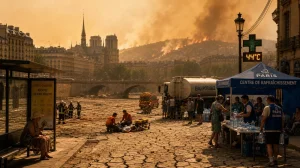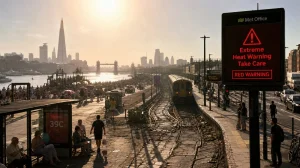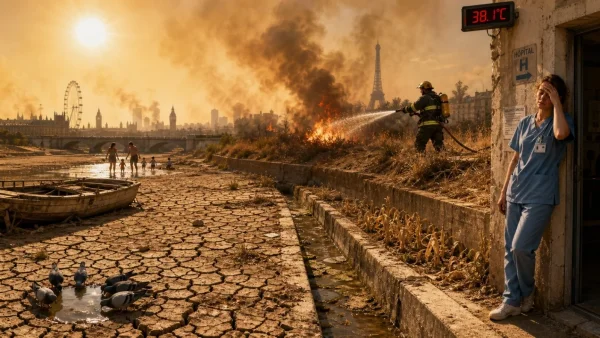
On Thursday the sweltering continued as a new heat wave moved through western Europe, driving UK figures to 38.1C, the hottest of the year to date. This fifth heatwave has put fragile services on notice and deepened the threat from fire and drought, leaving officials with little choice but to contemplate hard measures for the protection of land, health and water.
France’s national weather service has put down readings near 41 C in some parts of the country and 38 C in Paris. After an extraordinary summer, forecasters say the worst of it will move east on Friday and let up over the weekend for a short while.
What changed today
West London saw 38.1 degrees Celsius (100.6 F), the Met Office reported, edging out the 38 C (100.4 F) high from June 28. Still, it did not best the 38.5 C (101.3 F) mark put in place in August 2003.
It is a cross-border crisis. In France the national weather service noted a climb in temperature from the Rhone valley to Aquitaine. Meanwhile Britain has put down two days at 38 C, on par with 2022, and a record four in 2026 of 36 C or more.
Counting this as the fifth of the year, with the first in May, the pace and the peaks are doing considerable damage to the ecosystems and public services that were built to a cooler standard.
Why it matters: systems under heat stress
For all intents and purposes, the two countries are not well set up for this kind of sustained heat; one does not find air conditioning anywhere but in an office or shop. That puts a strain on hospitals and emergency response where a lack of cooling is an immediate hazard.
In Britain the Royal College of Nursing reports nurses have been felled by heat exhaustion in hospital wards, many in old buildings without proper cooling. ‘When you have staff collapsing or being admitted to the very hospital they work in because it cannot cope with the heat, it is clear how badly they are being failed,’ Nicola Ranger said.
Daily life and coping responses
With the mercury rising, there was a rush to the beaches and outdoor pools. In Bordeaux, families made for the city’s ‘water mirror’ to fill bottles and splash their faces, at times with birds in tow.
Indoors the relief is scant. Most homes and workplaces provide no shield from the warmth, which makes for complicated safety and routine.
Water is running short
Rivers are being drained and crops shrivel as drought takes hold in both nations. Governments and others are having to put in place short- and long-term fixes to mitigate the effects of human-induced climate change on household and agricultural water use.
Southern Water, responsible for the south of England, has put in an application for a drought order, something of a rarity.
Under the proposed ban, businesses would be prohibited from nonessential water use such as car washing or putting water in nondomestic pools. The measure is justified by an ‘exceptional’ dearth of rain that has put supplies on the Isle of Wight and in Hampshire at risk.
It is for Environment Secretary Angela Eagle to make the call on the application. Should she approve it, it will mark the first time such a prohibition has been put in place since May 2006 and would be a sign of things to come; if the rain does not come and the heat persists, expect curbs to be further tightened.
What restrictions and responses are on the table
Those in official and response roles have pointed to a number of immediate steps and possible curbs to mitigate the risk:
– A drought order from Southern Water to put an end to nonessential business water use.
– Prime Minister Andy Burnham is mulling over a ban on disposable barbecues.
– UK crews have been called in to deal with a wildfire in the New Forest on ground that is tinder-dry.
– In France, firefighters have put forward a warning of strike action unless they see more staff and resources made available.
Wildfire threat escalates
The authorities are on high alert given the parched state of the land and the absence of any significant rainfall. Britain has taken on a sandy brown hue in place of its customary green. This week alone, firefighters in southern England have had to work hard to put out a fire in the New Forest, with wind and dry conditions making containment a problem.
According to the National Fire Chiefs Council, there have been 1,017 wildfires in England and Wales this year, equal to the record set last year. It is a reminder, even without the worst of the continental infernos, that the UK has to come to terms with a new reality of drier, hotter summers.
The danger zone has expanded considerably in France. Not only have fresh fires appeared in Brittany and the Pas-de-Calais in the north, well away from the arid south, but last month a historic conflagration near Bordeaux consumed forests and forced some 250,000 from their homes. After a trying summer, French firefighters are threatening to walk out for more resources to handle the extreme weather. The warning speaks to the chasm between what they can do and the scale of the emergencies now playing out in several regions.
Local leaders in the UK are also looking to act. “I do believe we need to get the message out loud and clear,” said PM Andy Burnham. “People should not be using those barbecues outside at this moment in time.” He indicated he would give consideration to an outright ban on the disposables in view of the wildfire risk.
What comes next
The Met Office has noted that it would take nothing more than average conditions for the remainder of August to surpass last year’s record for the hottest year, a sobering thought for policymakers. Forecasters put the brunt of the heat moving east on Friday with a receding over the weekend.
But even when the temperature eases for a while the strain will be there. Reservoirs are under pressure, soils are still dry and health services are left to cope in buildings not built for these modern extremes. Without an upgrade to the system, the effects will only mount.
For the time being the advice to residents is straightforward: hold back on water, steer clear of fire hazards like a disposable barbecue and look after your more vulnerable neighbours. As for the authorities, the task is to safeguard supplies and stand by the front line before the next surge comes.