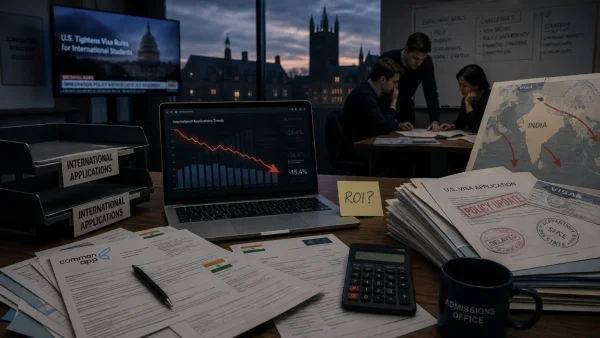
For campuses that have counted on India to fuel their growth, the sharp downturn in applications is forcing a change of plan. Figures from the Common App put the decline in undergraduate applications from India at 15% for the 2025-26 cycle, despite an uptick in overall volumes for 2026-27. The policy environment has become the new arena for competition.
What the numbers show
The Common App is reporting its most pronounced pullback from abroad to date. International applications put in through March 1 were down 10%, an end to years of steady gains.
You will find the steepest country-level drops in India’s 15% fall. Asia as a whole was down 11% on the back of fewer Indian candidates, while Africa saw a 17% slide, Ghana among them with a 34% decrease.
A summary of the key figures:
– A 15% year over year fall in India applications
– 10% drop in international applications by March 1
– 11% decline in Asia, with India in the lead
– 17% in Africa (Ghana off by 34%)
Policy squeeze reshapes demand
At the heart of the matter is the hardening of US immigration and visa regulations. In July the Trump administration did away with the ‘duration of status’ rule and put fixed end dates in place for student and exchange visitor visas.
That means a four-year cap for students, with any extension of stay necessitating paperwork with US Citizenship and Immigration Services. The 60-day grace period to leave or change schools has been halved to 30 days.
An X account for the White House has made the connection between the slump in applications and these stricter policies. There are also reports from within the US that the administration is mulling a $100,000 charge for foreign graduates who want Optional Practical Training.
Uneven impact across campuses
Exposure varies from one institution to the next. Jamie Beaton of Crimson Education would argue that those unable to demonstrate a solid return on investment will be under the most pressure to fill seats. Harvard, Stanford, MIT and Duke are in a different position and should prove more resilient.
Signals beyond classrooms
One sees the same drag from policy outside the admissions office. US Customs and Border Protection tallied 20,614 encounters with Indian migrants in the first five months of fiscal 2026, versus 67,212 in the same stretch of 2023, a 69% reduction.
The southwestern border tells a similar story: encounters with Indians were down nearly 99% to 417 by May of fiscal 2026 from 30,109 in 2023. To the north, authorities put the number at 2,250, roughly 91% less than in fiscal 2024.
Gilbert Guerra at the Niskanen Center puts much of the irregular migration decline down to the tougher stance and the fact that the cost and risk are not worth it when the chances of asylum look slim.
How universities are reading the trend
The message from recruitment is clear. IIE’s Spring 2026 report shows only 39% of US schools have seen stable or better application numbers from India for the year ahead.
It is a high-stakes situation. Per the Open Doors 2025 report cited by IIE, Indian students made up 31% of the international population in the US in 2024/25. A prolonged slide would have real implications for the finances and viability of programmes.
What to watch next
As the international market cools, it will come down to perceived value and policy. How a university handles visa support and career outcomes will be the measure of its worth. The next admissions cycle could be shaped by the implementation of the new rules and whether the administration goes ahead with extra OPT fees.