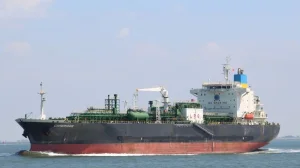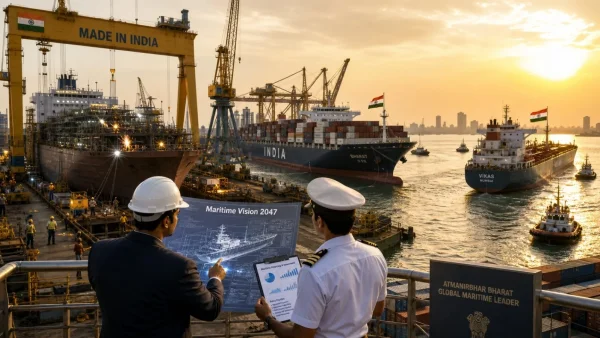
It is an effort to stop what New Delhi sees as a costly drain on the trade balance. By adding 100 Indian-flagged vessels in half a decade, the country hopes to hold on to some of the $75 billion it hands over to foreign lines each year for the transport of essential cargo.
In flagging this at the National Shipping Board’s Sagar Samvad, the plan marks a departure from dependence on overseas tonnage in favour of putting domestic control over the flow of crude, gas, coal and urea. It is a strategy to bring a greater share of India’s freight wallet home.
Why this pivot matters
The shipping bill is no small matter. Shantanu Thakur, the Minister of State, was blunt in his assessment: ‘We must command our own waterline.’ He characterised the $75 billion outgo not as a lack of capability but a problem of competitiveness and demand-partnership.
There is urgency in that because of the exposure to global freight and foreign capacity. Having more ships under Indian ownership would insulate the economy from supply shocks and keep value where it belongs.
The competitive gap India must close
Price is the obstacle for shipowners. Representatives in the industry put the cost of operating an Indian flag at 16-20% above a foreign one. And when it comes to winning cargo under the Right of First Refusal regime, locals are put under pressure to meet those foreign rates.
Executives at the event were quick to point to the headwinds of taxes and financing that eat into margins and put the brakes on fleet expansion. In the absence of relief, owners find it hard to make the necessary investments.
According to industry voices, the cost disadvantage comes down to these factors:
– Taxes on ship imports and maintenance services
– Tax on seafarers wages
– Freight income taxation
– The higher cost of domestic financing
Policy architecture taking shape
To redress the balance in favour of Indian flags, the National Shipping Board has put forward a five-pillar roadmap. Union Minister Sarbananda Sonowal went so far as to call it the architecture of a nation that has decided to take ownership of its trade, rather than mere incentives.
The NSB has proposed the following to get ahead of the competition:
– Fiscal reforms to narrow costs
– Cargo support for Indian tonnage
– Competitive financing options
– A streamlining of regulations
– Better ease of doing business
Getting access to capital that is both long-tenor and low-cost will be pivotal. One cannot order ships at scale without the kind of funding international players have at their disposal.
Capacity buildout goes beyond ships
This push for fleet growth is in keeping with the Maritime Amrit Kaal Vision 2047 and the 2030 vision. On a broader logistics front, the government is looking to quadruple port capacity to 10,000 million tonnes a year by 2047.
A home-grown ecosystem is also in the works. The Rs 10,000 crore Container Manufacturing Assistance Scheme has already seen Maersk place orders for containers made in India, the government says. And as world demand climbs, Labour Minister Mansukh Mandaviya has pointed to the opportunity presented by India’s sizeable seafarer pool.
Where the fleet stands today
The numbers show a registered fleet of 1,544 vessels – 1,052 coastal and 492 overseas. With 92 new entries to the registry in FY26, gross tonnage topped 14.2 million in March, an increase of 1.584 million GT.
Sonowal has suggested another 62 vessels could be added in FY27 for a further 2.85 million GT in capacity. Provided the reforms free up investment, the 100-ship target in five years is within reach.
What success would change
A successful five-pillar plan would allow Indian shipowners to put up a better fight for national cargo and wean themselves off volatile foreign markets. For ports and crews alike, it would tie manufacturing, talent and capacity into a cohesive maritime loop.
The stakes are evident. Reform is needed to avoid the RoFR squeeze and the 16-20% uphill battle that faces Indian owners. With it, the path is clearer to become one of the top five ship-owning nations in the world by 2047.