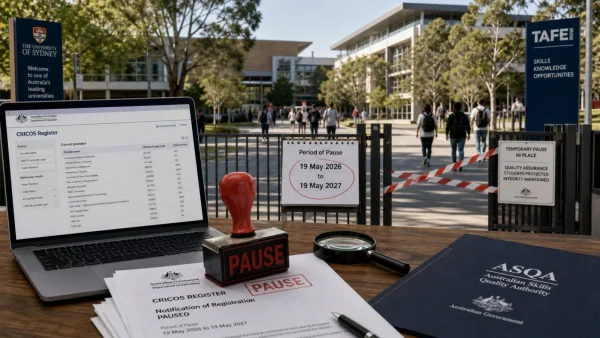
What it means for international students is that your options might be a bit more limited for a while. But don’t worry, anything already on the books will go ahead as planned. Newcomers to the market won’t be able to get in the door until May 19, 2027, and even current providers can’t put most new courses on the table.
Who is exempt and what keeps moving
There are a few workarounds, of course. If you’re an approved institution, you can still open up new teaching sites for what you have or swap out an old program on the National VET Register. Any application in the system before the 19th of May will be handled by the Australian Skills Quality Authority in the usual way.
To understand the operational window, note these points:
– Effective from May 19, 2026 to May 19, 2027
– Applies to new CRICOS registrations and most new courses
– Covers VET and ELICOS applications
– Public providers are exempt
– Valid applications before May 19, 2026 proceed
Key dates and scope
The whole of Vocational Education and Training and English language courses for overseas students are in scope. And CRICOS, the official list of who is allowed to teach visa holders, is still the one making the call on enrolments.
Why the pause is happening
According to the government, regulators have to put in the time to deal with some integrity issues that have been called out in the system. We’re talking about sub-par quality and some less than genuine operators, especially in the VET side of things. You only have to look at the 2023 Nixon and Migration reviews to see where the red flags were – visa misuse and holes in the process. With over 900 VET providers on CRICOS and a 35 per cent jump in those taking on international students since 2021, the numbers speak for themselves.
Julian Hill, the Assistant Minister for International Education, made the call on May 18 and put it down to a need for a 'quality reset‘.
‘Australia is here for the real international students who want a top-tier education, and we are set on making this sector more robust,’ Hill said. ‘We didn’t make the choice to hold off on new VET or English language registrations without some thought. It gives us room to sort out the concerns we have with some of the new players and the oversaturation we’re seeing.’
Impact on campuses and classrooms
Public side of the fence is a different story. The freeze doesn’t apply to them. Government schools, TAFEs and Table A universities can keep their applications coming in. (For those not in the know, TAFEs are the publicly run vocational arms of the system.)
ASQA is the one in the driver’s seat for all of this. They are the ones who will be looking under the hood at provider compliance and course approvals. The legal backing for the suspension is in the 2025 Education Legislation Amendment Act, which has given them the power to step in when they spot an integrity risk.
So the word to institutions is to focus on what you do well instead of running to expand. ASQA is going to be watching the market closely during this lull. For the student, it’s not so much about having fewer doors to walk through as it is about a more predictable experience.
‘If we are to remain the place of choice for students from around the world, we have to be unrelenting on quality and the student experience,’ Hill was at pains to point out.
What comes next
In the end, the plan is to be rigorous with any applications on the table and put up a wall to the poor quality ones. You can expect a calmer market for the next year while everyone gets in line with the rules. When the 12 months are up, the authorities will have a better sense of how the sector should move forward.