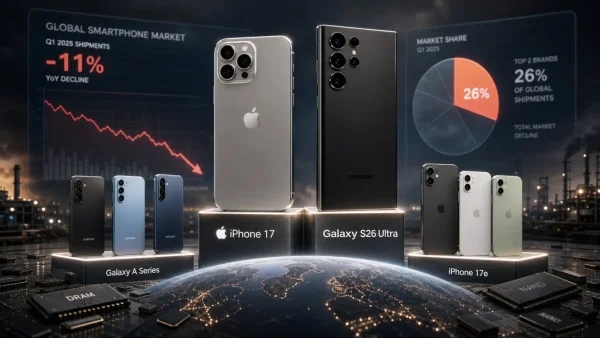
According to Counterpoint Research, Apple and Samsung have made their hold on the global leaderboard firmer in Q2 2026. The top devices from each put in a combined 26% of worldwide unit sales. The firm puts that surge down to the momentum behind the likes of the iPhone 17 and the Galaxy S26 Ultra, notwithstanding an 11% year-on-year fall in the market.
At 26%, it is the best share for a June quarter, an increase of two points on last year. Manufacturers are being forced by tight supply and climbing memory costs to focus their efforts on fewer but more consequential models, says Counterpoint.
Why the June quarter looked different
Portfolios have been reshaped by a tightening on memory. Global smartphone shipments were at their lowest for a second quarter since 2013, with shortages in DRAM and NAND driving up component prices and taking the heaviest toll on lower-priced hardware.
Consequently, there has been a preference for key volume drivers and premium options rather than an expansive lineup. The top 10 is an Apple and Samsung affair, a sign of how share is consolidating around a handful of blockbusters:
– 26% of global unit sales went to the top 10 models
– A year-on-year rise of two percentage points in share
– An 11% contraction in the market over the same period
Apple leans into premium demand
Karn Chauhan, a senior analyst at Counterpoint, reports that Apple saw a 5% uplift in unit sales for the quarter. There was strength in India, Japan and the Middle East and Africa, while South Korea saw figures almost double.
With 6% of the world’s unit sales, the iPhone 17 was the clear best-seller. Its Pro and Pro Max versions followed in the next two spots. Chauhan would have you believe this is due to trade-ins and financing, as well as the base model closing the gap with its Pro counterparts.
Then there is the iPhone 17e, which also made the top 10. Counterpoint finds that keeping the price the same as the old model while adding MagSafe and more internal storage has kept up demand, not least in the US and Japan where carriers have been supportive with promotions.
Samsung doubles down on flagships, keeps A-series vital
For Android, the Galaxy S26 Ultra was the one to beat in Q2. In fact, it is the first ultra-premium Android to head the sales charts in a June quarter. It did better than what came before it and was responsible for over half the series’ sales.
Harshit Rastogi of Counterpoint notes that the later release of the S26 series put more sales in the second quarter. He also sees the privacy display and AI features as differentiators that Samsung has been quick to promote and back with resources.
The Galaxy A line remains a fixture in the top ranks for its value and availability. Every A model in the top 10 comes with at least six years of software support, which suits the longer replacement cycle of the mass market.
Market concentration and competitive map
With five apiece in the global top 10, Apple and Samsung are proof of a market coalescing around the big names. The data from Counterpoint shows consumers are moving up the price ladder as costs go up, so the premium mix is stronger.
Samsung’s new flagship is now its best seller, having climbed five spots on the rankings. Yet mid-range offerings with long-term software support are still to be found among the top-sellers, offering a balance of longevity and value.
What to watch next
One could say the market is becoming more reliant on a small set of high-volume products as makers deal with a weak demand environment and the ongoing memory shortage. This works in favour of those who can drive upgrades through financing and keep their flagships in demand.
It is an uphill battle for anyone not part of the Apple-Samsung duopoly. To get into a top 10 run by these two will require a more aggressive approach to the market and sharper differentiation, as well as the kind of support and promotion that can make or break a product.