Today’s risk appetite was jolted by a fresh bout of AI optimism. With Nvidia putting forward a compelling case for its sales through 2028, both Nasdaq futures and stocks across Asia were in the green. It was enough to re-energise the AI trade and give US tech benchmarks a firmer opening, not to mention lift South Korea’s Kospi.
AI momentum resets market tone
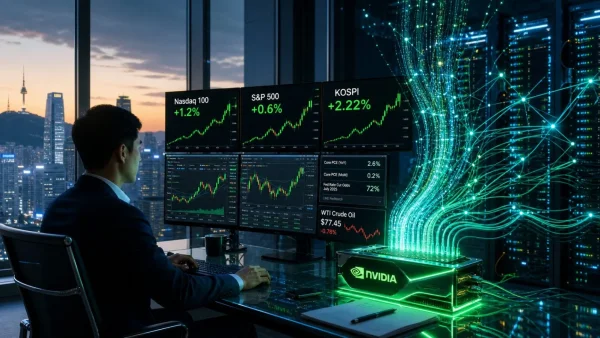
In extended trading on the US side, Nvidia shares were up 4.2% on the back of a signal for strong 2028 growth. That kind of message does much to restore faith in the staying power of AI infrastructure outlays. Marvell Technology Inc. and Sandisk Corp. made after-hours gains too as investors made their way back into the AI supply chain.
The Nasdaq 100 futures were 1.2% higher and S&P 500 contracts put on 0.6%, a clear indication of a tech-led start. It seems investors are once more making AI earnings visibility a priority following a period of choppiness where every bit of data or revision in guidance would see leadership change hands.
Why Nvidia’s guidance matters now
On the earnings call, Chief Financial Officer Colette Kress put the number at roughly 70% revenue growth for fiscal 2028. You will recall analysts were calling for something in the 45% range; the discrepancy is a measure of how attuned the market is to any capital-expenditure signals from the AI space.
That more favourable revenue trajectory supports the idea that demand for data centres and networking is unbroken. A strategist at Nomura Securities would tell you the market has already taken to the outlook before the analysts have a chance to revise their models, a constructive turn of sentiment on AI if ever there was one.
Asia takes the cue; currencies steady
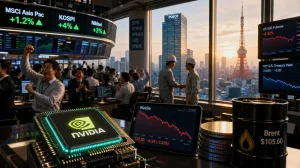
The MSCI Asia Pacific index was 0.6% in the black, but the Kospi was the story of the day with a 2.22% rise, a figure often taken as a read on AI-linked activity. Japan’s Nikkei 225 put in 0.41% and the Topix 0.32%. The Hang Seng futures were an exception to the risk-on mood, slipping 0.2%.
As for the currency markets, there was little to report. The yen was holding at 159.19 to the dollar and the offshore yuan near 6.7210. The lack of an FX reaction points to equity-specific catalysts behind Thursday’s rebound in risk assets rather than any broad macro shift.
Rates caution tempers the rally
Bond traders have been wary, upping the odds of a Fed move this year given the latest US inflation print. Short-dated Treasuries have underperformed and the dollar has firmed, with money markets leaving no room for doubt that a hike is priced in by December.
The core PCE index was up 0.2% for the month and 3.3% over the year. The broader measure came in at 3.7% year-on-year, while real consumer spending was flat after the May and June run-up. Those are the sorts of readings that make for an uncertain road to easier policy.
Commodities reflect geopolitics and growth mix
Brent crude has given up ground to around $87.20 a barrel as the market tries to balance diplomatic headway in the Middle East with the Russia-Ukraine situation. West Texas Intermediate was down 0.7% to $81.67, a sign oil traders are still watching geopolitics and the resilience of demand.
You could argue the softer oil and a stronger dollar are in step with the cautious rates environment. But equity markets have chosen to look past it, with the durability of AI earnings taking centre stage for the time being.
Key takeaways for investors
A few things stand out from today:
– Nvidia’s 2028 numbers put the capex strength in perspective
– 1.2% gain in Nasdaq 100 futures, 0.6% for the S&P 500
– The Kospi led the way in Asia with a 2.22% jump
– Core PCE figures: 0.2% m/m and 3.3% y/y
– An increase from the Fed by December is fully in the price
What could come next
Now the market will be looking to see if AI-related earnings can keep ahead of rate expectations. Any word from the suppliers in the chip and data centre space will be examined to confirm that 2028 plans are still on track.
Nvidia’s ambitions have re-centred the bull case for the moment. Should other companies put forward similar commentary, the AI trade may well continue to lead in the US and Asia, even with the pressure policymakers are applying at the front end of the curve.