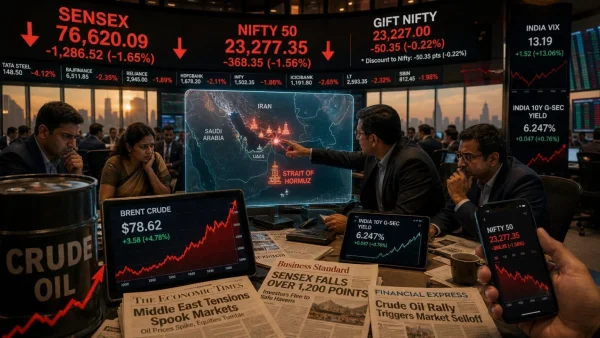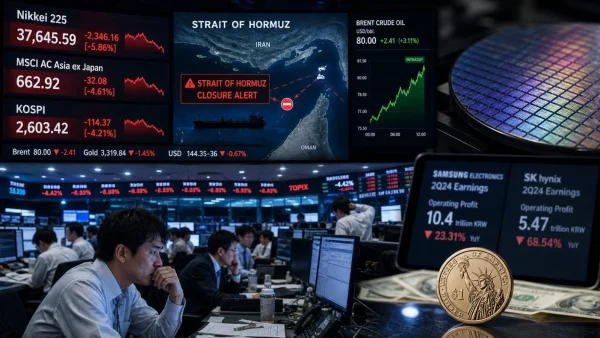
It was not an easy start for the week in Asia. Oil’s spike and the return of some inflation jitters left stocks on the back foot in the wake of Iran’s assertion over the strait. The reaction was enough to send capital to the dollar and rework the odds of a further rate increase in the US, putting a dent in what little risk appetite there was right as we head into earnings season.
Oil shock resets Asia risk appetite
Brent was up 3.3% in the early going to $78.50, with US crude 3.4% higher at $73.83. Then came word from President Donald Trump that the US would once again block Iranian shipping and make an example of other cargo in the waterway, and Brent was at $80.
Washington puts the number of vessels it has seen through the strait in the last day at 20 or so, but you don’t see much of that on the tracking sites. In any case, Tehran’s story has put a fine edge on uncertainty in the energy space and stoked global inflation risks.
The region’s equities have been cautious about it. The Nikkei in Japan is down 1.0%, the MSCI Asia-Pacific ex-Japan has given up 0.2%, and South Korea is 0.4% off after a near 8% fall in the prior week. On Wall Street, S&P 500 and Nasdaq 100 futures are pointing in the same direction, down 0.3% and 0.5% respectively.
Fed hike bets firm up as dollar steadies
All this has put the question of US policy back on the table. Fed fund futures have moved 2 ticks, which works out to 34 basis points of tightening by the time the year is out. Money markets are now showing roughly 50-50 on a July move, in the aftermath of Governor Christopher Waller’s comments that the numbers may call for a rate rise to put a lid on prices.
Yields have inched up in response. The 10-year is at 4.59%, and the greenback has put in a bit of a show. The index is holding at 101.12, the euro has softened to $1.1403, and the yen has been pushed to 161.96, erasing some of the ground lost on Friday.
Not the most convenient moment for the Fed. Chair Kevin Warsh is due before Congress later in the week while the market is making sense of the June print. Headline CPI might be a touch lower than 4.2% thanks to some earlier ebb in fuel costs, but with oil where it is, that could be short-lived.
Chip trade becomes bellwether for global sentiment
When it comes to gauging the mood of the market, semiconductors are still the tell. South Korea has become something of a proxy for the chip cycle. The sell-off of late has had to do with some of the more aggressive wagers on AI and memory prices coming under fire.
You can see it in the case of SK Hynix. Its shares on the Nasdaq were up nearly 14% on their first day of trading in the US on Friday. A few days later, a rout in Seoul made its way across the pond and the ADRs were in free fall, a sign that some are worried the run has gone too far.
There is a lot of scrutiny on how well the AI trade can hold up with tensions running high and the cost of money where it is. It makes for some hard choices in the portfolio, even if a few strategists will still put their weight behind tech and the cyclicals in Japan, for instance, on the strength of the valuations and what they expect from the books.
Earnings season tests AI spending narrative
Now the calendar is the thing. We have the big US banks to report starting Tuesday, and Netflix and GE as well.
The numbers put together by analysts point to a 23% rise in S&P 500 profits for the second quarter, which would be one of the more robust showings you’d see outside of a post-recession recovery.
Then there is what’s happening under the surface of the megacap tech stories. Morgan Stanley strategists are of the view that US stocks in general have some upside left in their earnings. It is a nice change of pace after the S&P 500’s recent run was put on hold by an oil spike and a softening in chip stocks, all of which has brought up the issue of how much longer the AI-fueled rally can hold.
Spending at the corporate level is no less ambitious. Meta has put another $40 billion on the table for its Louisiana data centre, bringing total outlays at the facility to well over $250 billion as it puts more AI computing in place. Over in Europe, Intel is forking out 5 billion ($5.7 billion) to put more capacity into its Irish plant and make up some ground in the AI space.
You can see the same kind of conviction on the supply side. TSMC put out a 36% increase in quarterly sales, in line with the high bar set for them, and it does little to dent the belief that demand for AI compute is here to stay. There is a certain dissonance between that kind of strength from upstream suppliers and the whipsaw we have seen in the equities of some of the chipmakers.
Currencies, commodities, and the policy path
There is a late-cycle feel to the cross-asset landscape. With the dollar and yields on the up, non-interest-bearing assets have had to take a hit. Gold was down 1.1% to $4,076 an ounce as some in the market made room for cash and shorter-dated options, rethinking their inflation hedges in light of the move in oil.
FX has been no stranger to this, particularly in Europe where the euro’s small slide to $1.1403 is a reflection of worries that if crude stays up, it will put a crimp in real incomes and make for some hard calls on policy. In Japan, the dollar-yen has firmed up on the back of some talk of having the $1.8 trillion GPIF repatriate a bit of capital.
Some have pointed to the possibility of the fund moving from its 50/50 domestic-to-offshore ratio to something more like the 60/40 it was before the pandemic. But those who have been looking at it say any repositioning will be a slow process; the plan for FY26 is already set, so don’t expect a sudden rush of yen buying.
On the policy front, things are inextricably linked with geopolitics now. The White House has said it will get to work on its Hormuz plan right away, but has been quiet on the specifics or how it will be done with allies. And the US and Iran have been at it again through Monday, keeping the risk of tit-for-tat in the energy sector alive.
What to watch next
For the time being, the market is fixated on a few things:
– Where CPI and PPI are headed in relation to the oil bounce
– What we hear from the likes of banks, Netflix and GE
– Warsh’s testimony and whether the Fed changes its tune
The calculus for a trader is straightforward. Should oil keep climbing and the odds of a July hike go up, the dollar may have more to run and equities will be anything but smooth. A milder inflation number and a steady hand from the Fed, on the other hand, would make for an easier path for earnings.
South Korea is still a good barometer for the rest of the world. If its chip-heavy index takes another hit, it could send ripples, particularly with some leveraged bets still in the process of being unwound. That is in addition to the news coming out of the US on the situation in the Hormuz and the state of tanker traffic.
It all comes down to whether the jitters in energy are enough to force a repricing of the risk curve. With Brent in the $80s and US yields above 4.59%, even a 23% profit jump might not be enough to keep equity multiples from being tested. In such a case, it is the balance sheet and pricing power that will separate the leaders.
Coming into the week, investors are in a defensive mood but not closed off to new ideas. The AI story is far from over – witness the SK Hynix debut, TSMC’s numbers, or the billions being put to work by Intel and Meta. The task at hand is to weather the oil shock without throwing a wrench in the works of that investment cycle.