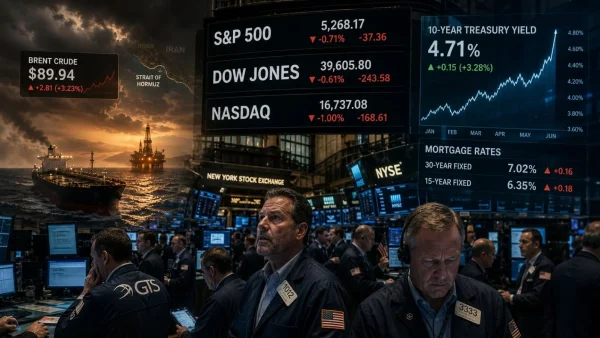
Monday was a day Wall Street gave up ground. Oil prices were up and the S&P 500 was down as Brent crude futures put in a gain of over 2%, putting energy back in vogue and making life harder for rate-sensitive and consumer plays. Investors were also preparing for retail numbers that may well reset their view of the US consumer.
Oil spike reshapes sector leadership
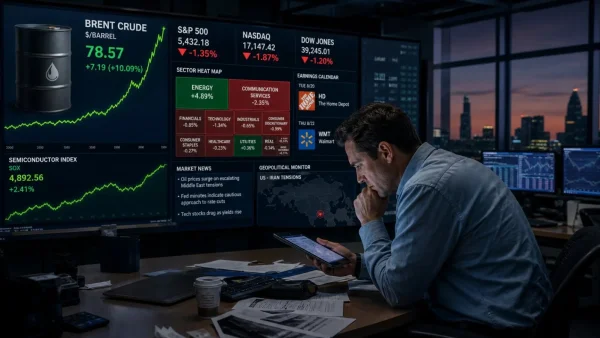
Crude’s latest move has upset the balance in the market. Reuters reports oil futures closed more than $2 higher a barrel, with supply worries stoked by the state of US-Iran diplomacy. The S&P 500 energy index was 1% in the black and industrials added 0.3%, but communications services had the worst of it, falling around 1.6% on the back of Meta Platforms.
There has been a defensive rotation into cash flow and pricing power. One can see the nerves about whether all that artificial intelligence spending will pay off in the technology sector of the S&P 500, which has been indecisive between gains and losses even with some strength in the chip complex.
Macro tensions and thin August volumes
Geopolitical risks are back in play and the usual lack of liquidity in August is all the more apparent. ‘You have a case of summer doldrums and a wait for data on the consumer,’ says Phil Blancato, chief market strategist at Osaic Wealth. ‘Concerns about softer data of late have the market being a bit tepid, waiting for direction from the retail earnings.’
Retail earnings become the market’s compass
Following the soft jobs and retail sales figures in July, there is a desire for a better read on wage sensitivity and where wallets are at. When Home Depot comes out on Tuesday and Walmart on Thursday, they will be viewed as telling indicators for both staples and discretionary demand.
In the end, the S&P 500 wound up 39.55 points lower, or 0.51%, at 7,746.21. The Nasdaq Composite was down 76.87 points to 26,652.29, a drop of 0.31%. The Dow Jones Industrial Average finished at 53,469.20 after losing 263.21 points, or 0.49%.
Eleven of the 11 sectors in the S&P 500 saw declines, with consumer staples, consumer discretionary and communications services in the lead. It was an extension of the cooling seen on Friday when the S&P 500 slipped from its record close and the Nasdaq ended some 1.3% adrift of its peak.
AI trade splits: chips rally, software stumbles
Look beneath the surface and the technology space was hardly uniform. While the PHLX semiconductor index put in a strong showing with a near 2% rally, the S&P 500 Software & Services index was down 2.8%. The latter was weighed down most heavily by Microsoft’s slide, even as some of the chip leaders made gains.
Micron and Applied Materials were among the benchmark’s top performers, rising 4.5% and 5.6% respectively. Then there is Nvidia. As the bellwether for AI outlays and the planet’s most valuable firm, it is a key driver of sentiment in data infrastructure, cloud and hardware alike; all eyes will be on its report next week.
There was also some scrutiny of spending plans following a Friday report from Reuters. Two sources privy to the company’s books say Anthropic, in advance of an IPO, has put its 2028 revenue forecast at somewhere between $190 billion and $200 billion. That number has only fanned the debate over whether valuations can be justified by what AI actually monetises.
Breadth and standout movers
The market had a negative tilt to its breadth. On the NYSE, decliners ran up a 1.7-to-1 score over advancers, tallying 176 new lows to 213 new highs. The Nasdaq was not much better, with 2,921 names falling to 1,834 that rose (a 1.59 ratio), and 100 new lows against 79 new highs.
In the energy patch, Vista was a gainer of note. Its US-listed stock climbed 4% on news of Peter Thiel picking up a 1% stake in the Latin American oil outfit, a reminder of how a move in crude can re-rate an upstream story in short order.
Why it matters and what to watch next
Today’s action was a clear signal that earnings are going to dictate where risk is taken from here. Should Home Depot and Walmart prove that consumer spending is resilient, one might see support in retail and cyclicals. If they do not, defensives will likely hold their appeal and energy will follow the crude.
The AI trade is playing out at two speeds: software is being put to the test on margins and timing, but the hardware side of training and capacity is holding firm. Nvidia’s guidance may well tell us if the strength in chips is here to stay or is about to wane.
Some intraday figures from earlier: the Dow was off 0.49%, the S&P 500 0.37% and the Nasdaq 0.31%. By the close, most sectors were still under pressure though industrials and energy managed to end in the black. Whether Monday’s drop was a pivot or merely a pause will become apparent in the coming sessions.
For now, investors are focused on a few things:
– Chips on the up, software down 2.8%
– Oil once again dictating sector leadership
– Market breadth favouring the decliners
– Retail earnings to set the tone for the consumer
One last point on positioning: the 1.6% fall in communications services is evidence of how megacap internet can pull an index down despite a semi rally. With August volumes running light, there is a tendency for moves to overshoot. So the numbers from the big retailers and Nvidia's results are an outsized factor in the near-term trajectory for US equities.