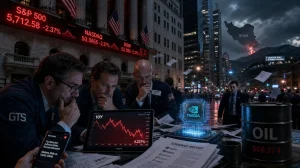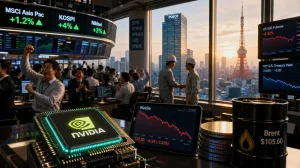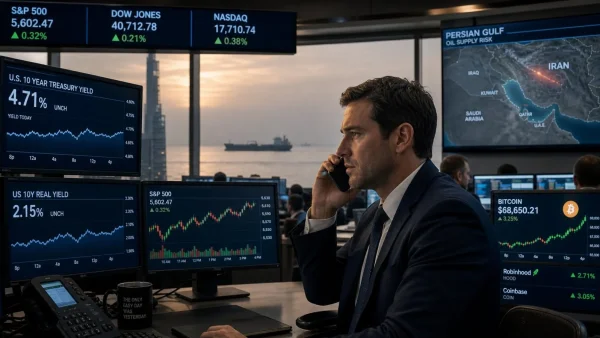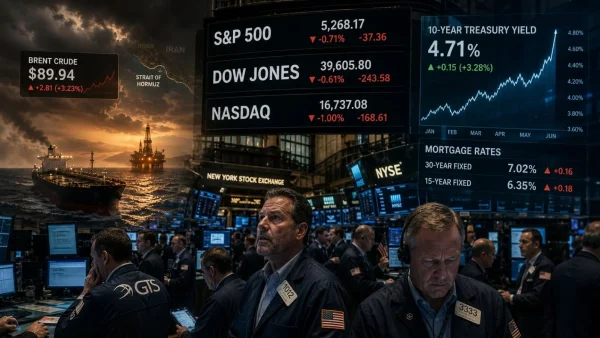
The week has started on a defensive note for US stocks as stubborn bond yields and the cost of oil have cooled that winning streak, leaving the S&P 500 at a distance from its recent highs. With futures mixed, traders have turned their attention to the Strait of Hormuz; tensions there are setting the market tone as Brent nears $90.
Oil shock shifts market focus
There is a reshuffling of near-term positions driven by crude’s resurgence. On Monday alone, Brent was up 2.7 per cent to 90.87, having been in the vicinity of $89 a barrel after a 6% gain the prior week. WTI futures made it to $83.21 a barrel, a clear indication that supply concerns are trumping any hopes of an easing in rate-hikes.
One cannot be sure where the flow will stabilise. Iran has all but shut down the Strait of Hormuz since 28 February and the wider dialogue to put an end to the US-Iran war has not advanced much. Add in the attacks on shipping and new hostilities in Lebanon and you see why risk premiums have been aggravated; Brent is more than 45% higher this year.
Rates reprice as energy fuels inflation risks
The higher price of oil is making itself felt in bonds. The 10-year Treasury yield was 4.72 per cent on Monday, up from 4.68 per cent late Friday and well above the 3.97 per cent level before the conflict with Iran. As fears of rates resurface, the 10-year is being pushed to 4.73%, and the 30-year has hit 5.31%, a level not seen since 2007.
That kind of move has already sent average long-term US mortgage rates close to a one-year high. But there is still an expectation of relief: soft July inflation and retail sales have led markets to assign a 67% probability to the Fed holding rates in September, a marked improvement from the sub-50% odds a month back.
For now, all eyes are on what the Fed has to say. Expectations may be steered by the FOMC minutes or Chair Kevin Warsh at Jackson Hole. Warsh has made it known he favours giving Wall Street less in the way of guidance, so if the data is anything but clear, volatility could remain in play.
Wall Street’s rally meets a reality check
It has been a good three weeks for stocks, with the S&P 500 putting in a fresh all-time high on the strength of some blockbuster results. Index members are poised for about 50 per cent growth in spring EPS over last year, the best in five years, and that has drawn investors to the AI names.
But the ascent of oil had its toll on Monday. The S&P 500 gave up 40.70 points to finish at 7,745.06, a 0.5 per cent decline. The Dow Jones Industrial Average was down 272.63 points to 53,459.78 and the Nasdaq composite shed 84.25 to 26,644.91.
Not all the stress was uniform. L3Harris Technologies was among those to slide 4.6 per cent following the departure of CEO and chairman Christopher Kubasik, who the company said was leaving over conduct unrelated to operations or reporting. Berkshire Hathaway put more of its money into Alphabet, yet the stock was down 0.5 per cent in any case. Constellation Brands was not so fortunate; it tumbled 6.2 per cent once Berkshire made an exit.
Retailers and chips diverge
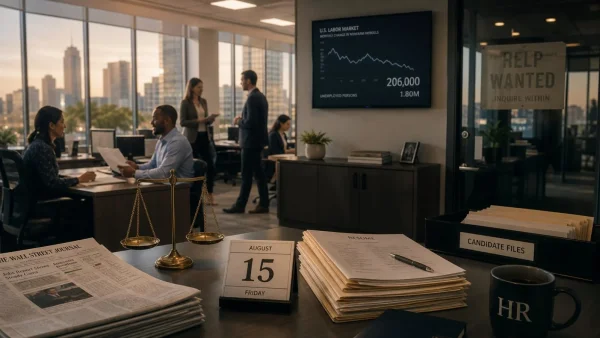
This week brings a key test of the consumer. Home Depot, Target and Walmart will be reporting, and they do so against a backdrop of June’s job cuts and a month in which shoppers have been less generous with their spending. Should there be any sign of demand fatigue, it would put the market’s earnings-driven resilience to the question.
Semiconductors present the other side of the story. The Philadelphia Semiconductor Index put up 1.6% in a market that was otherwise lacklustre, with Micron and Intel among those showing strength as investors shuffled their tech positions. It is a reminder that AI-related names are still in favour even when higher rates are weighing on equity multiples at large.
Futures, flows and the week’s setup
Sentiment was mixed ahead of the open. S&P 500 futures were up 0.1% and the Nasdaq 100 0.5%, but the Dow Jones Industrial Average gave back 88 points for a 0.2% loss. A degree of selectivity was in evidence pre-market: Alibaba and Intel each put on 1.5% and SoFi Technologies 2%.
Overseas, Asia did well, with gains of 1.4 per cent in Shanghai, 1.3 in Hong Kong and 0.7 in Tokyo’s Nikkei 225, while Europe was in the red. In the absence of much in the way of US catalysts, traders are looking to a handful of items for direction:
– The FOMC minutes
– Kevin Warsh’s appearance at Jackson Hole
– Earnings from the big three retailers
– Any new economic curbs, as were alluded to last week
The bond market is worth an eye too. Long-end yields in Germany and Canada have hit levels not seen since 2010, and after the 10-year auction went through at the most expensive financing cost since 2007, one can see the global effect of term-premium and inflation worries.
Geopolitics raises the stakes
There is no letting up on US-Iran tensions. The port blockade is now in its sixth month and constricting the energy picture. Donald Trump has spoken plainly about it in an interview, saying the pressure is on Iran and making no bones about bombing Oman should it get in the way. He offered no timetable for an end to the matter.
For its part, Iran says it is putting the finishing touches on a statement with Oman regarding ship transits in the Strait of Hormuz. But with the 60-day window for a peace deal gone and no word of an extension, the market is on edge for the kind of disruption that sent Brent whipsawing between USD 72 and USD 102 last month.
Then there is policy. Treasury Secretary Scott Bessent intimated last week that fresh curbs may be on the table. With energy tightness stoking inflation, further sanctions would only add to the bid in crude and the lift in yields, a mix that is hard on valuations.
What it means for investors now
It is a tug of war between the heady profits and AI fervour on one hand and the oil-fuelled inflation and yields on the other. How it resolves will depend on what the Fed has to say and whether the retailers prove the naysayers right or wrong.
Tactically, the market is being selective rather than turning risk-off. But with the 10-year over 4.7% and Brent in the $90 area, capital is getting pricier. One would expect an upside move to require another bit of an earnings surprise to hold.