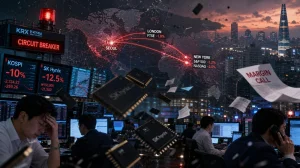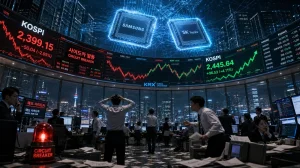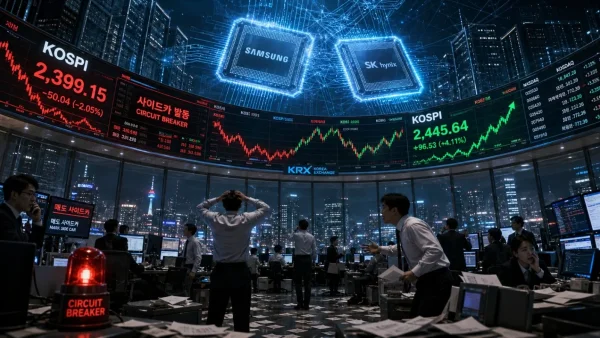
What had been the market’s most popular bet in South Korea came to an abrupt end. On June 23, 2026, the Kospi fell 8% and set off a 20-minute circuit breaker when the rally in the chip sector, all but made of AI, turned on a dime. Foreign money was in full sell mode, fuelling a downturn that has some wondering if the AI boom is as solid as it seems.
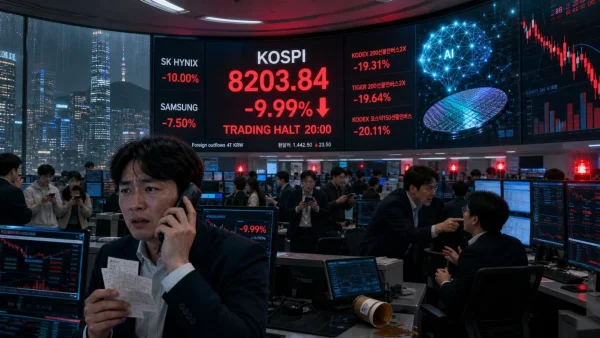
Even once things got back up and running, the damage was done. The benchmark made new intraday lows, slipping past 9%. When the bell rang, the Kospi was at 8,203.84, a 910.71-point or 9.99 per cent drop from where it started. A quick way to lose any sense of momentum in a market that was only just making records.
A crowded AI trade meets a stress test
You can’t have a South Korean rally without semiconductors, and that puts you in a spot where it can go either way. Intraday, SK Hynix was down more than 10% and Samsung 7.5%, erasing some of the good times for the sector.
This is no small step back after the kind of run we’ve seen. Just this week, SK Hynix had put in eight days in a row of 2% or better, for a year-to-date jump of close to 350%. And with leveraged ETFs in the mix, they make both the climb and the fall steeper.
There are those in charge who see the risk in that kind of feedback. The head of the financial watchdog has some misgivings about having given the OK on these leveraged wares and is looking at ways to put a lid on the kind of whipsaw we’re seeing in ETFs for Samsung and SK Hynix.
Foreign money turns from fuel to brake
The overseas capital that was driving the bus has bailed out. Exchange figures show foreigners put over 2 trillion won ($1.3 billion) on the block in the morning, and by mid-day you were looking at 4 trillion won ($2.6 billion) in outflows. There were some local traders looking to pick up stock on the cheap, but the sellers had the upper hand.
Some of the numbers that defined the day:
– An 8% dive in the Kospi before the halt
– A 20-minute stoppage in trading
– SK Hynix in the red by 10% or so
– 7.5% off at Samsung
– More than 4 trillion won ($2.6 billion) in foreign selling
Circuit breaker, breadth, and cross-sector pain
After the 8% slide, the Korea Exchange called time. But when the pause was over, the index had even more room to fall.
The numbers don’t lie: breadth was thin. Out of 918 issues in play, you had 771 on the downside to 131 that made any headway, a sign of a market pulling back from more than just semiconductors.
You could see the selling move into some of the big names. LG Energy Solution was down 2.98%, but it was the auto sector where the pain was most evident – Hyundai Motor and Kia Corp gave up 8.78% and 6.47% respectively. It’s a case of broader nerves over valuations that have run hot, with some of the tech malaise rubbing off on them.
Global cues and the next catalyst
There was little comfort from abroad. US tech has been on edge, not least with the dip in SpaceX, and now all eyes are on a test coming up later this week: Micron Technology’s quarterly report.
As a barometer for AI memory demand, what Micron puts out will be telling. A good showing might put some of the hardware side of the trade at ease. If they come up short, though, it could put more pressure on a correction in Asian tech.
From market darlings to volatility engines
It hasn’t been an easy month for the Kospi. After the benchmark’s first-ever foray above 9,000, making it one of 2026’s top-performing indices, the index is now more of a touchy subject when there’s even a whiff of an AI lull.
Talk of profit-taking and whether the AI story can continue to produce the kind of earnings it has is top of mind for analysts. And with as much leverage and concentrated ownership as there is in a handful of these stocks, you can expect the ride down to be a rough one.
Why this matters for market positioning
If you follow South Korea’s equities, you know it’s an AI infrastructure play, with Samsung and SK Hynix at the heart of it. That focus is what has driven the returns, and it’s what makes for a steeper fall when the mood changes, like we saw on Monday.
Some strategists will tell you it comes down to how the chips stack up against each other. The view is that for the Kospi to go higher, Samsung may have to leave SK Hynix in the dust, particularly if its Q2 results are as strong as some think.
Policy response and what to watch next
The regulators aren’t just standing by. Lee Chan-jin, head of the Financial Supervisory Service, has put out word that they are mulling over ways to steady the ship and curb the kind of ETF-fuelled whipsaw we’ve been seeing. He even had the rare candor to backpedal on the decision to let leveraged funds on the top chip stocks through.
Now it’s a matter of where the positioning is and what the earnings say. Foreign money has been cashing in and the retail side is a bit more exposed, so Micron’s figures may be the line in the sand between a healthy correction in a hot market and something more.
The message for investors is straightforward. The case for AI is still there, but the trade is overdone and every number is being magnified. You can see in South Korea’s market right now how fast the thing you were leading with can become your undoing.