What was once theory is now in the clinic in the form of a single infusion that can make a sharp dent in bad cholesterol. The early human figures for Verve 102 from Eli Lilly and Verve Therapeutics have not gone unnoticed by cardiologists around the world; they show an LDL reduction of up to 62% holding for 18 months on the strength of one treatment.
The significance is hard to overstate. LDL or “bad” cholesterol is what forms plaque in the arteries and impedes blood flow, with heart attacks and strokes as the consequence. Most patients are on a regimen of pills or injections for years to keep it in check. A durable option that requires only a single session would be a change of pace for some high-need groups in terms of daily life and risk.
What this one-shot therapy tries to change
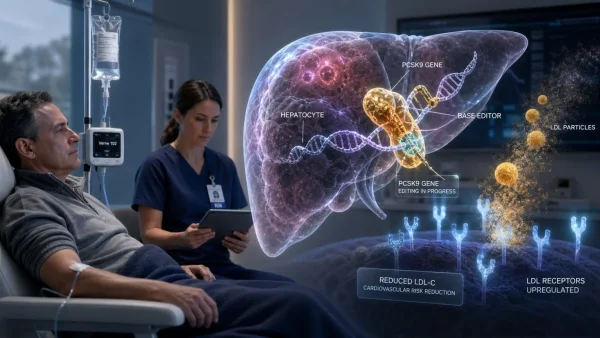
Verve 102 is an intravenous infusion built to edit DNA in situ. Its purpose is to turn down the PCSK9 pathway in the liver so that organ can do a better job of clearing LDL from the blood without the need for further dosing.
Under normal circumstances, the protein PCSK9 puts a cap on the number of LDL receptors liver cells have. Verve 102 works by making an alteration to the PCSK9 gene to curtail the production of the functional protein. With less PCSK9 activity, more receptors are left available to improve LDL removal.
How base editing differs from drugs
There is a distinction between in vivo base editing and medicines that put a temporary hold on PCSK9. The former is an attempt at a precise and enduring modification of the DNA. While researchers are hopeful for a lasting effect on LDL, one cannot yet say that such durability has been demonstrated in people over a lifetime.
What early human data show so far
The Phase 1b Heart 2 trial has put forward some numbers. After a solitary infusion, researchers saw meaningful decreases in both PCSK9 and LDL. One should note the study was set up to look at safety, tolerability and biological impact rather than clinical outcomes.
Depending on the dose, PCSK9 fell in the range of 51 to 88 per cent. For LDL cholesterol the drop was between 9 and 62 per cent. At the top end of 1 mg per kg, LDL came down an average of 78 mg per dL, or about 62 per cent. Those were the figures through 18 months of follow-up.
Promising as they are, these are early days. The trial did not have the scale to tell us if Verve 102 will stave off a stroke or heart attack. That will require larger and longer investigations to verify any real-world benefit.
Who might benefit first, and what to expect
At present, the focus is on those for whom LDL is most difficult to control, such as patients with heterozygous familial hypercholesterolaemia or premature coronary artery disease who find standard therapies wanting.
But Verve 102 is investigational. It is not approved for routine use and does not replace statins, ezetimibe or PCSK9 inhibitors. Any part it may play in the future hinges on demonstrating sustained effect and safety in bigger trials.
For those following the news, the current state of play is this:
– It is still a therapy in clinical trials
– We have data going back 18 months
– Long-term safety is under review
– Conventional medicines are still the first line of defence
The big questions ahead
Time will be the ultimate judge. To have gene editing become part of routine cholesterol care, researchers have to prove that one infusion can safely produce a durable LDL reduction over the years and that this means fewer cardiovascular events.
Assuming those obstacles are overcome, a one-off treatment of the PCSK9 pathway could alter how we manage hard-to-treat or inherited high cholesterol. Until then, Verve 102 is a preview of a day when the daily pill burden may give way to a single, well-targeted edit.