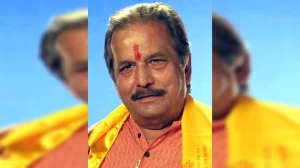
Well-known actor Govardhan Asrani – usually called just Asrani – died in Mumbai on Monday, aged 84, after a long sickness. The well-regarded comic, who really made his mark on Indian films with his perfect timing and how he showed feeling in his acting, had been in Bharatiya Arogya Nidhi Hospital in Juhu because of problems with his breathing. His family said fluid in his lungs was the cause of his death. The final ceremonies took place at Santacruz Crematorium, with close family and friends there, as he wanted a simple goodbye.
A Simple Start and a Life-Long Love of Acting
Born on January 1st, 1940, in Jaipur, Rajasthan, Asrani was raised in a normal middle-class Sindhi family. His dad owned a carpet store, but the young Asrani wasn’t interested in that trade. Rather, he became interested in performing very soon. He finished school at St. Xavier’s School and got his degree from Rajasthan College, Jaipur. While at college, he made money by being a voice on All India Radio, and this helped him get better at changing his voice – something which would later help his acting.
In 1964, Asrani went to the well-known Film and Television Institute of India (FTII) in Pune; this choice would change his life. He first acted in a film in 1967, in the Hindi movie Hare Kaanch Ki Choodiyan, where he was the friend of actor Biswajeet. As well as his early Hindi work, Asrani also had leading roles in several Gujarati films, proving he could act in a lot of different ways.
The Best Years and Famous Acting
Asrani’s big chance came in the 1970s, when his career was at its highest point. His acting as the strange jailer in Ramesh Sippy’s Sholay (1975) is still one of the most famous funny acts in Indian films. The line “Hum angrezon ke zamaane ke jailer hain” still makes people laugh, even now. The part, which took from Charlie Chaplin’s The Great Dictator, showed how good Asrani was at showing expression, using his voice, and using irony.
As well as Sholay, Asrani’s work in films shows how many things he could do. He worked with great directors like Hrishikesh Mukherjee, Gulzar, and B.R. Chopra, and was in well-known films like Bawarchi, Abhimaan, Mere Apne, Koshish, Parichay, and Chhoti Si Baat. He and star Rajesh Khanna made more than 25 films people remember, including Bawarchi and Do Ladke Dono Kadke.
Making Comedy New for a Newer Public
After the 2000s, Asrani made himself new for a new age of comedy by working with film-maker Priyadarshan. He made people laugh in very successful films like Hera Pheri, Hungama, Chup Chup Ke, Garam Masala, Bhool Bhulaiyaa, and Bol Bachchan. His power to stay well-known for many years showed how he could change and how well he understood what was funny.
Asrani also tried directing, as well as acting. His 1977 film Chala Murari Hero Banne – which he wrote, directed and starred in – showed his own ideas and love of telling stories. He went on directing things like Salaam Memsaab (1979) and stayed involved in theatre all his life, often saying that theatre made an actor real and new again.
A Record in Laughter and Affection
With a career of over fifty years and more than 350 films, Asrani became one of the most loved “character” actors in Hindi films. Whether he was acting as a silly helper, a hard boss, or a lovable idiot, he brought real feeling and warmth to all his parts. His later work, including Dream Girl 2 (2023), showed that his comic skill had not gone.
Asrani is survived by his wife, actress Manju Bansal, and their son, Naveen Asrani. The pair met while making Aaj Ki Taaza Khabar and Namak Haram*, and their relationship lasted, both on and off the screen.
Actors and film-makers from many generations have sent in messages, all remembering Asrani’s catching laughter, his perfect timing, and his modesty. Actor Akshay Kumar called him "a legend who gave us a million reasons to smile“, while director Anees Bazmee said he was “a great actor and an even better person”.
Govardhan Asrani’s death marks the end of a time, but his films will go on giving future actors something to look up to. His road from a radio voice in Jaipur to one of India's most loved comics is proof of passion, trying hard, and the lasting power of laughter.