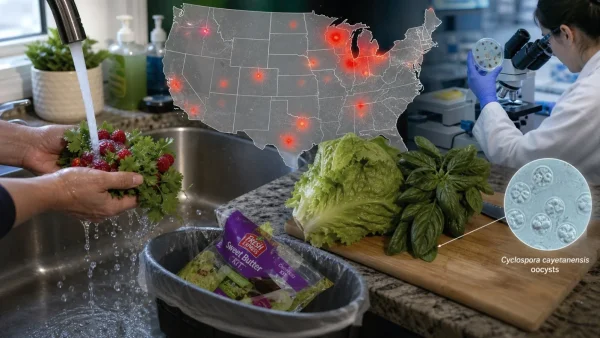
It is an outbreak that has moved fast, with the CDC and state health departments tallying at least 2,944 cases of cyclosporiasis in 32 states as of last Friday. Given that the origin is still a mystery and watery diarrhoea is the telltale sign, there is a need for some plain guidance on how to avoid it.
Why this is in the news
The numbers we have are likely an undercount, according to the CDC, since some will get over it without ever being tested. And it can be a long haul; symptoms may come and go for weeks, throwing a wrench in work or travel plans. We have seen it in everyone from five-year-olds to those in their late 80s, so it does not discriminate by age.
You get it from food or water that has been contaminated with faeces. In this country, fresh produce is the usual suspect. We have had our share of foodborne incidents in the past with raspberries, basil, snow peas, mesclun and cilantro. It is not something that is passed from one person to another very often.
Hot spots for the virus
Michigan is where the activity is concentrated. State figures show 1,562 infections and 44 hospitalisations through Friday. Put that against the 50 or so cases Michigan would normally have in a year and it is a 31-fold increase. New York is up to 470 since the start of May, and Ohio has 364.
You will find over 100 cases in both Illinois and Florida. California has put down between one and 10. These are just the latest from the states and are subject to change as the work is done and more tests are run.
There was a CDC report in early July that put the total at 843 in 31 states, but if you look at a broader picture from all the state reports, the number was over 4,000 by the 13th. Michigan alone has 2,640 to put on the record since the end of June.
Then you have North Carolina with 205, Illinois 141, Colorado 90, Indiana 72 and Texas 48, with five of those ending up in the hospital. On top of that, the CDC has 1,500 or so more to sort out to see if they were picked up here in the US.
The facts on the ground
There is no sign of one big multistate event. What the CDC and FDA are doing is monitoring a few different clusters in an effort to get to the bottom of it. As of yet, nothing has been tied to a particular food, grower or supplier.
From the doctor’s office
If there is one thing the CDC will point to, it is the ‘explosive’ nature of the watery diarrhoea. Nausea, vomiting, cramps, bloating and a loss of appetite are also in the mix. It usually shows up a week after you have been exposed, but can be as soon as two days or as long as two.
There is a way to treat it. A 10-day course of an oral antibiotic like Bactrim, Septra or Cotrim (trimethoprim-sulfamethoxazole) is the standard. If the symptoms are not letting up or there is any sign of dehydration, it is time to see a physician.
Some precautions for the home
The word from health officials is to put in the extra effort with washing and to be mindful with the greens. There is no call to put off eating your fruits and vegetables while this is being looked into, but a few things in the kitchen can help:
– Leave the pre-cut salad and chopped veggies on the shelf
– Go for the whole head of lettuce or an unbroken herb
– Toss the first couple of outer leaves
– Give the berries and such a good rinse under the tap
– Do not count on a soak in a bowl to do the job
Cyclospora has a way of holding on to what it is on. Running water is the only sure way to get it off; soaking will not cut it.
What to expect
The case counts will be in flux as the states and the CDC make their updates. While investigators are on the trail of the supply chain to find any common thread, the best one can do is to be diligent with the produce and not hesitate to get care if the diarrhoea lingers.