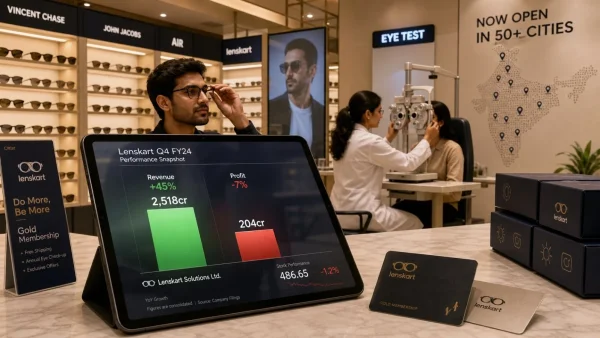
Then again, for an investor, the March quarter was a bit of a mixed bag. When the eyewear giant put out its results on May 20, 2026, net profit was down 7% year-on-year, even as the top line leapt 45%.
Q4 snapshot and why it matters
That’s the kind of trade-off you’d expect from Lenskart’s present-day approach: get big, improve the product mix, and trust that operating leverage will follow. The filings make it plain that the revenue was there, driven by service demand, if not as much in the way of bottom-line gains this time around.
Take India’s average selling price, which was up 15.9% in Q4 to Rs 1,865. Management says you have to look at the move to higher-end wares, and also the fact that last year’s base was soft due to a New Lens Replacement promotion in FY25.
Key quarterly markers the company highlighted were as follows:
– Net profit: Rs 204 crore, down 7% YoY
– Revenue: Rs 2,518 crore, up 45% YoY
– Eye tests: 6.8 million, up 45% YoY
– India SSSG: 24.2% in Q4
– Share price: down 1.2% to Rs 486.65
Premium tilt and customer flywheel
We ran 6.8 million eye tests in the quarter and 23.8 million over the course of the year, a 48% increase. Roughly half of those in India were with new patients. In their words, ‘Every eye test makes the market we can serve a little bigger. We are deepening our growth, not just making it wider.’
There is no question the push for premium is gaining ground in India. Some 20.5% of our FY26 revenue in the country came from orders of Rs 10,000 or more. Our NPS was 81.4 this quarter, up from 76.9 when FY25 ended. We have 8.8 million Gold members and subscription fees are up 85% to Rs 199 crore.
Scale without cannibalisation
Same-store sales in India were up 24.2% in Q4. What’s more, Same-Pincode Growth was 690 bps in front of that, so the new stores aren’t just taking share from the old ones; they’re finding new customers. For the year, SSSG was 20.8% and Same-Pincode 27.3%.
We’ve made inroads in 157 new tier 2+ cities, and we are seeing the same kind of outperformance in our international business, so the network effect isn’t an India-only story.
Store economics and capital efficiency
Store count has almost kept pace with that, with 542 net additions in FY26 compared to 282 in FY25. And we have been disciplined about it: operating cash flow has been what has underwritten the growth and the capex. If you put aside the IPO money, return on capital employed is 23% in FY26, versus 13.8% the year before.
International momentum and mix shift
In the rest of the world, Q4 revenue was 35% higher and EBITDA margin is 9.2%. Over the full year, we saw 30% revenue growth and a 335 bpt lift in EBITDA to 7%, which is ahead of where we were in India at a similar size.
Meller has been the driver behind a 36% jump in international sunglasses. In total, we moved 28.8 million units in India in FY26 (from 22.9 million) and 6.5 million in other territories (from 5.4 million). India accounted for 58% of the pie in FY26, with the rest coming from abroad.
Full-year picture and what to watch
All in, we did Rs 9,002 crore in revenue for the year, 35% more than the Rs 6,653 crore in FY25. Profit is up 38% to Rs 530 crore. You could say the scale and efficiency are mellowing out some of the hiccups you might see in a given quarter.
What matters now is how well we put it into practice: hold the line on the premium side, drive margins overseas, and keep adding cities without one store stepping on another’s toes. The street has been a little cool on it, with the share price off 1.2% to Rs 486.65.