Starting Monday, September 7, India’s equity markets will have to follow a stricter set of rules as the two exchanges roll out their revised pre-open procedures. While the 15-minute window remains, the overhaul is intended to yield a cleaner opening price discovery. That means market orders are now confined to the opening five minutes and price matching has been moved to the 9:10 AM to 9:12 AM slot.
Why the pre-open is changing
In a sense, the exchanges are making the open conform to the way the close is handled. Sebi brought in the Closing Auction Session on August 4 for cash-market stocks that have derivative contracts; it is an auction process that pools orders to arrive at one closing price.
According to NSE, the pre-open revisions are a reflection of that same auction logic. It is meant to streamline the handover to continuous trading each day and foster better coordination with derivatives, resulting in sturdier liquidity and less distortion at the open.
What is different from today
Under the new framework there is a clear separation between how orders get into the book and how prices are determined. The market is given a timed runway before the auction gets under way. You will find a tighter sequence that leaves little room for last-minute gamesmanship and makes execution priorities plain.
Tighter order entry controls
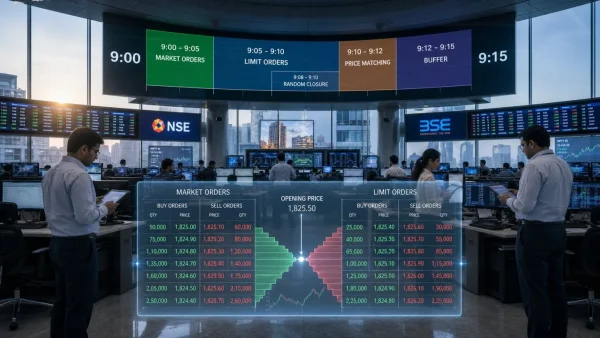
Market and limit orders alike can be put in, altered or cancelled from 9:00 AM to 9:05 AM. This is the sole time market orders will be taken.
After 9:05 AM until 9:10 AM, only limit orders are in play; any market order will be turned away. Be aware that a random closure is possible in the last two minutes of this period, from 9:08 to 9:10 AM.
Should a trader wish to have a market order take precedence over a limit one during price determination, it has to be lodged in those first five minutes.
Matching and transition
The call auction that confirms trades and establishes the opening price will now run from 9:10 AM to 9:12 AM for order matching, in place of the old 9:08 AM to 9:12 AM timeframe.
Then comes a buffer from 9:12 AM to 9:15 AM to see off any disruption to the opening equilibrium as things shift to regular continuous trading.
Who is covered
This is not just for Futures and Options traders. The new pre-open framework is in effect for the entire equity cash market, covering InvITs, REITs, partially paid-up shares and SME stock in addition to what is on the main board.
The exchanges want consistent mechanics at the open whether one is dealing with a large-cap bellwether or a smaller listed firm.
What this means for trading strategies
Timing becomes all-important for those wanting to be sure of execution. A market order has priority in the auction but is only good until 9:05 AM. Past that point, one has to rely on limit orders to shape the book from 9:05 to 9:10 AM.
The five-minute phase where only limits are permitted is a stabiliser of sorts. It lets participants respond to early flow without fresh market orders tugging at the equilibrium price. The exchanges say the setup is to cut down on the kind of late-stage manipulation that was once made easy by a wider order-entry window.
Some action points to keep in mind:
– Get market orders in before 9:05 AM
– Reserve 9:05 AM to 9:10 AM for limit orders
– Be on the lookout for a random closure from 9:08 to 9:10 AM
– The opening price will be put in place from 9:10 to 9:12 AM
A harder line on market orders also puts a different spin on trading overnight news. Those looking to chase gaps have to make their move fast. Others with a sensitivity to price can use the second phase to fine-tune limits and control for slippage or inventory risk.
The road ahead
NSE and BSE are standardising auction-based price discovery at either end of the day by bringing the open in line with the closing auction. They anticipate a neater transition to continuous trading and a closer fit between the cash and derivatives sides of the house.
The signal to investors is unambiguous. Rely on the first five minutes for a market order if execution is a must, then use the 9:05 to 9:10 AM interval to put in your limits. With the 9:12 to 9:15 AM buffer and matching locked in at 9:10 to 9:12 AM, the open ought to be more orderly when volatility is high.