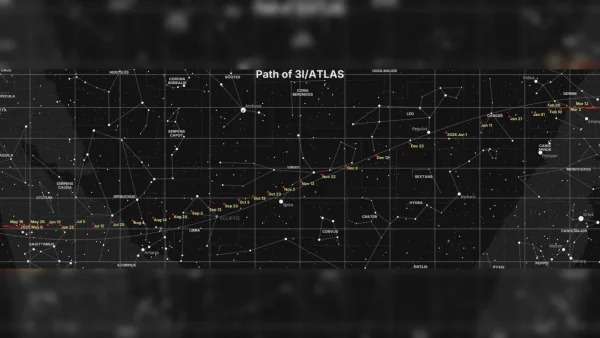
An interstellar visitor that enters our solar system is a great rarity and is simply an awe-inspiring wonder of the cosmos. Hence, Comet 3I/ATLAS, only the third known interstellar object, briefly trespassing through our solar system, has inexplicably brightened unusually quickly as it approached the Sun, in the dashing presence of astronomers. This celestial anomaly has left astronomers in a frenzy trying to figure out what comments can be made about its origin and composition.
The Unfolding of a Cosmic Mystery
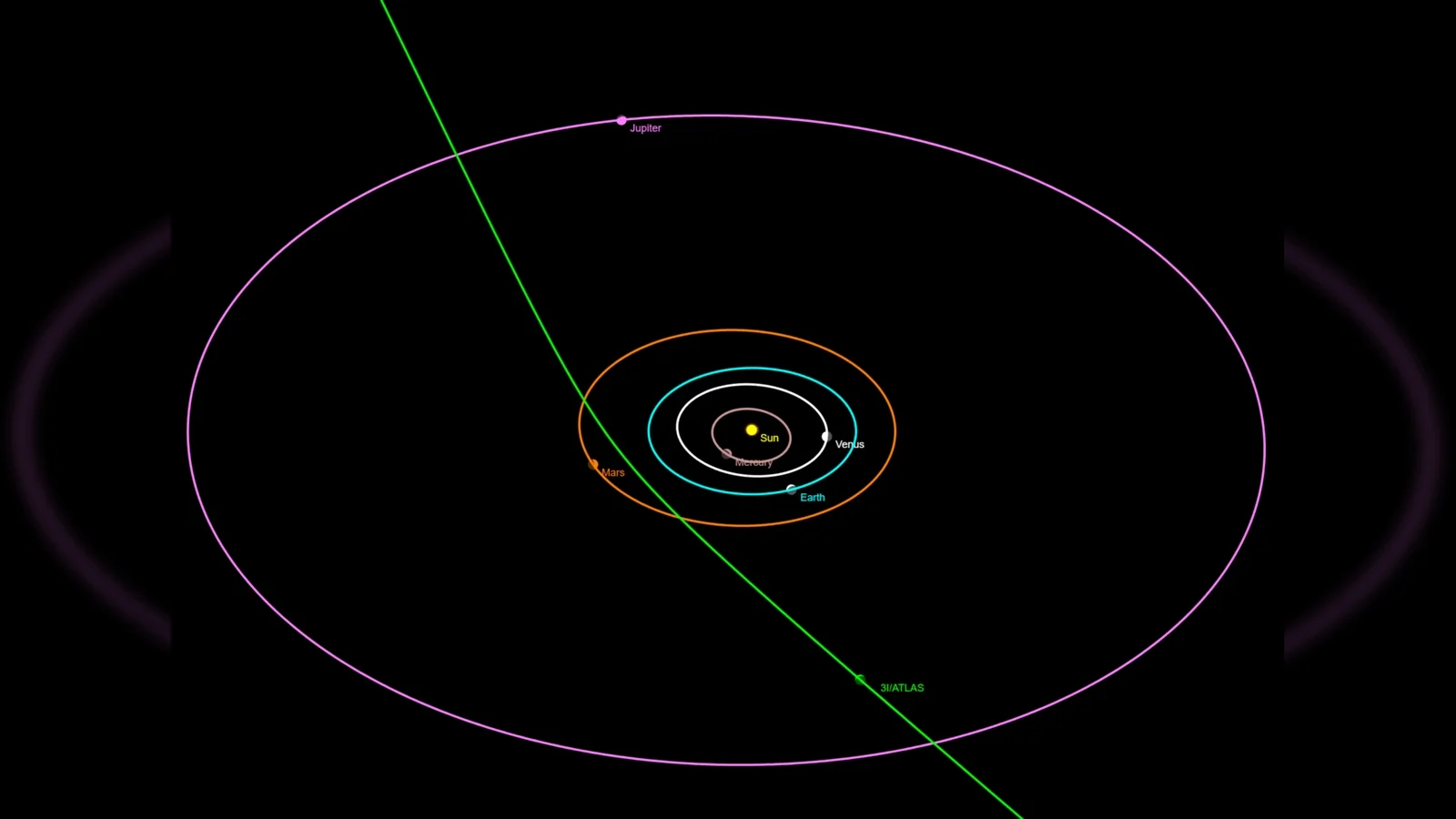
The trajectory of Comet 3I/ATLAS into the solar system follows that of two interstellar objects, namely the mysterious ‘Oumuamua in 2017 and comet 2I/Borisov in 2019. Each of these visitors provides a rare opportunity to infer the chemistry and evolution of faraway planetary systems. Scientists had expected that as 3I/ATLAS would have approached its perihelion, or the closest distance to the sun, on October 29, 2025, it would have gradually brightened just like an Oort Cloud comet-an icy body far away on the edges of the solar system.
Comets normally gradually brighten as they near the Sun when sublimation kicks in-wherein solid ice is transformed directly into gas due to solar radiation. The process releases dust and gas, which together form an awe-inspiring halo, termed as coma, and a majestic tail. All this was set to go awry with 3I/ATLAS. Its brightness raced up disproportionately faster, leaving all researchers puzzled.
The Brightness Dilemma
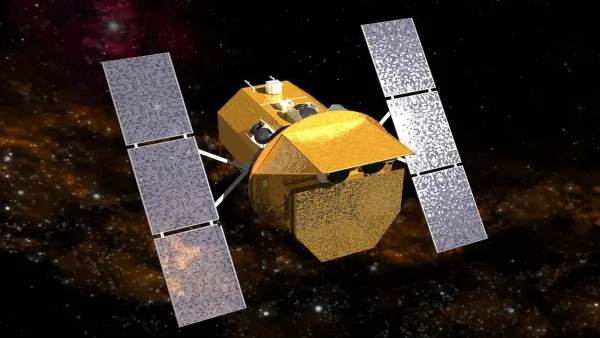
Multiple space-based observatories detected this mysterious brightening, including NASA’s Solar Terrestrial Relations Observatory (STEREO) and SOHO. Finally, ground-based telescopes may have a chance to observe it again whenever it emerges from behind the Sun in mid-to-late November 2025.
In a recent paper published on arXiv, Karl Battams of the Naval Research Laboratory and Qicheng Zhang of Lowell Observatory raised the question: “The reason for 3I’s rapid brightening… remains unclear.” All sorts of hypotheses have come into play for this anomaly. Could it be, for example, that high velocity produces its illumination as it approaches the Sun? Or it could be something intrinsic to its composition anyway-asilianish-type appearance-due to a typical Oort Cloud comet.
Insights from Beyond
The possible compositional differences offer several interesting implications. Suppose 3I/ATLAS holds an internal structure different from any so far known to exist within any comet; this would bring into play the possibility of having originated from a planetary system with a special chemical profile. The characteristics of the cometary nucleus-its composition, shape, or structure-might have been sculpted by its parent system or long interstellar voyage.
An added stratum to this conundrum was that carbon dioxide sublimation appeared to be dominant at distances thrice farther than the Earth’s from the Sun. This quite abnormal activity could have inhibited water-ice sublimation, thereby altering the expected thermal response.
A Window into Interstellar Chemistry
Comet 3I/ATLAS is steadily making its way through the solar system, and with it comes a vastly valuable chance for provide an initiative to study interstellar chemistry at near range. As the comet exhibits different behaviors in different phases of its orbit, astronomers aim to determine its origin and the broader dynamics of distant star systems.
The rapid brightening of Comet 3I/ATLAS is a testament to how much more remains to be learned about these travelers. Each new interstellar object enriches celestial theories beyond our cosmic backyard regarding planetary formation and evolution.
Looking Ahead
The saga of Comet 3I/ATLAS is far from over. As Comet 3I/ATLAS moves away from the Sun, it becomes visible in late November 2025, and astronomers eagerly await more observations from this shadowy specter. Would it be a plateau in brightness or another unforeseen behavioral twist? Every observation adds another piece to the puzzle of interstellar visitors.
In a universe full of mysteries waiting to be unraveled, Comet 3I/ATLAS stands at the precipice of our ever-changing knowledge about the cosmos. With continued study and investigation, who knows what further secrets these roaming visitors might disclose?