The thirst for understanding the universe’s origins and infancy has been keeping captivated the scientific community for the longest time in the wide and shady infinite cosmos, the big question to search out the essence of its starting point and baby steps that were taken. Just recently, a group of various scientists discovered that James Webb Space Telescope(JWST), the very famous one, uncovered for the first time, the mysterious population III star, which is our universe’s first set of stars that are believed to have arisen shortly after the Big Bang occurred. This pioneering project marks a major step ahead in the world of space research and the journey of exploring the universe.
Unveiling the Universe’s First Stars
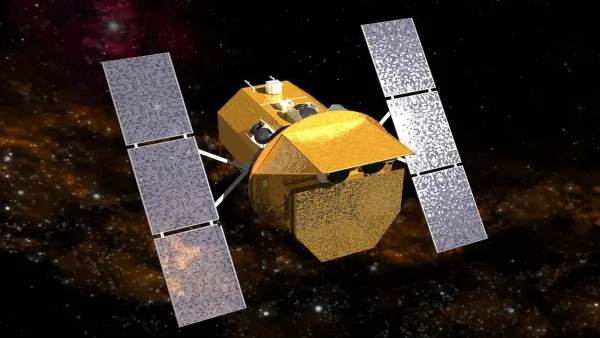
The James Webb Space Telescope, a $10 billion wonder of present-day technology, has eyes that can look straight back and to the very edge of the universe. On this day, it looks at a faraway galaxy called LAP1-B. This galaxy, which is at an impressive 13 billion light-years distance from the earth, appears as it did only 800 million years after the Big Bang. The galaxy’s light has traveled over enormous cosmic distances, bringing with it reminiscences from the time when the universe was still in its baby stage.
Eli Visbal, an important scientist in this research from the University of Toledo, states that these stars could be the primeval Population III stars researchers have been trying to find for a long time. “If indeed then stars of LAP1-B are Pop III,” Visbal noted, “this is the first detection of these primordial stars.” Such discovery was facilitated by leveraging the JWST’s sensitivity in conjunction with a cosmic phenomenon referred to as gravitational lensing.
Gravitational Lensing: Nature’s Cosmic Magnifier
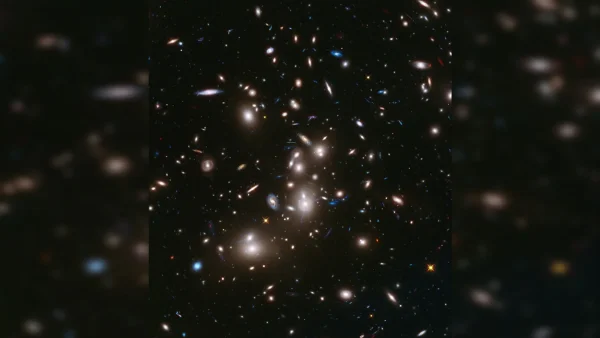
The phenomenon of gravitational lensing, was firstly predicted by the famous German physicist Albert Einstein through his general theory of relativity in 1915. It denotes a situation when a massive object located between a remote source and an observer can make the light from that source bend and intensify in a way that could be likened to the action of a magnifying lens. In the instance of the LAP1-B case, the large aggregation of galaxies known by the name MACS J0416.1-2403 (MACS0416) is situated at a distance of 4.3 billion light-years and works as a lens to get the light from LAP1-B in an intensified form.
This particular incident where “A” was correctly forecasted, was a situation that astronomers weren’t too surprised (about) when they used it. The main problem now is that they want to be able to tell the gravitational effect from the one due to the space illumination and the distortion from the jet that was also present, but still they are locked on these two.
The term in which LAP1-B existed was labeled as “the epoch of reionization.” It was the time when the ultraviolet light, coming from the very first stars and galaxies, was the main factor that converted the neutral hydrogen and helium gas into charged plasma, which in turn was the end of the cosmic dark ages. There is a theory that there were Population III stars preceding this epoch, and they appeared around 200 million years after the Big Bang.
The early stars were different than any other seen so far in the Universe just because they were mainly made up of hydrogen and helium with very little of the heavier elements or metals. Since they lacked metals, they were able to reach huge masses—oftentimes over 100 times that of our Sun—and this was the reason that they always formed as small groupings due to little disruption during the course of their formation.
In the words of Visbal, the cooling of the primordial gases was not as efficient as in the gas that was enriched by heavy elements such as carbon and oxygen, and that was the reason that the Population III stars were bigger than the later generations of stars.
The Importance of This Finding
Recognising Population III stars is central for shedding light on the way galaxies were forming and evolving during the early days of the universe. They would be the basic blocks of the bigger galaxies and hence would allow the researchers to unveil the hidden part of the universe in a manner of speaking.
The fact that the Population III stars are so major indicates it is beyond all questioning that it has been extremely difficult to track these starts as they were too faint and so distant from the Earth. Nevertheless, LAP1-B’s behavior matches the profile one would expect in the star formation scenario for the first generation: namely, the presence of low metallicity gas around massive star clusters.
In addition to that, this very find points up the fact that artificial mass also may be a channel for locating Population III stars gravitationally lensed stars amid high redshift regions or those at great distances from our planet.
A View on the Cosmic Ladder
The findings about LAP1-B mark a very significant point in the annals of astronomy. Astronomers must hark back to past observations and look at the Universe in a new light in order to make things clearer.
The James Webb Space Telescope is in the vanguard of the exploration of these mysteries that it wants to find out more about the universe than it was ever possible. It is on the verge of not only unraveling the star formation enigma that has been around forever but also of making the accretion disks of black holes formed by the deaths of massive stars obvious through its observations.
To sum up, the above-mentioned findings give proof of how cutting-edge technology like JWST can provide interesting views of the most remote past of our universe – a proof of our ongoing curiosity about our origin and the unknown territories that lie past our cosmic horizon.