These four new Labour Codes, starting on November 21, 2025, are a major change to how work, pay, and following the rules will happen in a $5 trillion economy. They’re designed to make pay clearer, use digital systems to make sure rules are followed, and include more people in a growing and varied workforce.
The government, following the Aatmanirbhar Bharat idea, has taken many separate rules from over the years and combined them into one system. The Code on Wages, 2019, the Industrial Relations Code, 2020, the Code on Social Security, 2020, and the Occupational Safety, Health and Working Conditions Code, 2020 are now the main guidelines.
Why the Codes matter now
India’s job market is becoming more diverse quickly, with businesses growing across states and different industries and operating 24/7. The Codes are meant to make sure there’s a workforce ready to go, while also giving employers confidence in what’s expected of them – something essential for investment and continued growth.
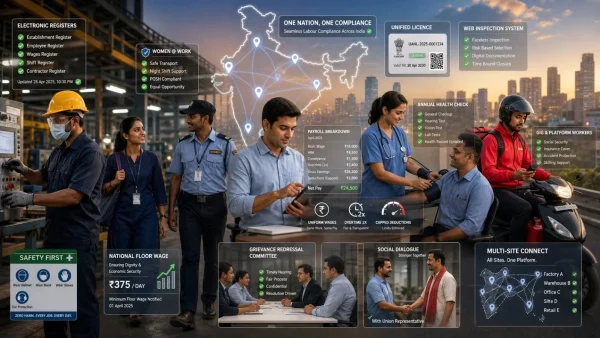
They are also changing how compliance is done, from a complicated process where things weren’t clear to a system based on facts and transparency. Inspections done online, electronic records, and one combined license are aiming to fix the points that have historically slowed down growth, especially for businesses with locations in many places.
A cleaner playbook for pay
For a long time, businesses have had trouble with different definitions of “wages” in different laws. The Codes solve this by using one, consistent definition of “wages” in all four laws. This will give employers a clear understanding of what they owe and reduce arguments over pay.
From ambiguity to uniformity
The changes go even further by getting rid of limits on how much basic protection workers should have. Workers will get their pay on time, overtime pay, and limits on what can be taken from their pay – and this now applies to all employees, no matter how much they earn. A National Floor Wage will create a minimum income for the whole country, lessening the difference in minimum pay in different regions.
Timely, equitable pay rules
The power of the rules to be enforced has been increased. Wages must be paid within two workdays of when someone is fired or leaves their job, to prevent workers from having to wait. Overtime must be paid at twice the normal rate, and the total amount taken from an employee’s wages is limited to and cannot exceed 50%, protecting how much they actually take home.
Safer, healthier, and more inclusive workplaces
Now, working hours, vacation time, and safety standards will be the same across all industries, instead of being different depending on the rules that used to apply. The Codes also begin to focus on preventative health by requiring yearly medical checkups for certain workers, linking safety to their long-term health.
Including women is being strongly encouraged. Women are now allowed to work night shifts if they agree and if there are good safety measures in place, to allow more women to work in industries that are open all the time. It is now specifically required to pay women the same as men for the same work, and to make sure there’s equality in both what’s written in the rules and how things are done.
New flexibility without weakening protections
One of the biggest changes is officially recognizing employment for a set period of time (fixed-term employment) in all industries. Employees on a fixed-term contract will now get the same benefits as permanent employees, including a portion of their end-of-service benefit (gratuity) even if they haven’t worked for the usual five years.
Industrial harmony will be improved with more ways for workers to be represented. Businesses with 20 or more employees must create Grievance Redressal Committees to quickly solve disagreements. Officially acknowledging negotiating unions will strengthen collective bargaining, meaning more discussion and less stopping work.
Here are the immediate takeaways for employers and workers:
– Pay rules are uniform across the Codes
– Wage protections apply regardless of salary level
– Overtime is paid at twice the normal rate
– Deductions cannot exceed 50 percent of wages
– Disputes face time-bound redressal routes
Compliance goes digital
The way inspections are done will be very technology-focused. Inspections done online and electronic records are designed to reduce the amount of judgement used by inspectors, speed up inspections, and create a clear record of compliance. This will cut down on paperwork and improve oversight.
Getting a license is also becoming easier. A combined system, including being able to get one license to operate in multiple states, should make administrative tasks less complicated. For companies with many locations, fewer things to comply with could mean they can expand more quickly.
What changes on the ground
For payroll departments, having one definition of “wages” will stop guessing and inconsistency. Businesses will be able to calculate contributions and benefits more accurately, and workers will be certain about what makes up their social protections and overtime pay.
For HR managers, allowing women to work at night, along with equal pay and improved safety, will open up more places to find people to hire in industries that need staff around the clock. It shows that inclusion is now part of the legal structure, not just something the government wants to happen.
For operations managers, having the same standards for working hours, time off, and safety will reduce how many different rules they have to follow. The yearly medical checkups for certain workers will make wellbeing an ongoing thing, instead of just something done to meet the rules.
The bigger picture
By finding a balance between flexibility and protection, the Codes aim to make India’s labour market match the speed and size of the country’s growth. Businesses will be able to move quickly with fixed-term employment and digital compliance, while worker protections will be strengthened with clearer pay and faster ways to solve disputes.
These changes show a move from dealing with problems after they happen to governing in a way that anticipates them. They are meant to make workplaces safer, pay fairer, and relationships between employers and employees more predictable, without reducing the basic protections that give workers confidence.
In the end, the four Labour Codes are about more than just bringing things together at one time; they’re about creating a lasting basis. A transparent, fair, and modern labour environment is being created, to support a workforce that is expanding and becoming more diverse.