You could say Japan has hit an underwater jackpot. Researchers have turned up what they are calling record-breaking levels of invisible gold in a Pacific volcano. It has people talking of a mine down the line, but it is also making them ask whether these kinds of deposits should be put to use at all.
A record find on Japan’s seafloor
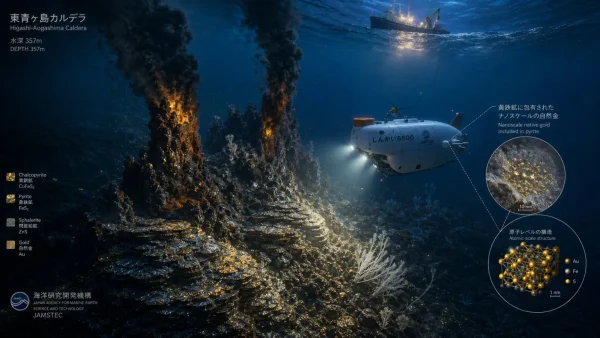
You will find the site in the Higashi-Aogashima hydrothermal field, 350 kilometers (217 miles) to the south of Tokyo and well within Japan’s economic zone. They first came across it in 2015. Since then, the caldera has been home to black smokers and mounds that are still in the process of laying down their metal.
By the accounts of those in the field, the amount of hidden gold here is as high as you are likely to see anywhere in the world. The team says the pyrite in this particular crater has more gold in it than has ever been put on the books for a deposit like this.
Why much of the gold cannot be seen
There are no flakes or veins to spot. For the most part, the metal is stowed away in unassuming minerals. According to Japanese experts, the gold in the pyrite comes in two guises: as nanoparticles and as single atoms put in place by the crystal itself.
A regular microscope won’t do. To get at the truth, the team used SIMS, or Secondary Ion Mass Spectrometry. It is a highly sensitive way of working that has a way of showing up the kind of fine-grade, invisible gold that would otherwise be overlooked.
How the deposits are forming
It is a volcanic affair. Superheated fluids from below make their way up through the seabed with metals in solution. When they run into the cold of the ocean, they harden into chimneys and thick sulphide mounds, and in the process, the growing pyrite takes in the gold.
Pyrite is fool’s gold for a reason. But in this case, the experts will tell you the real value is inside it, held in check as the mineral builds up from the hot, metal-laden water of the seafloor.
Commercial promise meets hard reality
Higashi-Aogashima is not as deep as some of the other vent fields in Japan, so it is easier to work with. With such rich sulphides on hand, it is the top contender for any mining to be done in Japanese waters.
Making a business of it is another matter. There is not a seafloor gold mine in operation today. Getting the invisible gold out of the pyrite is no easy task, and the scientists are at work on ways to do it without the price tag becoming prohibitive.
This is where the experts put their emphasis:
– You can’t get around the technical side of extraction
Ecology, ethics, and the call to protect
The very study that put the gold on the map is also making the case to keep commercial mining off the active mounds. The authors point to the science and the ecology as grounds for leaving the living vents alone.
We don’t have a full count of the marine life in these parts yet. That makes for some unease when it comes to the prospect of heavy equipment, noise, or sediment plumes in an environment that is hard to come by.
Balancing discovery with responsibility
What has been found adds to the body of knowledge on how metals build up in a volcanic seabed, and it has the old debate over industrial extraction going again. The word from the researchers as Japan considers its options is to be cautious and to put understanding of the ecosystem first.
What this means for Japan
It is a rare position to be in: a top-tier resource in your own waters. But it is also a test. Until there is an economical way to free the gold from the pyrite, a mine is not on the table.
For the time being, it is back to the lab and some field work. Groups from Shizuoka, Waseda and the University of Tokyo are honing their methods in hopes of a way to tap the deposit that does not do lasting damage to the seafloor.
The bottom line
Japan is in a better spot for an underwater mine than it has been, but not in a hurry. The numbers for the invisible gold are there to draw in some ingenuity. Then there are the living vents, which require a bit of holding back. How it plays out will be a matter of the right technology and the right timing.