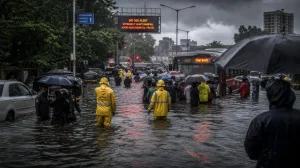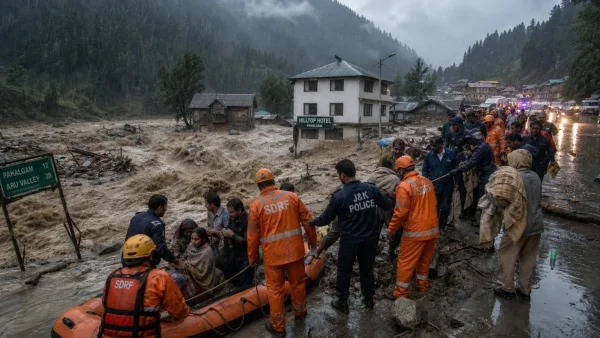
It was a scene of some chaos in parts of Pahalgam on Saturday. A cloudburst over Nala Overa put a lot of water into the local streams, and it didn’t take long for hotels and homes to be under, leaving no choice but to evacuate. There have been no reports of anyone being hurt or killed, but with the rain not letting up, officials say things are still up in the air.
When a stream put in a fast rise and went over its banks, several properties were left in the water. As a matter of course, some of the tourist population was put in a better spot, and locals were told to give the runoff-swollen waterways a wide berth.
Rescues race against rising water
The district administration didn’t wait; within minutes they had emergency teams in place. You will find Jammu and Kashmir Police, SDRF and others out there. The first order of business, by all accounts, was to size up the danger and make sure there were clear paths for people to leave.
There is 24/7 watch on the water to see how things stand for both visitors and those who live here. We are still waiting on some figures as the teams put together the full picture of what the cloudburst has done.
Where the surge began
Put simply, a hard spell of rain – a localised cloudburst if you ask the authorities – hit the forests in Awoora and Dehwathu of Anantnag. It was enough to put a flash flood in the Awoora stream and send it churning downstream.
The topography in the area only made it worse, and the water made its way to the lower-lying bits near Pahalgam. With Nala Overa showing a spike in levels, the response was to keep anyone from going where it is not safe along the stream.
Risk is not over, say forecasters
The IMD is calling for more of the same in the way of rain and thunder in the Pahalgam area. The ground is already sopping, so there is a word of caution: stick to your wits near the slopes and the streams.
For one’s own good, given the state of the water, the following is being put forward:
– Don’t go near any channel that is running over
– Keep a distance from the kind of slopes and streambeds that can be treacherous
– Do as you are told until we are back to normal
Tourism corridor on alert
Some of the hospitality side of town has taken a hit. After the Awoora stream let up its banks, a few hotels were in the water. Tourists were put in a safer place before it could get any worse.
Houses in the vicinity have been affected as well. The teams have been at it, steering residents from the open riverbanks and shoring up barricades in spots where the flow was changing in a hurry.
The appeal is for everyone to be on their guard and to listen to the personnel on the ground. The administration wants to put the access routes in order and make sure nobody is lured in by the current.
Himalayan states brace for more rain
Kashmir is not the only one with weather on its mind. Himachal Pradesh and Uttarakhand have been in the line of fire with some of the heaviest rain, and the result has been landslides and roadblocks. In both states, you will see a number of steps being taken to limit the exposure.
The IMD has put out a heads-up on even more rain, so the response has been to close some schools and put the disaster teams on high alert. It is about easing the load on emergency services and keeping people from roads they should not be on.
In Sirmaur and Solan in Himachal, the rain has been unrelenting, and as a consequence, every school and Anganwadi in the districts has been shut. Staff are to be in, though, according to the district administrations.
As for back in Pahalgam, the work is not done. Monitoring and relief will go on until the danger is a thing of the past. The advice is to stay put and not make for the water unless you have to.
While our teams are out mapping the damage and clearing the way, the administration is counting on the public to be of help. With another round of rain in the offing, how well we respond to the alerts will be what gets the region back on its feet.