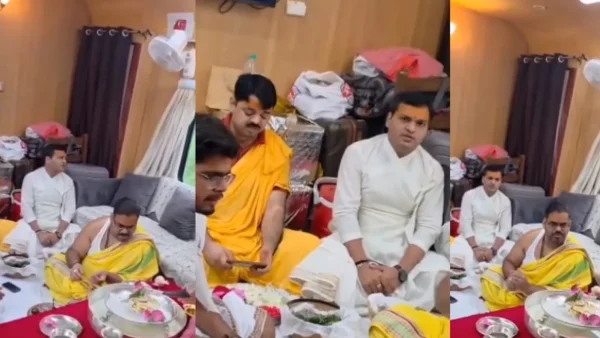
A video of a puja inside a moving train triggered a flurry of questions online, and Northern Railway has now clarified what happened. The zone says the ceremony took place in a privately booked saloon coach hired through IRCTC for 3,08,580, not a regular passenger coach, reopening debate over rules and consistency.
Why the video sparked debate
The clip, widely shared on X, shows a priest on the coach floor conducting rituals as devotees, many in white, participate. Since the train was in motion, users questioned whether religious ceremonies are allowed on board and whether rules are applied equally across communities and activities.
Comparisons quickly surfaced with earlier controversies, including a viral ‘Suhagrat coach’ episode and debates around prayers on trains. While the incidents are different, they fuelled a common argument online: are standards uniform, or do reactions vary depending on the context and participants?
Railways explains the booking
Responding to posts seeking answers, Northern Railway said the event happened inside a saloon car secured under commercial rules via IRCTC. The booking, according to the zone, was confirmed on 8 July 2026 after an advance payment of 3,08,580.
The saloon was scheduled to be attached to Train No. 12926 Paschim Express for a one-way New Delhi to Mumbai journey on 10 July, subject to operational feasibility. Officials noted that such coaches are separate from ordinary passenger compartments and can be booked privately.
Here is how the Railways framed its position:
– The coach was a privately booked saloon
– The booking was made through IRCTC
– The advance amount was 3,08,580
– The journey plan depended on feasibility
Safety and operations
The Railways stressed that safety, punctuality, security and passenger convenience remain paramount. It said no one was injured and stated that the priest seen performing abhishek was part of a ceremony conducted within the privately hired saloon.
The clarification focused on the commercial nature of the booking and the separation of the saloon from public coaches, without detailing whether additional permissions are needed for rituals inside such hired spaces.
What a saloon coach allows
A railway saloon is not a standard sleeper or chair car. It is a special, self-contained coach typically used by officials and VIPs or hired commercially where permitted.
These coaches are designed for privacy and amenities, often featuring air conditioned bedrooms, a living and dining area, a kitchenette and attached washrooms. Crucially, they remain distinct from regular passenger coaches in configuration and use.
Wider reactions and unresolved points
Online, one stream of opinion argued that a legally hired private space should be treated like any other private gathering. Others asked whether similar activities by different groups would see identical responses, highlighting concerns about selective outrage.
Northern Railway has not announced any inquiry or cited rule violations. It has maintained that the coach was lawfully booked and that operations and safety were unaffected.
Key questions that remain open include:
– Do guidelines permit rituals inside privately booked saloons?
– Is any extra permission required for ceremonies?
– Would the same rules apply across all religions?
– Is there a uniform policy for private saloon events?
For now, the Railways’ stance centres on two points: the booking complied with commercial rules, and the activity occurred in a coach set apart from passengers. What comes next may depend on whether the national carrier issues a clearer, written policy on private events in saloon coaches and how it ensures consistent application across cases.