The short-lived spell of monsoon we had has run its course. The IMD does not see any broad return to form for the week or so. Since the upturn in early July, the country’s rainfall deficit is up to 18%, and it is a make-or-break time for putting in paddy, soybean, cotton and pulses.
For those areas that rely on the rain, the message from the weather service is unambiguous. It is the pattern of July’s downpours as much as the volume that will set the pace for sowing. A long stretch without rain can put a crimp on planting in the heart of the monsoon where there is little irrigation to fall back on.
Why this pause matters
The IMD has put out a word on the quiet activity over much of the country, something that could put a hold on the ground covered in sown area last week. All around, major crops are behind where they were a year ago, and the core of the monsoon zone is showing a sizeable shortfall in rain.
According to the IMD, the current weakness is in step with the kind of atmospheric setup you would expect, one that is not conducive to low-pressure building up in the Bay of Bengal. You need those to get the kind of widespread rain seen in the centre and northwest.
IMD’s 7-day outlook
We are in for subdued numbers in central, western and peninsular India for the next six or seven days, per the IMD. In a separate read on Sunday, the agency put ‘subdued rainfall activity’ over the plains of the north-west and west-central, and in the south of the peninsula, for the week ahead.
In the words of the agency, here is what to expect:
– No real monsoon revival for at least six to seven days
– Rainfall to be on the lower side in the central, western and peninsular regions
– Some heavy to very heavy rain in the northeast and the east
– Gusty thunderstorms in a few eastern and Himalayan states
Where rain will still persist
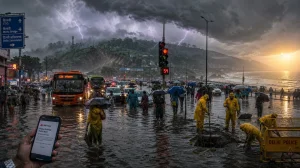
Even as things dry up in many places, the IMD is calling for moderate to heavy showers in the northeast, the eastern Indo-Gangetic plains and in Sub-Himalayan West Bengal, Sikkim, Bihar and eastern U.P. for the next few days.
There is also a forecast for isolated heavy to very heavy falls in parts of the northeast, as well as in Bihar, U.P., West Bengal and Sikkim through the weekend. The Met department has separately put ‘heavy to very heavy’ rain on the table for the northeast, Bengal and Bihar in the next 2-3 days, with some ‘isolated heavy’ in east U.P. over 4-5 days.
The deficit picture and the turning point
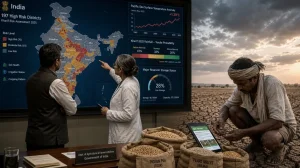
The monsoon made a fast recovery earlier in the month, bringing the all-India number down from 40% in late June to 14% on July 9. This new dry spell has taken some of the wind out of that, and the deficit was 18% on Sunday. The IMD says it may only get wider from here.
Fifteen states have come forward with figures showing a 20% or more deficit in cumulative rain since June 1 – in some cases as high as 73%. That list includes Bihar, Jharkhand, Punjab, Gujarat, Chhattisgarh, Kerala, Karnataka, Telangana and Andhra Pradesh. In the east and northeast, the deficit stands at 37% given the lack of rain in Bihar, Jharkhand and five of the northeastern states.
El Nino backdrop
All of this is happening in a strong El Nino year. It is a climate pattern, born of warmer-than-normal waters in the equatorial Pacific, that comes around every two to seven years. In India, it is a sure sign of a weak monsoon and a hard summer.
What comes next for agriculture
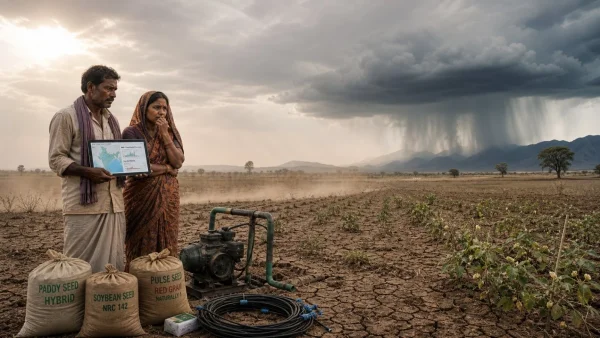
In the districts that are at the mercy of the rain, the coming week is the one to watch. Should the lull hold, the window for kharif sowing in July will close in. The IMD makes no bones about it: the odd shower in the east and northeast will not make up for the overall lack of a proper monsoon phase.
Those in the deficit belts, from the field to the state office, will be on the lookout for a solid low-pressure system to form in the Bay of Bengal. For now, it is a matter of holding on to soil moisture, being measured with sowing and heeding the daily word from the IMD.