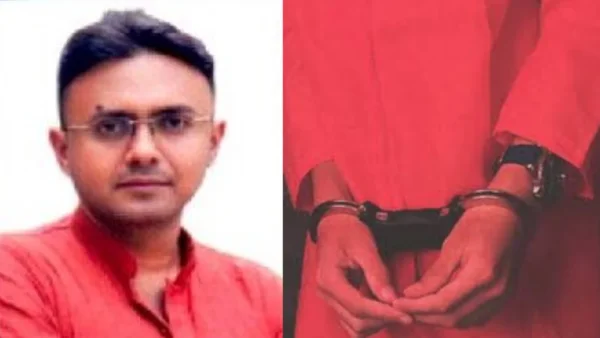
CPI(M) leader Lahek Ali was arrested in Baruipur on Sunday over mob violence that followed the rape and murder of a minor, intensifying a charged law-and-order and political moment in West Bengal. Police called him a prime suspect in lynching and vandalism cases, making him the first political figure detained in the episode.
Arrest tied to Baruipur unrest
Police said Ali instigated the violence that erupted after the minor’s body was found, and that he will be produced in court on Monday. According to a district police officer, Ali faces allegations linked to lynching and destruction of property.
Ali was the CPI(M) candidate from the Baruipur West seat in the recent assembly polls. Biman Banerjee of the Trinamool Congress won, while the Bharatiya Janata Party finished second.
What sparked the violence
The 12 year old girl went missing on July 4. Her body was recovered from a pond in the Surjyapur Haat area on July 5, police said. The autopsy indicated rape and murder.
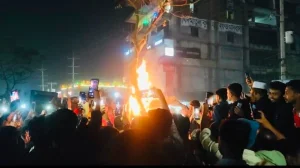
Anger on the ground quickly spiralled. In Surjyapur under the Baruipur police station, protesters blocked roads, torched tyres and vandalised police vehicles, disrupting daily life. Amid the unrest, an enraged mob allegedly lynched Indrajit Mondal, a local resident.
Fallout and community impact
By the time Ali was picked up on Sunday night, police had already arrested around 40 people in connected cases. These include investigations into the minor girl’s death, Mondal’s lynching, and damage to both public and private property.
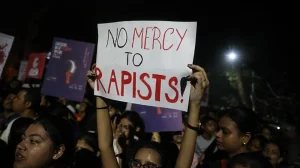
In Kolkata, supporters of the Trinamool Chhatra Parishad and Trinamool Youth Congress held a protest march from Ballygunge to Hazra over the incident, reflecting the wider political temperature beyond Baruipur.
Competing claims and political stakes
The arrest has triggered a sharp exchange over responsibility for the violence. CPI(M) central committee member Sujan Chakraborty alleged political vendetta behind Ali’s detention. He argued that misinformation had clouded the case and said the party would fight the matter legally.
Separately, Suvendu Adhikari said on Saturday that people rejected by voters may have played a key role in inciting the violence. He also suggested that radical and fundamentalist groups could be involved, while asserting that Mondal was not involved in the rape and murder.
What officials and leaders are saying
Key positions, as stated by stakeholders, are as follows:
– Police allege Ali instigated the mob
– CPI(M) says the arrest is politically motivated
– Adhikari links the violence to defeated candidates
Encounter death under CID lens
Police said one of the prime accused in the rape and murder was killed in an encounter after he ‘tried to escape from police custody’ during reconstruction of the crime scene on July 8. In another account, officers said the suspect allegedly snatched a revolver around the midnight of July 7 before being shot.
The Criminal Investigation Department is probing the encounter, a development that could shape how investigators account for custody procedures and the evidentiary chain in the rape-murder case.
Why this matters now
Ali’s arrest folds a political layer into a case already defined by public outrage and fear. The violence following the girl’s death exposed fraught trust between residents and authorities, alongside demands for swift justice without vigilante reprisals.
For families in Surjyapur, the consequences were immediate: blocked roads, burnt tyres and a day-to-day routine knocked off course. For parties across the aisle, the incident is a flashpoint to test narratives on governance, policing and accountability.
What comes next will hinge on court proceedings, the CID’s findings on the encounter, and whether investigators can separate crime, mob reaction and political accusation without compromising due process.