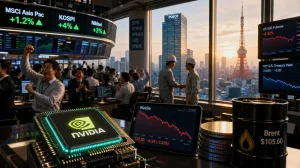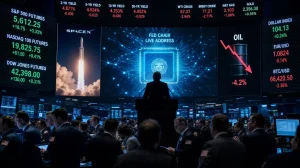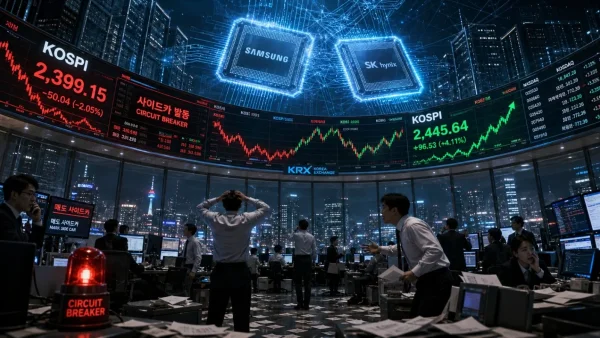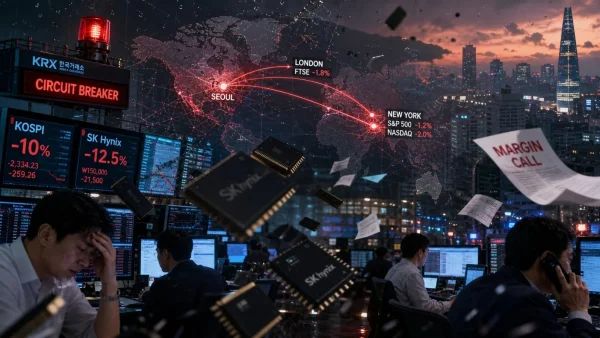
You could see the risk appetite on Wall Street waver on Tuesday when news from the south put a crimp in global AI business. Nasdaq futures were down 800 points by 3:25 PM IST, for a loss of over 2 percent; S&P 500 futures weren’t far behind, ceding more than 1 percent. All because of a 10 percent tumble in Seoul’s Kospi that was enough to stop trading in its tracks.
The contagion was swift. MSCI’s Asia Pacific IT Index gave up almost 5 percent, an end to eight straight days of gains. Over in Europe, the red ink was out: the Stoxx 600’s tech sub-index was off by 3 percent, Euro Stoxx 50 futures by just over 1, and the MSCI World index 0.6 percent in the hole.
What set it off
It all started with a story out of the local press: SK Hynix is likely to put the brakes on some of its AI memory-chip buildout and turn its attention to less expensive commodity DRAM. In response, shares in both SK Hynix and Samsung Electronics were hammered 12.5 percent, and the Kospi followed suit with a 10 percent drop that prompted a short circuit break.
This came at a time when the market was already running hot on AI. Even with Tuesday’s slide, you’re still looking at a 277 percent gain for SK Hynix this year and 140-plus for Samsung. Some analysts have put a finger on the heavy retail presence and record levels of margin borrowing in Korea as things that could make any move to the downside even steeper.
“Right now, if there’s a headline that suggests AI-memory demand is topping out, it will be sold into,” says Amanda Lyons, who heads research at Energy Group Capital. “Where you have the problem is in the positioning and the price, not in what they are building.”
The AI trade in question
For 2026, AI has been the engine behind equity returns, no small thanks to the kind of money being put into data centres and silicon. But the talk is shifting from momentum to whether the payback is there to justify the valuations we’ve seen. A day like Tuesday is a case in point for how jumpy the trade can be to a change in the supply chain.
Even the US big boys were unsteady. The Nasdaq put in a 1 percent loss on Monday, in part because Alphabet was 5 percent in the red after a couple of star AI defectors made for OpenAI and Anthropic. That kind of softness in tech was hard to ignore, even with some of the usual geopolitical hiccups mellowing out.
Now it’s about where you are positioned
With so much of the index made up of AI names, investors are having a look at their concentration and leverage. When you have a crowded room, there isn’t much cushion left if the news doesn’t pan out or the timeline for delivery gets pushed back.
Traders are eyeing a few trouble spots:
– You only have a handful of chipmakers in the AI supply chain
– We don’t have proof yet on the returns from all that infrastructure spending
– And in Korea, the way the retail side is leveraged can magnify any wobble
Reading the futures
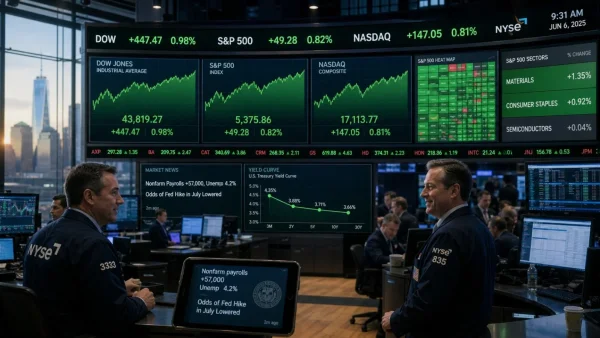
US markets were off to a cautious start. The Nasdaq 100 and S&P 500 futures were down 2 and 1 percent respectively, with the Dow a modest 0.4 percent lower. Come 3:25 PM IST, the numbers told the story: 800 points off for the Nasdaq, 100 for the S&P 500 and 280 for the Dow.
Oil wasn’t going to be a balm for the equities. Word came out that the U.S. had given Iran a 60-day pass to keep selling oil, and prices inched down. Brent was under $77 a barrel, but you wouldn’t have known it from the mood in the tech sector.
One to keep an eye on
Later in the week, Micron is due to report and it may well put a new spin on what we think of AI memory demand. Pre-market, the stock was 8 percent in the red. Folks want to know where data-centre spending is heading and what the pricing is like for high-bandwidth memory, the stuff that has propped up the sector.
There were other signs of jitters in the growth space. SpaceX was 16 percent in the tank after putting forward a $20 billion bond deal. The stock is only 15 percent above its $135 issue price, a far cry from the $225 it hit not long after listing.
In the end, it comes down to this: can the capital being put into AI show up in the earnings before people get tired of the valuation? The bulls will say a dip is an opportunity. The bears will tell you the trade is too full and there’s not much of a way out when the story sours. How Micron does, and what follows, will probably be the tie-breaker for the next round.