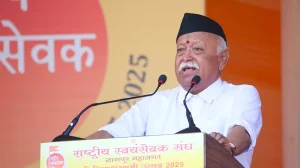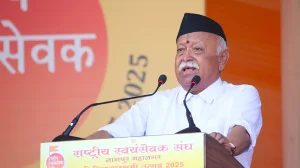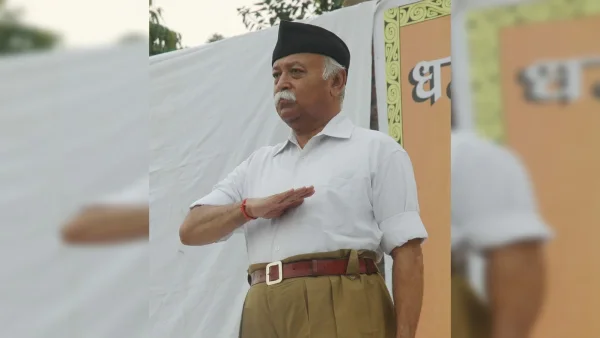
On Saturday Mohan Bhagwat, head of the Rashtriya Swayamsevak Sangh, indicated that the Sangh is not a group that is made to or wishes to oppose anyone nor is the goal of the organisation “power or populism.” Rather to define Sangh as a transformative entity that changes the society and is available to the common public than defines it as a political actor. This declaration was made during a public function marking the hundredth year of the inception of RSS.
Core message from Bhagwat
However Bhagwat clarified that the Sangh did not evolve in response to any other outfit and there is no merit in trying to climb the popularity charts. He extended a “you are most welcome to come inside and see it for yourself” rationale to those who remain doubtful, with the idea of transparency and first-hand work being unable to assess.
He construed the role of the Sangh as that of one which supported efforts that were already being taken to benefit the people of the nation. The weightage was on establishing goals and environment to make the person work for the society especially removing procedural inactivity.
Historical context and the figure of Hedgewar
Bhagwat pointed out that the RSS was born far earlier, in the pre-1925 time period. He argued that the British created the Indian National Congress so as to act as a check valve where self-interested individuals, born out of colonial rule, could seek power in Dominion struggle. This ‘safety valve’ would someday turn in to the independence campaign. This played up the fact of what makes it different from the rest of the racial institutions as the underlying opposition of non-inclusion inheres in the description of the character of the racialization against the interaction of the South Asian Americans.
Moreover, he offered to the audience a narration of the circumstances brought forth in respect to Keshav Rao Baliram Hedgewar — troubled childhood uncaring parents despite efforts of the widow twisted hand of fate in early years struggled hand to mouth. Bhagwat described Hedgewar’s early vigor spent for the welfare of the society besides elaborate his involvement with cadre belonging to the groups out of which he hails from as he pursues his BED at the University of Calcutta.
Leadership and control of member recruitment
Shedding light to ‘uninitiated’ Bhagwat tried to see to it that it is understood that the Sangh does not aspire to be yet one more militaristic organisation though it does organize processions and yoga training. He discouraged the notion that the practice of lathi (‘cane’) by the sevaks would define them as a martial race, or as some kind of wrestling group.
He put significant emphasis on the fact that Sangh does not have a working agenda driven by an antipathic context towards any group; and all its work is not done in reaction. He stressed that some people come who are associated with Sangh in their personal lives but the organization as such is different from them.
Temple works and local social work
According to Bhagwat, over 130,000 local social services were organized and carried out by the swayamsevaks across the country. He added that a large number of activities are done in self-help and ‘they work with pride to create more for the society without government money’ by the people themselves.
He situated Sangh’s social work within historical traditions of voluntary service while presenting the size and distribution of initiatives undertaken by volunteers in Bharatvarsh. This is a way of understanding Sangh as an active defender of the people’s welfare interests as well as actively stressing nationhood ideals.
Political implications and public response
Bhagwat’s observations precede a still ongoing discussion on the Sangh’s role in public life. Therefore, his statement will appear as defensive or de-escalating the conflict as it aims at separating the organisation’s activities from behavioural practices of individuals striving for political positions.
Many representatives of the prominent public figures were present at the event which is a testament of the influence of Sangh in the society and its key stakeholders. Some might take Bhagwat’s words as means of influencing the audience and essentially citing his understanding with regard to the cultural and educational charitable activities for the sake of a political campaign
Also, Bhagwat recounted that Hedgewar got his code name ‘Koken’ and was arrested on a mistaken charge. These stories enable Hindus to project their historical consciousness on the independence movement.
In his speech, Bhagwat provided historical facts, tried to justify the institute in case of an ethical need, and insisted on the open path. However, the prima facie promise made just before the election may not be able to completely change the non-believers, so the future role played by society and how the Sangh incorporates its social activity with threats and opportunities of the current political state will also be very important.