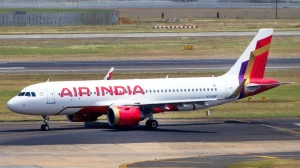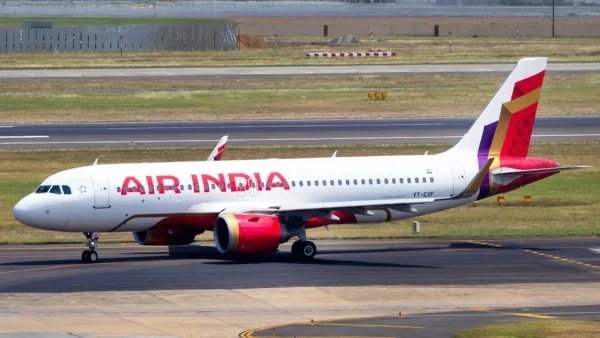
The Directorate General of Civil Aviation (DGCA) fined Air India Rs 1 crore after it was learned that the Airbus A320 was flown on eight revenue sectors having an expired Airworthiness Review Certificate (ARC). These flights took place on November 24 and 25, 2025, and were reportedly said to erode severely the public confidence in safety compliance of the airline.
DGCA action and fresh penalty
According to the confidential penalty issued by DGCA on February 5, along with the directive to pay it within 30 days to Air India, around Rs 1 crore were being directly disputed on the acting aircraft. The letter was addressed to the airline CEO and said that the lapse had an adverse impact on all operational safety standards. In due course, DGCA told that key post holders in engineering had to be removed by Air India and an internal investigation had to be made by the airline.
After the airline reported the incident voluntarily, the DGCA grounded the aircraft and started a probe into the matter. The inquiry board represented evidence, such as maintenance records, operational decisions and on-accountability of the chain of command to say that systemic failures were the reason.
Details of the flight and the aircraft involved
The Airbus A320 in question was the former Vistara aircraft, which got into Air India in 2024. The operations had scheduled services on New Delhi, Bangalore, Mumbai, and Hyderabad for two days on eight sectors with passengers and without a valid ARC.
The Air India spokesperson said that the aircraft had been taken out of the schedule for an engine change and once found fit enough was reinducted into service. According to the airline, the certificate had lapsed without being realized on time by the staff members in that period; hence, they reigned the ARC after the aircraft-engine-service confirmation.
An ARC is granted only after a mandatory yearly audit has been conducted of its maintenance records, which include airworthiness certification records, observations, and basis, and physical state of the aircraft in regards to compliance with airworthiness standards. The ARC is an indication from the civil aviation administration that verifies that the Certificate of Airworthiness is still valid, and thus the airplane definitely possesses the degree of actual airworthiness required for commercial flying service.
Flying in India without a validly approved ARC for the aircraft lets loose the many subordinate safety checks. The approval would have been provided against strict maintenance and documentation standards, therefore the moment any airline fails the requirements to go along, it becomes obvious that such topmost systems have been working with no vigilance and procedural discipline.
Air India Response and Corrective Actions
Air India admitted to receiving the DGCA notice and said the airline has fixed the issues and shared all details with the DGCA. Air India stated that the flaw was self-reported and that multiple personnel responsible for the fluke were removed from flying duty and an internal audit will take place to ensure sustained compliance and resolve operational issues(source).
The airline also maintained its commitment to operational integrity and safety. The certificate of airworthiness (CfA) for the aircraft was subsequently issued, and the aircraft subsequently returned to service, according to the aviation sources.
Safety culture and regulatory oversight at large
This statement by the DGCA that the particular incident further eroded public confidence could be taken as expressing a far broader concern regarding the fact of compliance culture. Accordingly, the need for severe internal-control enforcement, almost clear accountability and improved maintenance handover controls are now marked as demanded by this legislative arm.
This enforcement action occurs at a time when Ongoing regulatory attention towards the airline has revealed an fuel control switch issue, leading to further urge for very strict oversight only given the recent big crash last year. Regulators might now strip airlines of delegated authority or enforce more safety audits to ensure these companies actually comply with certification requirement.
It is much more interesting to observe this ultra-niche market from an organic perspective and indeed relatively harder than to account for it. On the one hand, there are very few corners and niches of the economy that are an integral part of another sector of industry, while on the other, such sectors are legit in a truly Swiss style economy [“Nicaraguan rules to conduct the due and diligent investigation that’s collective”].
When attracting demand, as in advertising, Via Pedigree, for instance, clients know that they have to pay more because they would still be getting something metrically desirable in terms of pedigree. Hill YAR of books submitted for publication, according to this, will always circumvent the necessary dread as exploiting outside-Independent’s unwillingness altogether.