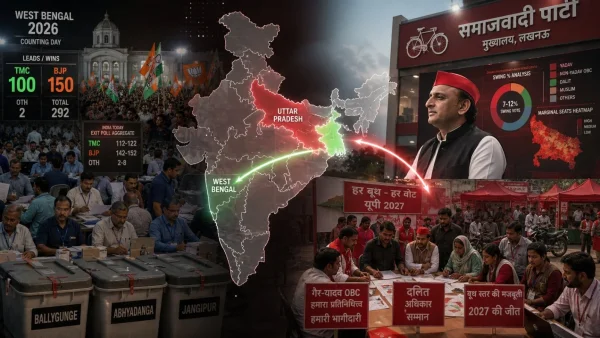
The political situation changing in West Bengal is changing how the opposition parties across the country are planning things, and it’s happening far from Kolkata. Early results show the BJP getting between 100 and 150 seats (and the TMC doing worse than expected), and this has a direct effect on Uttar Pradesh, where the Samajwadi Party has its most important election in t027.
Why Bengal’s turbulence matters beyond the state
The TMC party has been running West Bengal since 2011, and being in charge for 15 years often makes people tired of the current government. The predictions from exit polls and the early counting of votes showed a very close race, and some even said the BJP might win or that no single party would have enough seats to govern.
This election isn’t just about what happens in one state, it’s about how established political parties deal with strong, nationally organized opposing parties. The TMC didn’t completely fall apart despite the pressure, and they remained a strong competitor, keeping a large number of voters, showing how difficult it is to completely destroy a well-established regional political force.
The scale of movement in context
West Bengal's assembly has 294 seats, and a party needs 148 to be in charge. At several points during the counting, the BJP had over 100-150 seats, which is a quick change from previous elections and shows how weak the current, long-ruling government has become.
Even if this result isn’t a complete victory, it changes the strategy of opposition parties throughout the country. It shows how quickly support can move to a different side when people’s feelings become stronger and the organization of a party gets better.
UP 2027: the stakes for SP
Uttar Pradesh is a different political landscape, but faces a similar problem. The BJP has been in charge of the state since 2017, and by 2027 will have been in power for ten years. If people become tired of the BJP, the SP could benefit, as long as they turn people’s feelings into a strong organization and a clear message.
Akhilesh Yadav, the leader of the SP, improved the party’s performance in 2022, getting over 32% of the votes and more than 100 seats. This wasn’t enough to win, but it showed a good base of support that could be expanded with the right alliances and hard work at the local level.
Organisation and coalition building
The BJP’s success in West Bengal was built on having a strong organization at each voting location and campaigning constantly. This is the most important thing to learn. The Yadav and Muslim voters who usually support the SP are a good starting point, but not the only ones to aim for. To turn a change in the state into actual seats, the SP needs to also get the support of people from other backward castes (OBCs) and the Dalit community.
In a “first past the post” system (where the person with the most votes wins), just looking at the old numbers isn’t enough. Small changes in a few areas can change the results in many voting districts.
Narrative and leadership recalibration
The TMC stayed strong because of the benefits they gave to people, but other ideas about how the government is run, people’s identities, and progress also got people’s attention. What happened in West Bengal warns that simply giving benefits isn’t enough to have a convincing plan for the future.
In Uttar Pradesh, the SP needs to focus on creating jobs, improving law and order, and developing the economy. Having a popular leader is important, but West Bengal shows that personality isn’t as important as a well-organized, national campaign. How well Akhilesh Yadav is seen as a good alternative for Chief Minister will be judged by this standard.
Reading the numbers without illusion
Uttar Pradesh elects 403 members to the legislative assembly (MLAs), and 202 are needed for a majority. In 2022, the BJP had about 255 seats, and the SP had about 111. This difference is significant, but the opposition could close the gap if they work together and on a large scale.
A shift of just 7-8% of the votes in Uttar Pradesh could dramatically change how many seats each party gets. When many different parties are competing, small changes in voting in certain areas can have a large effect on the overall results. The changes happening right now in West Bengal (in an assembly of 294 seats where 148 are needed for a majority) show how quickly the political map can be redrawn when a party gains momentum.
From trend to takeaway
Trends aren’t final results, but they are indicators. The main indicator from West Bengal is that a party that has been in power for a long time can lose support very quickly when the opposing parties agree on a message and have a strong organization at the most local level. This is the model the SP needs to copy, not just admire.
What SP should prioritise now
The immediate horizon for SP is about choices that compound. Bengal’s lessons are operational, not rhetorical. The following priorities emerge from the present churn:
– Build booth-level networks across weak districts
– Engage non-Yadav OBCs and Dalits with specificity
– Centre jobs, law and order, and development
– Present Akhilesh as the alternative CM face
– Coordinate opposition votes to minimise splits
Each of these things is a way to counter the BJP’s proven strengths. None of them will work on their own. But when used together, they can change people’s unhappiness with the current government into actual votes.
Opportunity vs risk in 2027
There’s a real chance for the SP to do well, but it depends on certain things. The election in West Bengal shows that parties that have been in power for a long time can get weaker quickly, but only if the challenging party is united, has a plan, and is present at the local level. Being organized at the local level is essential when the race is close.
However, there are definite dangers. The BJP still has a strong organization and a lot of resources. If voters who are against the BJP split their votes, it will weaken the chance of the other parties doing well. Without getting support from a wider range of people in society, the SP can be competitive but still lose, and this is a pattern that the changes in West Bengal also point to.
The road ahead
Three things will decide what happens in Uttar Pradesh in t027. First, people being tired of the current government might create opportunities. Second, actually doing things on a large scale, not just saying things, will determine the results. Third, making alliances and getting support from more parts of society can turn a close race into a winnable one.
The way things are going in West Bengal in 1026 is both a warning and a guide. If the SP uses both of these things, they can turn a possibility into a strong position. If they don’t, they might miss another chance.