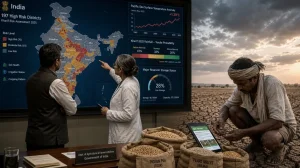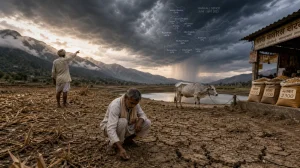
In what amounts to a sharper late-monsoon squeeze, the IMD cautions that September will see sub-normal rainfall and elevated heat, a mix that can stoke food inflation and put pressure on kharif output. The warning comes in the wake of an August that was the hottest since 1901 and a season that has already done enough to unsettle farm and price stability.
IMD flags weak September and hotter days
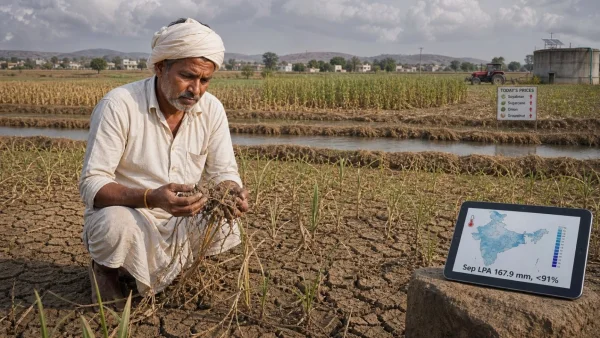
According to the India Meteorological Department, it is most probable that the nation will see monthly rainfall in September come in under 91% of the long-period average. The LPA for the month stands at 167.9 mm by the 1971-2020 reckoning.
The weather office is also anticipating above-normal maximums for the month. Mrutyunjay Mohapatra, Director General of the IMD, noted that strong El Nino conditions are in effect across the equatorial Pacific and should only get stronger.
One need look no further than August for evidence of the heat stress. The mean temperature there was 28.01 degrees Celsius against a normal 27.34, making it the hottest on record since 1901. Even the average minimum of 24.36 degrees was the highest in that period, well above the usual 23.68.
Patchy monsoon raises farm and price risks
Uneven distribution of rain is the greater concern. There are ongoing deficits in the east and north where rice is grown, and moisture stress is being felt in the soybean and sugarcane tracts of the west and south. If September remains dry for any length of time, it could impede grain filling, drive up procurement and constrict the supply of staples.
There may be some reprieve in places. While large areas are running short, the IMD has indicated that portions of the northeast and east, as well as select central and peninsular belts, are in for normal to better than normal rainfall.
For agri and energy planners, these are the key figures from the IMD:
– Rains in September expected to be under 91% of LPA
– A September LPA of 167.9 mm
– Above normal for September maximum temperatures
Macro signals: inflation and policy watch
Provisional numbers from the statistics ministry show food inflation is on the up. In July retail inflation was 4.45%, with food inflation ticking up to 5.52% from 5.32% the prior month.
In its August meeting the RBI MPC put its inflation forecast at 5%, a reduction from 5.1%, yet it was careful to point out the risks posed by volatile energy costs and an El Nino that could make for a sub-par monsoon.
V Anantha Nageswaran, the Chief Economic Adviser, offered some reassurance on the kharif sowing figures, which were only slightly down on last year’s. In his view the volatility in rainfall has not put a stop to activity as was担心的 back in June. He also saw a more favourable picture for GDP in the second and third quarters than had been feared at the end of June, though he stressed one must keep an eye on the Rabi season.
Sowing trends show acreage slip
The numbers bear this out. By 28 August total kharif acreage was 107.1 million hectares, less than the 109 million of a year ago. There has been a contraction in rice area to 41.4 million from 42.8 million hectares and maize has given up 388,000 hectares, now at 8.99 million from 9.38 million.
Then again, experts are warning that if September continues to be weak, it will be rainfed paddy, pulses and oilseeds that suffer most, with a knock on effect for rural incomes and pressure on vegetable and edible oil prices. A lack of moisture may put off Rabi preparations in certain areas too.
What August revealed about the monsoon
It has been a mixed season so far, opening with the driest June in over a decade. After being 35.4% under normal in June and edging to 1% above in July, August saw a slide to 16.3% below normal; the country put in 213.3 mm against the usual 254.9 mm.
For the period 1 June to 31 August, all-India totals came in at 603.7 mm or 13.8% short of what is normal. The IMD noted that while four low-pressure systems were in evidence for 26 days in August, their rains were for the most part restricted to the Indo-Gangetic plains. Back on 29 May the department had already revised its June-September outlook down to 90% of the LPA from 92% on account of El Nino. India has not had a monsoon this poor since 2023 when it was at 95%.
Mitigation and what to watch next
Mohapatra has cautioned that agencies and stakeholders need to be ready for the strain on water resources, hydropower, drinking water and the ecosystem, as well as the heat stress and agricultural impact of below-normal rain.
To blunt the effect the IMD is pointing to:
– Water conservation and storage
– Efficient resource management
– Contingency planning in agriculture
Given that the southwest monsoon is responsible for over 70% of the annual rainfall and some 45% of the net sown area is rain-fed, September will be telling for both the harvest and the inflation data. All eyes are on the regional rains to see if they can make up for the deficit across the country.