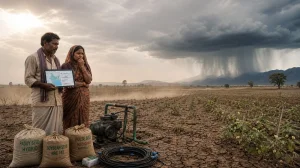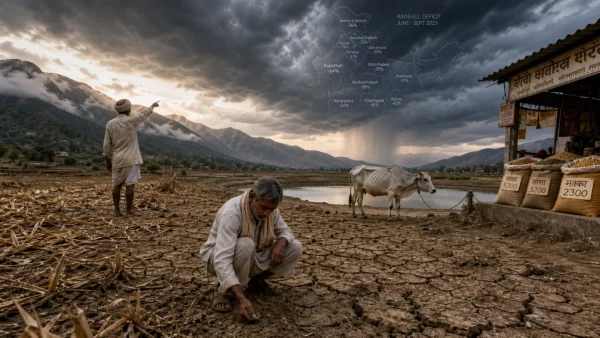
The timing could not be worse for the fields; as they call for steady rain, the Indian monsoon has turned drier than usual, which means firmer food prices and a weaker harvest are in the offing. According to the IMD, rainfall will remain below the norm in all parts of the country through September 2nd at the earliest. With the monsoon circulation stalling by the Himalayan foothills, the present 14% shortfall is set to grow.
Why the monsoon is faltering now
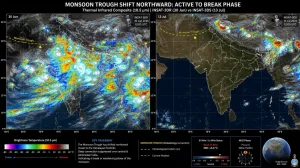
You can trace this setback to the monsoon trough. Rather than make its way into central India, it is held fast to the Himalayan foothills, a situation that confines the moisture corridor to the north and northeast. Consequently, many of the belts that rely on the rain are left wanting during what should be a productive part of the season.
Navdeep Dahiya of the independent forecasters sees the plain implication: with the trough in the foothills, ‘rainfall over the rest of the country will be reduced’. He says the pattern is unlikely to change for a week or more, making for poor conditions compared with the southward pulses one would normally see in August to put some life back into central India’s farms.
Forecasts turn cautious, risks broaden
In an extended range outlook put out on August 20th, the IMD is calling for sub-normal rain for the full two-week window. While there will be strong rain in the Himalayan belt and in the east and northeast, the agency is keeping its guidance for Peninsular India on the low side for the week ahead.
A low-pressure area is due to develop in the north Bay of Bengal off the West Bengal-Bangladesh coasts in the next 24 hours. That should bring heavy to very heavy rain to Odisha and Chhattisgarh until the 26th, a welcome respite in some basins if not enough to counter the general weakness across the nation.
But the worry is as much about prices as it is the fields. Patchy rains will mean sowing gaps and moisture stress, lowering yields and curbing market arrivals just as festive demand is building up. Food inflation is likely to be nudged higher. Traders and policymakers are already on guard for tighter supplies with the all-India deficit at 14%.
Private forecast downgrade sharpens the warning
Skymet has made one of the more notable mid-course corrections of the season. Its seasonal rainfall estimate has been pegged at 85% of LPA, down sharply from the 94% it had in April. There is also a 70% chance of drought being assigned by the forecaster as headwinds pick up in the final stretch of the season.
It is not simply a matter of totals, but of distribution. Skymet is forecasting uneven rain in India’s four homogeneous regions for the balance of August. A weak Indian Ocean Dipole and a more assertive El Nino will probably see the gap widen in September. The IMD has shown a similar trend, moving its own seasonal figure from 92% of LPA in April to 90% come June.
No new revision has been issued by the IMD of late, yet with the deficit in play and weakness expected to run until early September, that 90% number is under pressure. For the market, it is a sign of risk to production and price that will have a longer tail than the current fortnight.
Where the shortfall bites hardest
The map does not show an even deficit. The sharpest hit is in the east and northeast at 26% below LPA. The south Peninsula lags by 23% and northwest India is 11% under normal. Central India is the closest to par at 3% below, having seen some recovery from earlier low-pressure systems.
Such disparities have to be factored into logistics planning, reservoir replenishment and cropping calendars. Soil moisture deficits are a concern for regions that have been banking on the kind of trough-driven bursts one would expect in August; without them, field work is more of an ordeal and there is greater dependence on what late-season systems can provide.
Agriculture’s pressure points and inflation watch
Time is running short to put kharif prospects on a firmer footing. Garima Jain, Torq Commodities India’s head of agri business, has pointed to growing risks in the rain-fed areas of MP, Maharashtra, Karnataka, Rajasthan and Gujarat. “We are running a 14% deficit… it could well see the monsoon shortfall top 15%,” she says.
Jain cautions that an unpredictable monsoon, on top of supply chain headaches worldwide, has the potential to drive up food inflation. She makes the case for better domestic logistics and says that yield assessment and close monitoring are called for with crops like tur, soyabean and maize in the rain-fed belts.
There are several ways inflation can make its mark: from the cost of replanting and higher fodder to delayed sowing and a squeeze on perishables. Should the rains stay weak through September, the market will likely factor in a protracted disruption, not to mention the effect on state support and procurement.
Key developments to track
Over the coming fortnight, those following the situation should be on the lookout for a few things:
– The daily position of the monsoon trough
– What the Bay of Bengal low does in terms of formation and path
– Rainfall figures for Odisha and Chhattisgarh up to 26 August
– Any southward movement that might refresh central India
– The seasonal outlook as put out by IMD and Skymet
Climate backdrop: El Nino strengthens, buffers lag
The prevailing weakness comes as El Nino gathers strength. The Met Office has it pegged as the most potent in a hundred years or more, with Pacific sea-surface temperatures set to run 3C above normal. One can make the argument that such warming will see 2027 eclipse 2024 as the planet’s hottest year.
Normally the Indian Ocean Dipole would add some moisture to the monsoon and take the edge off El Nino. Not this time. The buffer is feeble, which means more variance in where and when the rain falls and convection over the subcontinent is further suppressed.
It is a familiar pattern but no less disruptive: you have surpluses along the Himalayan arc and deficits in the farming heartland, with false starts in the interior. It forces a move away from all-India indices and towards hyperlocal planning for both the state and private sector.
What comes next and why it matters
IMD is calling for below-normal rain to the 2nd of September so the next two weeks will be telling as to whether the deficit becomes entrenched. A failure of the trough to go south could leave reservoirs wanting for post-monsoon irrigation and put late-sown fields under stress.
Stakeholders are done hoping for catch-up rains and are instead managing the scarcity at hand. That means being efficient in moving produce from surplus to deficit markets and rethinking fertiliser and procurement plans.
By September, three things will be in focus: any revival in the Bay of Bengal, how the Indian Ocean Dipole and El Nino develop, and whether the trough makes a decisive move to steady parts of central India. The kharif calendar is not waiting.
Policymakers and the market will be looking for some corrective rain in the centre and to see if Skymet’s 85% of LPA call or the IMD’s 90% figure holds up. If the gap widens, the conversation will be about targeted policy and an agile response from the supply chain.
The monsoon is far from finished but the margin for error has gone. Unless circulation patterns sort themselves out, India will face a wider rainfall void come September and the repercussions will be felt from the farm gate to the household budget.