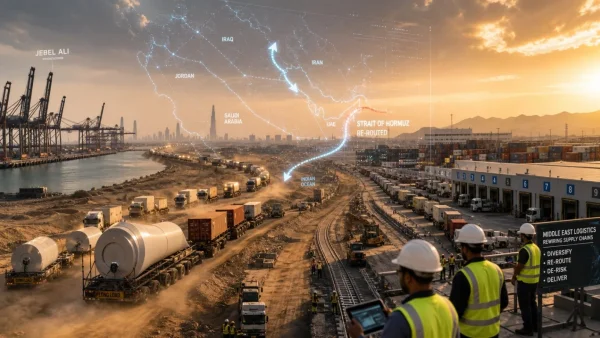
You could call it a case of forced rewiring. A hard stop at Hormuz has made shippers head for the desert and secondary ports to make sure food, drugs and factories don’t run dry. There is an interim deal on the table to open things back up, but we are not back to where we were and won’t be for some time.
It was meant to be a temporary fix, but now it’s looking like the way forward. The road corridors in Saudi Arabia, the UAE and Oman are no longer just an afterthought; they have a role to play. They can’t handle all the shipping, but they offer something you can’t put a price on: redundancy. Costs are up and so are lead times, but the balance of power in regional logistics is being redefined.
A fragile reopening meets a fast-moving reroute
An understanding between Washington and Tehran is set to be signed on Friday, and in theory, it should get things moving again in the strait. But the details are under wraps, and that has shipowners and forwarders on edge. You can’t blame them; even with this diplomatic band-aid, it will be months before trade is as it was.
In the meantime, diversification has picked up speed. “The land bridges and the smaller ports are a bit of a hassle, but they do the job,” says Peter Sand of Xeneta. His view is that even when Hormuz is open for business, shippers will be loath to put all their eggs in the Jebel Ali basket given the state of play in the region.
Siemens Energy is a good example of the change in tack. Some 12 days into the US-Israel and Iran conflict last year, they had a man drive from Jeddah to Dammam to see what would happen if the strait was closed. In the end, they put together a 250-page report on how to move a gas turbine over 2,000 km of tarmac.
When the strait did close, those plans went from the page to the road. “It takes a little more time and a few extra dollars, but the work still gets done,” says Karim Amin of Siemens Energy’s gas services. The lesson for any manufacturer is simple: when a chokepoint seizes, having a plan B is better than standing still.
UAE’s east coast rises as Jebel Ali slows
Head to the east coast of the UAE, away from the Gulf and Hormuz, and Khor Fakkan is on the up. Farid Belbouab of Gulftainer doesn’t see the east coast as a spare tire. “It is part of the architecture of our trade,” he says. And the disruption? “It made us put the pedal to the metal.”
To that end, Gulftainer is making a link between its Al Dhaid Dry Port, 50 klicks from Khor Fakkan, and the one at Sajaa near Dubai. They’ve put in nine truck gates, opened up the hours and are now turning 7,000 trucks a day – a far cry from the 100 they had before the war. Rail is on the cards for a complete multimodal setup.
DP World has the size to absorb the jolt. With a string of 60-plus ports and terminals and new money in places like Saudi and India, the group has been using feeder vessels and smaller ports to hold and re-route containers that can’t make it through. They have also put in place some side roads to keep customs and distribution on track at Jebel Ali, churning out 300,000 containers or so since hostilities began.
Still, the ships coming into Jebel Ali are few and far between, which gives others an opening. The appeal of the port is not gone, though. In the first four months of the year, the free zone raked in 854 million dirhams in new capital, most of it in the spring. You can find it in everything from warehousing to vehicle handling and light industry.
Jebel Ali is no slouch: 12,000 companies in the free-trade zone, and a footprint that is three times the size of Manhattan. It is the top container port in the world outside of Asia. But the quiet you see now is a reminder of how fast cargo can move on when the waters in the Gulf get rough.
Retailers and heavy industry changed lanes
The retail side has been quick to adapt. Take Spinneys. An earnings deck in May showed they were using a mix of road and other means to get product from the UK to the UAE, a 5,000-kilometer trek. For some of the medium shelf-life stuff from Europe, they intend to keep the road-freight option in the mix.
Then there is DP World. With less traffic at the door of Jebel Ali, they have turned to a road network that runs the length of the Arabian peninsula and on to Turkey and Iraq. And with that comes a lot of pressure on storage space. “Bonded warehousing in the region is in short supply,” says Amadou Diallo, Aramex’s chief executive. “The facilities are being filled up at a clip.”
It’s a shift you can see well beyond the ports and logistics yards. The kind of rethinking we’re seeing has made its way to the boardroom, the procurement desk and even the retail floor. The story is the same: if you have some room to manoeuvre and can reroute, your sales are safe. If you’re put on a single path, you’re left making up for what you don’t have.
Saudi Arabia makes a move
The kingdom is in a position to both vie with and work with the UAE. You’ll find thousands of trucks these days on a 20-hour run from Jeddah, via Riyadh, to Dubai. It’s a long way to go, which is exactly why the Saudis have to make good on their rail plans to handle what’s coming down the pike.
And they have no shortage of them. There is the Saudi Landbridge, a 600-mile or so project to put freight first between Jeddah and the capital. Then there’s the Gulf Railway to tie the GCC states together; Saudi Arabia Railways is looking to be done with that by 2030. They also put out a National Transport and Logistics Strategy in 2021 with an eye on doubling the rail network.
The money is there to back it. The Public Investment Fund made it clear in April that transport and distribution are central to where they’re headed. You can see road haulage and rail operations in the kingdom stepping up to the plate.
But it hasn’t been without cost. “Since the conflict, we’ve seen trucking prices in the Kingdom go up some 40%,” said Gaurav Biswas, head of Trukker. At the Jeddah Islamic Port, a truck can be sitting for four or five days while the port tries to keep up with the volume.
So operators are trying new things to make this desert bridge work. MSC, the top container line, is putting together a service from Europe to some of the smaller Middle East ports with a leg across Saudi by truck. DP World, for its part, has a map that shows a road link from Istanbul all the way to Oman, connecting the Red Sea.
“If the kingdom can turn these stopgaps into something more lasting, you could see a change in how cargo moves in the region,” said Sumru Altug of the Issam Fares Institute. “They have the geography and the economic weight on their side in this tussle with the UAE.”
Some of the key things to watch in Saudi:
– More extensive road links off the Red Sea
– New ways to get from Europe to the smaller Gulf ports
– A rail network set to be twice as big
– State investment in the logistics side of things
Where capacity is thin, you build resilience
For the time being, the infrastructure is under pressure. Patrick Schuster of Kuehne + Nagel will tell you the Gulf’s roads can only do so much with the trade that’s been held up. He’s had to introduce a level of triage in the supply chain: food and medicine come first.
You can spot it in the stockpiles. “In areas like auto parts, we’re running lower than we ever have,” said Hendrik Venter of DHL. “But with life sciences and health care, we just put it on a plane. We’re fine there. Until the port is open for business, though, we can’t call it normal.”
DHL is in it for the long haul. With seven big sites in Dubai, some of them at Jebel Ali, they are not going to let the volatility put a dent in their plans. “Shipping 2,000 kilometres from the Red Sea to the UAE isn’t tenable in the end,” Venter concedes. “But we’re still making our investments. And they are no small matter.”
You hear the same from the retail and industrial side. You can put a road on some of your product lines with Spinneys, and you’ll see why. When the strait was shut down, the route work Siemens Energy had put in place before the trouble started proved its worth. As Peter Sand of Xeneta puts it: land bridges and the smaller ports are holding up, but after this, no one is keen to be too reliant on one hub.
For those running supply chains, what comes first is obvious:
– The interim deal being put to paper on Friday
– How quickly we can put more road and rail in
– A read on when Jebel Ali will be back in full swing
But step away from the marquee ports and there’s still some friction on the ground. If Saudi Arabia is to make good on its push to grow, it’s not just about laying down new tarmac and track. You have to ease up on trade barriers, get driver visas through the system and make border rules less of a hassle to get things moving in a way you can count on.
The whole thing has brought an old fact of life in the UAE back into focus. Over 40 years ago, the Queen gave her blessing to the idea of making the coastline a centre for commerce. It wasn’t the scale of it that made it happen, but the resolve to have the capacity ready before you even needed it.
We’re seeing if that holds up now. DP World has taken a few hits, and the lull in calls at its main port is a reminder of the risks in Gulf shipping. Then again, the kind of money flowing into the free zone means firms are still putting their chips on the table for when things calm down.
On the east coast you have a different story. Khor Fakkan, being on the other side of Hormuz, is a natural hedge. Look at Gulftainer: they’ve put in nine truck gates and are handling 7,000 a day. That’s how you move when you have to. Rail is the question mark for the future of that.
If there is a common thread to all the juggling we’re doing, it’s that you have to be resilient to do business. The new roads in the region won’t take the place of Hormuz, but they give importers and exporters some breathing room to see out a crisis.
From here it’s about whether the Friday agreement leads to regular sailings and if the overland options stick. It’s going to cost – with trucking and warehousing as they are – but it’s a strategic one. Diversify your routes and you don’t have to worry about one bottleneck.
Shippers and governments are rethinking the whole layout of trade, not just the timetable. In a part of the world that’s all about making connections, the ones who can change course in a hurry will come out on top.